Monophyly in Biological Cladistics: Defining Evolutionary Relationships
In the complex field of biological cladistics—the method of classifying organisms based on shared characteristics—scientists rely on precise definitions to describe how life is related. At the heart of this classification system is the concept of monophyly. Understanding monophyly is essential for distinguishing true evolutionary lineages from groups that merely appear similar due to environmental adaptations.
A monophyletic group, also known as a clade, is a taxonomic grouping that meets two strict criteria: it must include its own most recent common ancestor (often more accurately described as an ancestral population) and it must include all descendants of that ancestor without exception.

Key Facts
- Monophyly (or holophyly) describes a group containing a common ancestor and all its descendants.
- Paraphyly occurs when a group includes a common ancestor but excludes one or more descendant subgroups.
- Polyphyly describes groups that lack a common ancestor and instead share traits evolved through convergent evolution.
- Monophyletic groups are often identified by synapomorphies, which are shared derived characteristics.
- The term "monophyly" originates from the Greek words for "one-tribe."
Comparing Monophyly, Paraphyly, and Polyphyly
To understand why monophyly is the gold standard for modern systematics, we must contrast it with two other types of groupings: paraphyly and polyphyly.
Paraphyletic Groupings
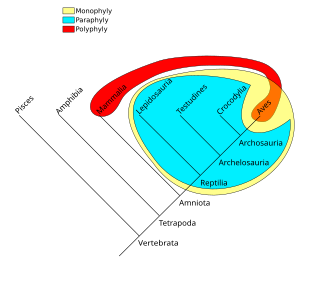
A paraphyletic group meets the first criterion of monophyly (it shares a common ancestor) but fails the second. It consists of the descendants of a common ancestor but leaves out one or more monophyletic subgroups. This often happens when certain descendants evolve significantly different traits, leading researchers to mistakenly categorize them separately.
![A cladogram [citation needed]of the primates, showing a monophyletic taxon: the simians (in yellow); a paraphyletic taxon: the prosimians (in cyan, including the red patch); and a polyphyletic group: the night-active primates, i.e., the lorises and the tarsiers (in red).](/images/c3/66/c366168bf9783caf557a34c6fc591ddb04f34a03f9e577b59fa901e40f2f385c.webp)
Polyphyletic Groupings
A polyphyletic group meets neither criterion. These groups do not share a recent common ancestor; instead, they are characterized by convergent evolution. This occurs when different species independently evolve similar biological features to adapt to similar environments. Examples include night-active primates, fruit trees, or aquatic insects. Because these traits are not inherited from a single common ancestor, polyphyletic groups are not considered valid taxonomic units by modern systematists.
Etymology and Historical Context
The terminology used in cladistics is rooted in Ancient Greek, providing a linguistic map of these biological concepts:
- Monophyly: From mónos ("alone, unique") and phûlon ("genus, species"), meaning "one-tribe."
- Paraphyly: Uses the prefix pará ("beside, near"), indicating a group that is "nearly" monophyletic but leaves something out.
- Polyphyly: Uses the prefix polús ("many"), referring to organisms arising from multiple ancestral sources.
While these definitions are standard today, they were not always so. When cladistics became mainstream in the 1960s, taxonomists often used these terms inconsistently, leading to significant confusion in early scientific literature.
Summary of Phylogenetic Groupings
| Grouping Type | Includes Common Ancestor? | Includes All Descendants? | Basis of Classification |
|---|---|---|---|
| Monophyletic | Yes | Yes | Shared derived characteristics (synapomorphies) |
| Paraphyletic | Yes | No | Common ancestry with some subgroups excluded |
| Polyphyletic | No | No | Convergent evolution of similar traits |
Frequently Asked Questions
What is a synapomorphy?
A synapomorphy is a shared derived characteristic. These are specific traits that evolved in the most recent common ancestor of a clade and are passed down to its descendants, helping scientists distinguish a monophyletic group from other organisms.
Why is a polyphyletic group not considered a valid taxon?
Polyphyletic groups are based on convergent evolution rather than genetic lineage. Because the members do not share a recent common ancestor, grouping them together does not accurately reflect the evolutionary history of life.
Is it possible to perfectly define a species or genus using monophyly?
Some scientists, such as D. M. Stamos, argue that a perfect cladistic definition is difficult. This is because species can form through "budding" from existing species (making the parent species paraphyletic) or through hybrid speciation.
What is the difference between monophyly and holophyly?
In most scientific contexts, monophyly and holophyly are used as equivalent terms to describe a group that includes a common ancestor and all its descendants.
How are these concepts used in modern science?
The concepts of monophyly, paraphyly, and polyphyly are used by researchers to deduce key genes for DNA barcoding, which helps in the identification and classification of diverse species groups.