Clades and the Science of Biological Classification
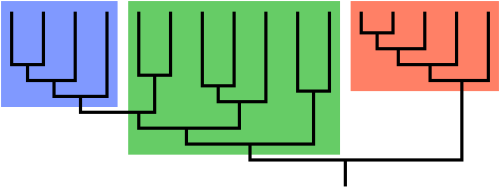
In the study of biology, a clade (from the Ancient Greek kládos, meaning "branch") is a group of organisms consisting of a single common ancestor and all of its descendants. Also known as a monophyletic or natural group, the clade serves as the fundamental unit of cladistics—a modern approach to taxonomy used across most biological fields to organize life based on evolutionary history.
The common ancestor at the root of a clade may be an individual, a population, or an entire species, whether extinct or still living. Because evolution involves repeated splitting of lineages, clades are nested within one another. Each split represents a point in history where populations diverged and began to evolve independently.
Key Facts
- Definition: A clade must include a common ancestor and all of its descendants to be considered monophyletic.
- Cladistics: The method of classification based on these branching relationships rather than just physical similarities.
- Nested Hierarchy: Smaller clades exist within larger ones (e.g., chipmunks are within the rodent clade, which is within the mammal clade).
- Modern Insights: Molecular cladistics has revealed that fungi are more closely related to animals than to plants.
- Broad Application: While primarily biological, the concept of clades is also applied in fields like historical linguistics.
The Evolution of Taxonomic Thought
Before the era of Charles Darwin, Linnaean taxonomy relied on morphological similarities—the physical appearance of organisms. While some of these groups happened to be clades, many were misleading due to convergent evolution, where unrelated species evolve similar traits independently.
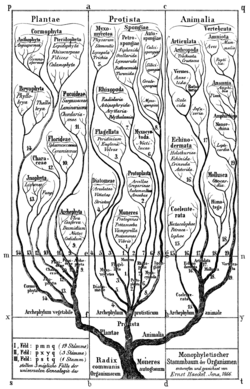
Following the 1859 publication of Darwin's theory of evolution, scientists began viewing classification as branches on a tree of life. In 1876, Thomas Henry Huxley proposed a taxonomy resembling the modern concept of clades. However, the term "clade" was not officially coined until 1957 by his grandson, Julian Huxley, to describe cladogenesis—the evolutionary splitting of a parent species into two distinct species.
The formal foundation of cladistics is credited to German biologist Emil Hans Willi Hennig (1913–1976). Hennig replaced the old "ladder" model of evolution—which incorrectly suggested that some organisms were more "advanced" than others—with a system of repeated branchings.
Defining and Mapping Clades
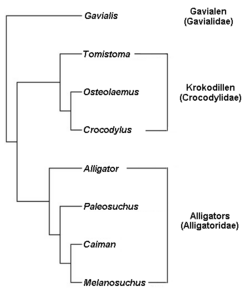
The process of reconstructing these evolutionary relationships is known as phylogenetics or cladistics. The resulting tree-shaped diagrams are called cladograms. These diagrams are not absolute facts but are phylogenetic hypotheses based on available data.
Terminology of Relationships
To describe how different clades relate to one another, biologists use specific terms:
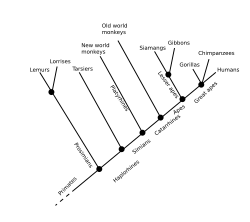
- Nested: When one clade is located entirely within another (e.g., apes are nested within primates).
- Sister Clades: Two clades that share an immediate common ancestor.
- Basal: A clade is basal to another if it branches off the lineage leading to the second group before the first branch that leads exclusively to members of that second group.
Determining Clade Age
Since the exact moment of divergence cannot be observed directly, scientists infer the age of a clade using fossil stratigraphy or molecular clock estimates. They distinguish between two types of age:
- Crown Age: The age of the most recent common ancestor of all living species within the clade.
- Stem Age: The time when the ancestral lineage of the clade first diverged from its sister clade.
Applications Beyond Animals
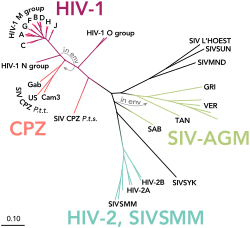
Cladistics is not limited to complex animals. It is essential in virology, particularly for tracking RNA viruses. For example, HIV is categorized into clades known as subtypes. These subtypes vary by geography; subtype B is predominant in the Americas, Europe, and Japan, while subtype A is more common in East Africa.
Summary of Cladistic Concepts
| Term | Definition | Example/Context |
|---|---|---|
| Monophyletic | Ancestor and all descendants | A true clade |
| Cladogram | Branching tree diagram | Hypothesis of evolutionary relationships |
| Cladogenesis | Splitting of a parent species | The process that creates new clades |
| Sister Group | Closest relative clade | Lemurs and lorises |
Frequently Asked Questions
What is the difference between a clade and a traditional taxonomic group?
A clade must be monophyletic, meaning it includes the common ancestor and every single descendant. Traditional groups were often based on physical similarities and might exclude certain descendants, making them paraphyletic rather than true clades.
Who is the founder of cladistics?
Emil Hans Willi Hennig is considered the founder of cladistics. He shifted biological classification from a linear "ladder" of progress to a branching tree of evolutionary relationships.
How do scientists determine the age of a clade?
Scientists use two primary methods: studying the layers of the earth where fossils are found (stratigraphy) and using molecular clocks, which estimate divergence times based on genetic mutation rates.
Can viruses be organized into clades?
Yes. RNA viruses, such as HIV, are organized into clades (often called subtypes). This helps researchers track the geographical spread and evolution of the virus.
What is a sister clade?
Sister clades are two groups that are each other's closest relatives, meaning they share a common ancestor that is not shared by any other group.