Taxon: The Fundamental Building Blocks of Biological Classification
In the vast and complex web of life, scientists need a way to organize every living thing into manageable groups. This is where the concept of a taxon (plural: taxa) becomes essential. A taxon is a biological unit consisting of one or more populations of organisms that taxonomists recognize as a distinct group. Whether it is a single species or a massive kingdom, a taxon provides the framework for understanding the diversity of life on Earth.
Once a taxon's description is established, it is typically assigned a specific name and a particular rank within a hierarchical system. This organization allows researchers to communicate clearly about the relationships between different organisms.
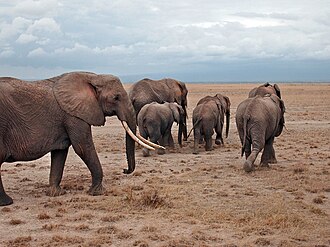
African elephants form the genus Loxodonta, a widely accepted taxon.
Key Facts
- A taxon is a taxonomic unit, such as a genus, family, or order.
- The term "taxon" was first used for animal groups by Adolf Meyer-Abich in 1926.
- Modern biology often defines a "good" taxon as one that reflects evolutionary relationships.
- Monophyletic groups (clades) include all descendants of a common ancestor.
- Paraphyletic groups, like the traditional class Reptilia, do not include all descendants of a common ancestor.
The Evolution of Biological Classification
The human impulse to categorize nature is not new. Archeological and anthropological studies suggest that prehistoric hunter-gatherers used folk taxonomies—informal systems of classification—to organize their knowledge of the environment. However, the formal scientific documentation of life began much later.
From the teachings of Aristotle to the influential works of naturalists like Magnol, Tournefort, and Carl Linnaeus, the field has grown significantly. Linnaeus's 10th edition of Systema Naturae (1758) remains a landmark in this history. By 1805, Augustin Pyramus de Candolle introduced a system for the "natural classification" of plants, further refining how we organize biological knowledge.
How Taxonomists Define a Taxon
Determining what belongs in a taxon is a complex process. Taxonomists must decide which organisms to include and which criteria to use for that inclusion. This is particularly important in Linnaean taxonomy, which relies on a specific hierarchy of ranks.
Once a taxon is formally named, its usage is strictly governed by specific nomenclature codes. These codes ensure that every scientific group has one correct, universally recognized name. For example, the International Code of Zoological Nomenclature (ICZN) governs animal groups, while other codes manage plants, algae, and fungi.
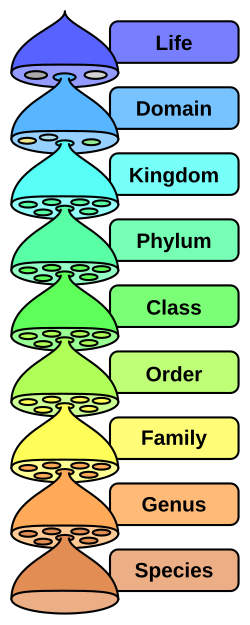
The hierarchy of biological classification's eight major taxonomic ranks. Intermediate minor rankings are not shown.
Monophyly vs. Paraphyly
In modern biology, many scientists advocate for phylogenetic nomenclature. This approach uses cladistic methods, which require taxa to be monophyletic. A monophyletic group, or a clade, consists of an ancestral species and all of its descendants. This method ensures that the taxon accurately reflects the evolutionary history of the organisms.
In contrast, some traditional groupings are paraphyletic. A paraphyletic group includes a common ancestor but leaves out some of its descendants. A classic example is the class Reptilia. While birds and mammals evolved from ancestors once classified as reptiles, they are traditionally placed in their own separate classes (Aves and Mammalia, respectively), making the traditional reptile group paraphyletic.
Understanding Taxonomic Ranks
A taxon is often assigned a rank, which indicates its position in the hierarchy. While ranks are common, they are relative and can change depending on the specific systematic schema being used. For instance, a group of organisms might be classified as a family in one system but an order in another.
Commonly used terms include:
- Super-: Indicates a rank above the current one (e.g., superclass).
- Sub-: Indicates a rank below the current one (e.g., subclass).
- Infra-: Used in zoology to indicate a rank below "sub-" (e.g., infraclass).
- Phylum/Division: "Phylum" is typically used for animals, while "division" is often used for plants and fungi.
| Concept | Definition | Evolutionary Accuracy |
|---|---|---|
| Clade (Monophyletic) | Includes an ancestor and all its descendants. | High |
| Paraphyletic Group | Includes an ancestor but excludes some descendants. | Lower |
| Linnaean Rank | A position in a hierarchical system (e.g., Family, Genus). | Variable |
Frequently Asked Questions
What is the difference between a taxon and taxonomy?
Taxonomy is the science or method of arranging and classifying organisms, whereas a taxon is the actual group or unit being classified (such as a specific species or family).
Why are some taxa considered "bad" in modern biology?
In modern systematics, a taxon is often considered less useful if it does not reflect true evolutionary relationships. Groups that are paraphyletic are frequently being reorganized into monophyletic clades to better represent phylogeny (evolutionary history).
What is a clade?
A clade is a monophyletic group, meaning it contains a common ancestor and all of its descendants. Many modern systematists treat the clade as the primary unit of classification.
How are scientific names regulated?
Scientific names are regulated by various nomenclature codes, such as the International Code of Zoological Nomenclature (ICZN). These rules ensure that every taxon has a unique, stable name that scientists worldwide can recognize.
Can a taxon be unranked?
Yes. While many taxa are assigned a formal rank (like Genus or Family), it is common in modern studies to refer to unranked groups, particularly when using cladistic methods to describe a clade.