Genera Plantarum and the Foundation of Botanical Nomenclature
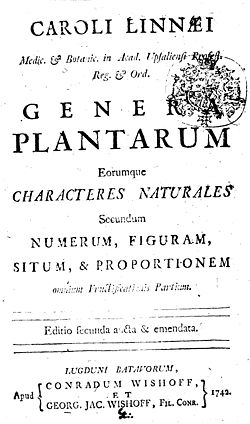
In the mid-18th century, the study of botany lacked a universal language, making the sharing of scientific knowledge difficult. This changed with the publication of Genera Plantarum by the Swedish naturalist Carl Linnaeus (1707–1778). First issued in Leiden in 1737, this seminal work provided a structured framework for identifying and naming plant groups, eventually becoming a cornerstone of modern biological classification.
Linnaeus's primary goal was to create a stable system of generic taxonomy. He believed that a botanist must be able to memorize the specific definitions, or diagnoses, of all plant genera to effectively identify species. By refining these definitions across multiple editions, Linnaeus moved botany toward a standardized, global system.
Key Facts
- Author: Carl Linnaeus, a Swedish naturalist.
- First Edition: Published in 1737 in Leiden.
- Core System: Utilized the "sexual system," grouping plants by the number and arrangement of stamens and pistils.
- Growth: The number of listed genera grew from 935 in the first edition to 1,105 by the fifth edition.
- Nomenclatural Role: The fifth edition (1754) is the critical reference for the starting point of most plant group names.
The Development of the Linnaean System
The creation of Genera Plantarum was deeply influenced by Linnaeus's time in the Netherlands (1735–1738). While serving as the personal physician to George Clifford, a wealthy merchant-banker, Linnaeus had access to an extraordinary collection of exotic plants in Clifford's glasshouses. This experience led to the publication of Hortus Cliffortianus (1738) and several other foundational texts, including Systema Naturae (1735).
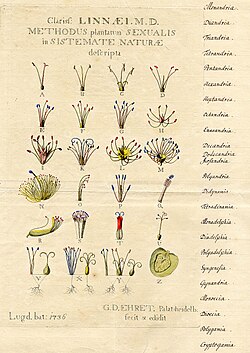
During this period, Linnaeus collaborated with the artist Georg Ehret. Ehret provided the illustrations for the "Sexual System" of classification, which Linnaeus included in Genera Plantarum. Although this collaboration was productive, it was not without tension; Ehret later accused Linnaeus of appropriating the work of others to build his own fame.
Botanical Classification and the Sexual System
Linnaeus divided the plant kingdom into 24 distinct classes. These classes were determined by the characteristics of the flower, specifically the stamens (male reproductive organs) and pistils (female reproductive organs).
The 24 Classes of Plants
- Classes A–K: Named based on the number of stamens, ranging from Monandria (one) to Decandria (ten).
- Class L (Dodecandria): Plants with 12 to 19 stamens.
- Classes M–P: Defined by both the number and the specific position of the stamens.
- Classes Q–T: Characterized by stamens united in a bundle or phalanx.
- Classes V–Y: Plants where stamens and pistils are located in separate flowers.
- Class Z (Cryptogamia): Plants without proper flowers, such as the fig.
Publication History and Nomenclatural Importance
Genera Plantarum underwent several revisions. While the first edition was dedicated to the physician Herman Boerhaave, later editions expanded the scope of the work. The fifth edition, published in Stockholm in August 1754, is the most significant for modern science because it serves as the complementary volume to Species Plantarum (1753).
According to Article 13 of the International Code of Nomenclature for algae, fungi, and plants, generic names appearing in Species Plantarum are associated with the descriptions provided in the fifth (1754) and sixth (1764) editions of Genera Plantarum. This linkage establishes the official starting point for the nomenclature of most plant groups.
| Edition | Year | Key Significance |
|---|---|---|
| 1st | 1737 | Initial publication; 935 genera described. |
| 2nd | 1742 | First major revision by Linnaeus. |
| 5th | 1754 | Linked to Species Plantarum; 1,105 genera. |
| 6th | 1764 | The final edition edited by Linnaeus. |
| 9th | 1830–31 | Final edition based on Linnaeus's work (revised by Kurt Sprengel). |
Scientific Legacy
Linnaeus introduced a rigorous method for drafting genus descriptions. He used specific symbols to denote the source of his evidence: an asterisk (*) for living material, a dagger (†) for herbarium specimens, and no symbol if he relied solely on literature or correspondence. This transparency in data sourcing was a major advancement in scientific reporting.
Experts like Frans Stafleu and William Stearn have noted that Genera Plantarum was more influential in the practical application of Linnaean ideas than even Systema Naturae. By eliminating unnecessary verbs and focusing on detailed floral parts, Linnaeus created a model for all subsequent botanical works. His insistence that the genus be the basic unit of taxonomy remained the standard until the rise of evolutionary biology.
Frequently Asked Questions
What is the "sexual system" of classification?
The sexual system is a method of grouping plants based on the number and arrangement of their reproductive organs, specifically the stamens and pistils in the flower.
Why is the fifth edition of Genera Plantarum so important?
The fifth edition (1754) is critical because it provides the formal descriptions for the generic names used in Species Plantarum, which is the official starting point for botanical nomenclature.
How did Linnaeus indicate the source of his plant descriptions?
He used an asterisk (*) to show he had studied a living plant, a dagger (†) to indicate he used a dried herbarium specimen, and no symbol if he relied on written reports or correspondence.
Who was Georg Ehret and what was his role?
Georg Ehret was an illustrator who created the engravings for the "Sexual System" used in Genera Plantarum and Hortus Cliffortianus, though he later criticized Linnaeus for not giving him proper credit.
How many plant genera were listed in the first and fifth editions?
The first edition listed 935 genera, while the fifth edition expanded this number to 1,105.