Polyp Zoology: Anatomy, Life Cycles, and Environmental Threats
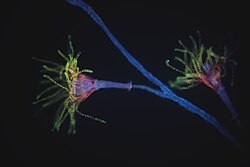
In the diverse world of marine biology, the polyp represents one of the two primary body forms found within the phylum Cnidaria (the other being the medusa). These organisms are characterized by a roughly cylindrical, vase-shaped body. While some exist as solitary individuals, others form massive, complex colonies that build the foundations of the world's coral reefs.
Solitary polyps typically anchor themselves to a substrate using a disc-like holdfast known as a pedal disc. In colonial species, polyps are connected to one another either directly or indirectly, creating a synchronized biological network.
Key Facts
- Phylum: Cnidaria.
- Body Structure: Cylindrical with a mouth surrounded by tentacles at the oral end.
- Ancient Lineage: Considered living fossils, having remained largely unchanged for approximately 500 million years.
- Feeding Mechanism: Use specialized stinging cells called nematocysts to paralyze prey.
- Conservation Status: Approximately 75% of the world's corals are currently threatened.
Classification and Life Cycles
The role and prevalence of the polyp stage vary significantly across different classes of Cnidaria:
Anthozoa
This class, which includes sea anemones and corals, exists exclusively in the polyp form throughout its entire life cycle.
Hydrozoa
Individuals in this class may exist as either a polyp or a medusa. Most species transition through both stages during their life cycle.
Scyphozoa and Cubozoa
In Scyphozoa, the medusa stage is dominant. Some species begin as a larval planula that metamorphoses into a polyp called a scyphistoma. This polyp then undergoes strobilation—a process where it develops a stack of plate-like medusae that pinch off and swim away. In Cubozoans, the planula develops into a polyp that eventually metamorphoses directly into a medusa.
Anatomy of a Polyp
The body of a polyp is structured like a sac composed of two primary cell layers. The outer layer is the ectoderm, and the inner layer is the endoderm (or gastroderm). Between these two layers lies the mesoglea, a structureless gelatinous substance that provides support and can vary in thickness depending on the species.
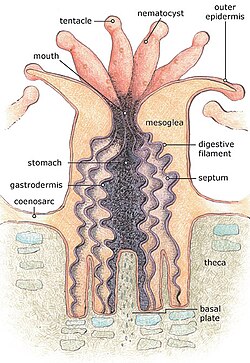
The oral end features a mouth surrounded by a circle of tentacles, an area known as the peristome. These tentacles serve as both tactile organs and hunting tools. They contain nematocysts—coiled, stinging cells that pierce and poison prey such as fish larvae and copepods. Once the prey is paralyzed, longitudinal and circular muscular fibrils allow the polyp to contract its tentacles and move the food toward the mouth.
While the structure is generally simple, Anthozoan polyps are more complex than Hydrozoan polyps. They possess a tubular stomodaeum (an internal throat) and mesenteries, which are radial partitions that extend into the enteric cavity.
Reproduction Methods
Polyps utilize both asexual and sexual reproduction to ensure the survival of their species.
Asexual Reproduction
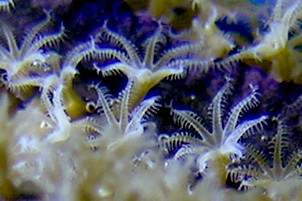
Most polyps reproduce asexually through budding. In many colonial species, the buds do not separate from the parent, leading to the growth of large stocks or colonies. Reef-building corals are a prime example of this, as they strengthen these colonies with a firm skeleton.
Sexual Reproduction
Sexual reproduction involves the production of gametes (eggs and sperm). In sea anemones, sexual plasticity allows clones from a single founder to contain both male and female individuals (ramets). In stony corals (Scleractinia), most adult colonies are hermaphroditic and participate in synchronized mass spawning events, where cross-fertilization is the dominant pattern.
Environmental Threats and Conservation
| Threat Category | Specific Examples | Impact on Polyps |
|---|---|---|
| Human Activity | Overfishing, coastal development, pollution | Habitat destruction and biomass decrease |
| Climate Change | Thermal stress, ocean acidification | Protein up-regulation and bleaching |
| Biological | Crown-of-thorns starfish, invasive species | Direct predation and competition |
| Chemical | Profenofos (insecticide), MEMC (fungicide) | Polyp retraction and reduced biomass |
The stability of polyp populations is currently at risk. Research indicates that heat stress in juvenile Acropora tenuis polyps can trigger an up-regulation of protein in the endoplasmic reticulum, though the severity depends on the age and growth stage of the polyp.
Frequently Asked Questions
What is the difference between a polyp and a medusa?
A polyp is a cylindrical, typically sedentary form attached to a substrate, while a medusa is a free-swimming, bell-shaped form. Some Cnidarians spend their lives as one or the other, while others cycle between both.
How do polyps capture their food?
Polyps use tentacles equipped with nematocysts, which are specialized stinging cells. These cells inject toxins into prey, such as small fish larvae, paralyzing them before they are pulled into the mouth.
What is strobilation?
Strobilation is a process occurring in certain scyphozoans where a polyp (scyphistoma) develops a stack of plate-like medusae that eventually detach and swim away as independent organisms.
Why are coral polyps considered living fossils?
They are referred to as living fossils because their basic biological structure has remained significantly unchanged for approximately half a billion years, dating back to the Cambrian period.
What are the primary causes of coral polyp decline?
The primary causes include thermal stress from rising ocean temperatures, ocean acidification, pollution from land-based agriculture (such as fungicides and insecticides), and destructive fishing practices.