Anthozoa: The Diverse World of Corals and Sea Anemones
The subphylum Anthozoa represents one of the most vibrant and ecologically significant groups of marine animals. Belonging to the phylum Cnidaria, these organisms include everything from the solitary, waving tentacles of sea anemones to the massive, reef-building structures of stony corals. Defined by their lack of a medusa (jellyfish) stage in their life cycle, anthozoans exist exclusively as polyps, creating some of the most biodiverse habitats on the planet.
All members of Anthozoa possess cnidocytes, specialized stinging cells used for prey capture and defense, a trait they share with other cnidarians like box jellies and jellyfish.
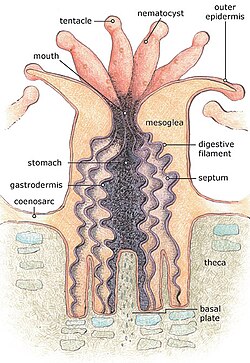
Key Facts
- Temporal Range: Present in the fossil record from 570 million years ago to the present.
- Habitat: Exclusively marine and brackish waters, ranging from shallow reefs to depths of 6,000 meters.
- Diversity: Over 6,000 described species, including solitary and colonial forms.
- Symmetry: Divided primarily into Hexacorallia (six-fold symmetry) and Octocorallia (eight-fold symmetry).
- Symbiosis: Many species rely on zooxanthellae for nutrition and calcium carbonate production.
Classification and Diversity
Anthozoans are categorized into two primary extant classes based on their symmetry and morphology. The Hexacorallia exhibit six-fold symmetry and include stony corals, sea anemones, tube anemones, and zoanthids. In contrast, the Octocorallia possess eight-fold symmetry and encompass soft corals, sea pens, sea fans, and sea pansies.
While shallow-water reefs are the most famous examples of anthozoan colonies, scientific data reveals that more species of coral actually live in deep water than in shallow environments. Throughout their evolutionary history, many taxa have migrated between these two zones.
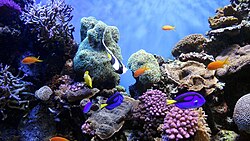
Major Taxa and Examples
| Class | Order | Example | Key Characteristics |
|---|---|---|---|
| Hexacorallia | Actiniaria | Sea anemones | Large, solitary polyps; often colorful. |
| Hexacorallia | Scleractinia | Stony corals | Aragonite skeletons; reef builders. |
| Hexacorallia | Antipatharia | Black coral | Found on vertical rock faces or deep water. |
| Octocorallia | Alcyonacea | Soft corals/Gorgonians | Worldwide distribution; often associated with reefs. |
| Octocorallia | Pennatulacea | Sea pens | Found from tidal zones down to 6,000m. |
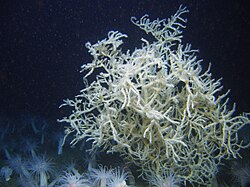
Biology and Symbiosis
A defining biological feature of many anthozoans is their relationship with zooxanthellae—unicellular, photosynthetic organisms that live within the coral's tissues. This symbiotic partnership is mutually beneficial: the zooxanthellae utilize the host's carbon dioxide and nitrogenous waste, while the anthozoan receives photosynthetic energy and an increased ability to produce calcium carbonate for its skeleton.
This relationship is not permanent. If environmental conditions change, the symbionts may be expelled. Furthermore, anthozoans living deeper than 50 meters are azooxanthellate, as there is insufficient sunlight to support photosynthesis.
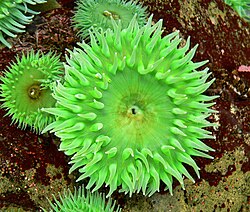
Reproduction and Development
Most anthozoans are unisexual, though some stony corals are hermaphrodites. Fertilization typically occurs externally in the open sea, often synchronized with the time of day or lunar phases to maximize success. The resulting zygote develops into a planula—a ciliated, swimming larva that drifts as plankton before settling on the seabed to metamorphose into a juvenile polyp.
Some larvae, such as those of Pocillopora damicornis, possess lipid-rich yolks that allow them to remain viable for up to 100 days, facilitating wider dispersal across the ocean.
Ecology and Environmental Impact
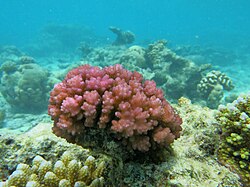
Coral reefs are among the most biodiverse ecosystems on Earth. Hermatypic corals (reef-builders) create complex three-dimensional structures that provide food, shelter, and breeding grounds for countless species of fish, mollusks, and crustaceans. Conversely, ahermatypic corals do not build reefs and are often found in deeper or colder waters.
These ecosystems are highly sensitive to imbalances. For example, in 1989, the invasive crown-of-thorns starfish (Acanthaster planci) destroyed 90% of the corals in the reefs of American Samoa.
Deep-Sea Habitats
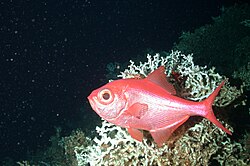
Beyond the sunlit shallows, deep-water corals like Lophelia pertusa in the Atlantic Ocean form extensive reefs. These cold-water structures support a unique community of sponges, crustaceans, and polychaete worms, proving that anthozoans are vital to ocean health at all depths.
Phylogeny and Paleontology
Molecular phylogenetics suggests that Anthozoa is a monophyletic clade, with Hexacorallia and Octocorallia acting as sister groups. The reconstructed ancestor is believed to have been a solitary polyp with bilateral symmetry, lacking both a skeleton and photosymbiosis, appearing as far back as the Tonian period (1000 to ~720 Mya).
The fossil record is rich with extinct orders from the Paleozoic era, such as Rugosa and Tabulata. Because these organisms produced hard calcareous skeletons, they are well-preserved, providing a clear timeline of coral evolution from 650 million years ago to the present.
Frequently Asked Questions
What is the difference between Hexacorallia and Octocorallia?
The primary difference is their symmetry: Hexacorallia have six-fold symmetry (e.g., stony corals and sea anemones), while Octocorallia have eight-fold symmetry (e.g., soft corals and sea pens).
What are zooxanthellae?
Zooxanthellae are single-celled photosynthetic algae that live symbiotically within the tissues of many anthozoans, providing them with energy and aiding in the production of calcium carbonate skeletons.
Can corals live in the deep ocean without sunlight?
Yes. These are known as azooxanthellate corals. Because they lack photosynthetic symbionts, they do not require sunlight and rely entirely on predation to survive.
What is a planula larva?
A planula is the free-swimming, ciliated larval stage of an anthozoan. It drifts in the plankton before settling on a suitable substrate to grow into a polyp.
What are hermatypic corals?
Hermatypic corals are reef-building corals that typically live in shallow, sunlit waters and produce large amounts of calcium carbonate to create reef structures.