Plant Variety Legal Protections and Breeders' Rights
In the world of botany and agriculture, the term plant variety carries a specific legal weight that differs from its common usage in gardening or scientific taxonomy. When a cultivated plant, known as a cultivar, is recognized as a "variety" under legal frameworks, it grants the breeder specific intellectual property protections. These protections ensure that the innovation involved in developing new plant strains is legally recognized and rewarded.
The Legal Framework of Plant Varieties
The primary international standard for these protections is the International Union for the Protection of New Varieties of Plants (UPOV) Convention. Under this convention, breeders can obtain plant breeders' rights, which prevent unauthorized use of the variety. The specific application of these rights depends on the internal laws of the countries that have signed the UPOV treaty.
For example, in the United States, these protections are managed through the Plant Variety Protection Act. In the European Union, a specialized system called the Community plant variety right provides intellectual property protection that is valid across all EU member states. This EU system is designed to align with the UPOV 1991 convention as well as TRIPS (Trade-Related Aspects of Intellectual Property Rights) and WTO (World Trade Organization) agreements.
Distinguishing Legal, Taxonomic, and Common Terms
Because the word "variety" is used in multiple contexts, it is often a source of confusion. It is important to distinguish between the legal definition and other classifications:
- Legal Variety: A cultivar protected under UPOV or national laws to grant breeders' rights.
- Taxonomic Variety: A rank in biological classification regulated by the International Code of Nomenclature for algae, fungi, and plants.
- Cultivar: A cultivated variety regulated by the International Code of Nomenclature for Cultivated Plants.
In practice, some professionals use these terms loosely. For instance, viticulturists (grape growers) almost always refer to grape cultivars as "grape varieties," regardless of their legal or taxonomic status.
Global Trends in Plant Variety Applications
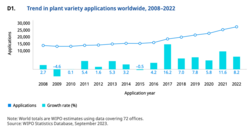
Interest in protecting new plant varieties is growing globally. In 2022, there were approximately 27,260 plant variety applications filed worldwide. This represents an 8.2% increase over 2021, marking the seventh consecutive year of growth in applications.
The majority of this global growth has been driven by China, followed by the United Kingdom.
Key Facts
- UPOV Convention: The international treaty governing the protection of new plant varieties.
- Global Growth: 27,260 applications were filed in 2022, an 8.2% increase from the previous year.
- Leading Regions: China and the United Kingdom are the primary contributors to recent growth in applications.
- EU Protection: The Community plant variety right offers unified protection across the European Union.
- US Legislation: The Plant Variety Protection Act is the primary legal mechanism for breeders in the US.
| Term | Governing Body/Code | Primary Purpose |
|---|---|---|
| Legal Variety | UPOV / National Law | Intellectual property and breeders' rights |
| Taxonomic Variety | ICN (Algae, Fungi, Plants) | Biological classification |
| Cultivar | ICNCP (Cultivated Plants) | Standardized naming of cultivated plants |
Frequently Asked Questions
What is the difference between a plant variety and a cultivar?
While often used interchangeably in casual conversation, a cultivar is a cultivated plant regulated by the International Code of Nomenclature for Cultivated Plants. A "variety," in a legal sense, is a cultivar that has been granted specific legal protections under frameworks like the UPOV Convention.
What are plant breeders' rights?
Plant breeders' rights are a form of intellectual property protection that grants the developer of a new plant variety exclusive rights to the production and sale of that variety, depending on the national legislation of the signatory country.
Which countries are driving the increase in plant variety applications?
According to 2022 data, China has contributed the majority of global growth in applications, with the United Kingdom also showing significant increases.
How does the European Union handle plant variety rights?
The EU uses the Community plant variety right, which provides a single intellectual property right valid throughout the entire European Union, ensuring consistency with WTO and UPOV 1991 standards.
Is a legal variety the same as a biological variety?
No. A biological or taxonomic variety is regulated by the International Code of Nomenclature for algae, fungi, and plants, whereas a legal variety is defined by intellectual property laws to protect the breeder's investment.