Grex in Orchid Nomenclature: Defining Hybrid Groups
In the world of botany, naming plants is a precise science. However, when it comes to the diverse and complex world of orchids, a specialized term is used to categorize hybrids based on their parentage: the grex. Derived from the Latin word for "flock," a grex (abbreviated as gx) serves as a vital tool for orchid enthusiasts and botanists to track the lineage of artificially bred plants.
While many plants are categorized by their physical traits, a grex is defined solely by the parents used in the cross. This system allows growers to organize the vast number of orchid hybrids created through human intervention, distinguishing them from species that evolve naturally in the wild.
Key Facts
- Definition: A grex is a group of orchid hybrids sharing the same parentage.
- Governing Body: Grex names are regulated by the International Code of Nomenclature for Cultivated Plants (ICNCP).
- Registration: The Royal Horticultural Society (RHS) is the international authority for registering new grex names.
- Naming Convention: Unlike species names, grex names are capitalized, not italicized, and written in a living language rather than Latin.
- Scope: The term grex is used exclusively within the orchid family (Orchidaceae).
Botanical vs. Horticultural Nomenclature
To understand the grex, one must first understand the broader framework of botanical nomenclature. In nature, interspecific hybrids (crosses between two different species) occur and are classified as nothospecies. The prefix "notho" indicates a hybrid origin. These are governed by the International Code of Nomenclature for algae, fungi, and plants and typically use a multiplication sign (×) before the species epithet, such as Crataegus × media.
A nothogenus is a similar concept but at the genus level, encompassing all hybrids between two different genera. For example, × Brassocattleya is a nothogenus that includes all hybrids between the Brassavola and Cattleya genera.
While nothospecies and greges may share the same parentage, they are not the same. A nothospecies includes back-crosses (offspring produced by crossing a hybrid back with one of its parent species), whereas a grex does not. Since January 2010, it has been prohibited to publish a grex name if a nothospecies name with the same epithet already exists.
How a Grex is Formed and Named
Orchids are particularly susceptible to hybridization because many natural barriers are based on pollinator behavior rather than genetic incompatibility. With a simple tool like a toothpick, a human hybridizer can cross-pollinate two plants to create a seed pod.
Every seedling resulting from a specific cross between two parents belongs to the same grex. This includes reciprocal crosses (where the pollen and seed parents are swapped). If two members of the same grex are crossed, their offspring also retain that same grex name.
Because of the randomization of genes during sexual reproduction, plants within the same grex can look very different—much like human siblings. To distinguish a particularly beautiful or healthy plant from its "sisters," growers assign it a cultivar name. While the grex describes the parentage, the cultivar name identifies a specific, genetically identical clone propagated for its superior traits.
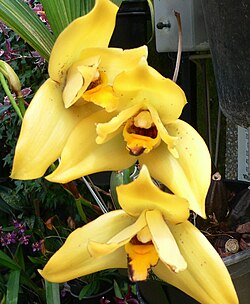
Naming Examples and Rules
The ICNCP mandates that grex names be limited to 30 characters (excluding spaces) and must be in a living language. Consider the following examples involving Cattleya:
- C. warscewiczii × C. dowiana → C. Hardyana (1896) gx
- C. Hardyana × C. warscewiczii → C. Eleanor (1918) gx
- C. dowiana × C. Hardyana → C. Prince John gx
Summary of Orchid Classification Terms
| Term | Scope | Basis of Name | Governing Code |
|---|---|---|---|
| Nothospecies | All Plants | Hybrid parentage (includes back-crosses) | ICN (Algae, Fungi, Plants) |
| Grex | Orchids Only | Specific parentage (excludes back-crosses) | ICNCP |
| Cultivar | Cultivated Plants | Shared characteristics/Clonal identity | ICNCP |
Frequently Asked Questions
What is the difference between a grex and a cultivar?
A grex refers to all offspring resulting from the cross of two specific parents, regardless of how they look. A cultivar is a single, superior plant from within a grex (or species) that has been selected and cloned to preserve its specific traits.
Who is responsible for registering new grex names?
The Royal Horticultural Society (RHS) acts as the international registration authority. Hybridizers submit applications to the RHS to establish a new grex name by specifying the two parents involved.
Can a grex name change if a parent species is renamed?
Not necessarily. According to the principle of priority, the grex name that was published first is maintained, even if one of the parents later becomes a synonym for another species.
Why are grex names not written in Latin?
The International Code of Nomenclature for Cultivated Plants (ICNCP) requires grex names to be in a living language to distinguish them from the Latin binomials used for naturally occurring species and nothospecies.
What happens if two plants of the same grex are crossed?
The resulting offspring are considered part of the same grex as their parents and receive the same grex name.