Piqueteros: The History and Impact of Argentina's Roadblock Protests
In the landscape of South American socio-political activism, few movements are as visible or controversial as the piqueteros. A neologism derived from the Spanish word piquete (picket), a piquetero is a member of a group that blocks streets and highways to demonstrate and demand attention for specific social or economic issues. What began as a localized reaction to unemployment in the mid-1990s has evolved into a national phenomenon that continues to shape Argentine politics today.
Key Facts
- Origin: Emerged in June 1996 in Cutral Có, Neuquén, following layoffs at the state-owned oil company YPF.
- Primary Method: Blocking roads, bridges, and access points to critical economic sites.
- Demographics: As of 2005, approximately 70% of piqueteros were women.
- Organization: Many evolved into Movimientos de Trabajadores Desempleados (MTDs), or Unemployed Workers Movements.
- Legal Status: Roadblocks are formally illegal under the Argentine Penal Code if they hinder transport or utilities.
The Origins of the Movement
The piquetero movement was born from economic turmoil caused by the imposition of shock therapy—a set of drastic economic measures intended to stabilize the economy but which often resulted in severe social dislocation. The first major instance occurred in June 1996 in the Patagonian town of Cutral Có. When workers were laid off by the state-owned oil company YPF, they blocked National Route 22. Because Cutral Có depended almost entirely on YPF for employment, the layoff devastated the local community, sparking a new form of protest.
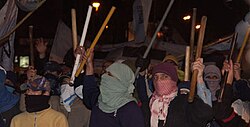
Evolution into a National Phenomenon
During the late 1990s, the movement spread rapidly. Argentina's economy struggled with an over-valued fixed exchange rate, leading to a loss of competitiveness in export markets. Simultaneously, the privatization of state companies led to widespread job losses. Piquetero protests expanded into the de-industrialized towns and impoverished neighborhoods of Greater Buenos Aires, specifically in La Matanza and Florencio Varela.
By 1997, the scale of the movement was evident, with 23 roadblocks in Buenos Aires Province and 77 across the entire country. This growth led to the formation of Movimientos de Trabajadores Desempleados (MTDs). These organizations moved beyond simple roadblocks to occupy government buildings and block supermarkets. Beyond protest, MTDs established cooperatives for food production, sewing workshops, and barter markets for goods and services. Some members also aligned with the recovered factory movement, such as the Zanon ceramic tile factory (now FaSinPat).
Conflict and Crisis
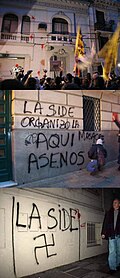
The tension between the state and the piqueteros reached a peak during the economic crises of the early 2000s. In 2002, two piqueteros, Darío Santillán and Maximiliano Kosteki, were killed during protests at the Avellaneda train station. While judicial investigations and press reports pointed toward the involvement of the Secretariat of Intelligence (SIDE), official proof of SIDE's organization of the event remained elusive. In 2006, two police officers, Alfredo Fanchiotti and Alejandro Acosta, were convicted of murder for their roles in the repression.
Political Integration and Welfare
The organizational success of the MTDs attracted various political actors, including traditional leftist parties and the Peronist Party. Over time, many MTDs were co-opted by municipal administrations or ideological factions. This created a hierarchical structure where movement leaders often acted as intermediaries for government welfare subsidies.
One such program, Planes Trabajar, provided "contracts" for 20 hours of work per week in public institutions, paying roughly 150 pesos (less than US$50) per month. In many cases, members were required to contribute a small portion of these subsidies to the movement to fund logistics and assembly facilities.
Criticism and Social Division
The piquetero movement is viewed through vastly different lenses across Argentine society:
- The Middle Class: Many acknowledge the right to protest but argue that blocking roads violates the constitutional right to free movement (Article 14) and endangers lives by delaying ambulances.
- The Political Right: Critics often equate piqueteros with criminals, citing instances of building occupations and property damage. Former President Mauricio Macri notably referred to piqueteros as "orcs."
- Internal Fragmentation: The movement is split between those who support the national government (viewed as progressive) and independent or leftist factions who view such support as a betrayal of the movement's radical roots.
| Feature | Details |
|---|---|
| Primary Tactic | Roadblocks (Piquetes) |
| Key Organizations | Movimientos de Trabajadores Desempleados (MTDs) |
| Legal Conflict | Article 14 (Constitution) & Art. 194 (Penal Code) |
| Key Figures | Milagro Sala (Leader from Jujuy) |
| Economic Driver | Privatization and shock therapy unemployment |
Frequently Asked Questions
What is a piquetero?
A piquetero is a member of a social protest group in Argentina that uses roadblocks (piquetes) to demand government attention for issues such as unemployment and poverty.
Why did the piquetero movement start?
The movement began in 1996 in Cutral Có, Neuquén, after workers were laid off by the state-owned oil company YPF during a period of economic shock therapy and privatization.
Are piquetero roadblocks legal in Argentina?
No. According to Article 194 of the Penal Code, hindering the normal operation of transport or utilities can be punished with imprisonment from three months to two years.
What are MTDs?
MTDs (Movimientos de Trabajadores Desempleados) are Unemployed Workers Movements that organized piqueteros into structured groups, managing both protests and community cooperatives for food and services.
What role do women play in the movement?
Women have a significant presence in the movement; reports from 2005 indicated that 70% of piqueteros were women, and several movements have been led by women, such as Milagro Sala.