Argentina Foreign Trade: Economic Evolution and Global Partnerships
Argentina's foreign trade is a complex tapestry of agricultural strength, industrial ambition, and recurring financial volatility. From its colonial roots as a supplier of salted beef to its modern role as a global powerhouse in soy and lithium, the nation's economic trajectory has been defined by its ability to navigate global commodity markets and manage its current account balances.
The country's trade activities encompass the export and import of merchandise as well as the trade of services, with a historical reliance on the primary sector that continues to influence its macroeconomic stability today.
Key Facts
- Primary Exports: Dominated by soy, cereals, animal fodder, and motor vehicles.
- Major Partners: Brazil and China are the leading trading partners, followed by the United States and the European Union.
- Economic Volatility: History is marked by alternating periods of massive trade surpluses and deep deficits linked to commodity prices and debt.
- Service Deficits: Trade in services is historically negative, driven largely by foreign debt interest payments and outbound travel.
- Regional Integration: A key member of Mercosur, though industrial asymmetries with Brazil often create trade tensions.
Historical Evolution of Trade
Colonial and Early Foundations
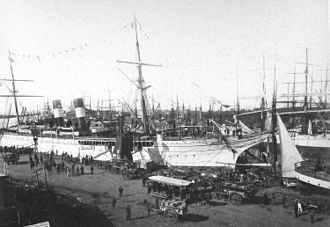
During the colonial era, Argentina's exports were severely limited by logistics. The primary export was salted beef, as fresh beef could not survive the long trans-Atlantic voyages. This same limitation prevented significant grain exports until the 1870s, when shipping technology improved.
The 20th Century: Surpluses and Shifts
Between 1900 and 1948, Argentina generally enjoyed trade surpluses, including a cumulative US$1 billion during World War I and US$1.7 billion during World War II. However, the tide turned under President Juan Perón (1946-55), whose administration imposed record taxes on grain exports. Combined with a growing need for expensive machinery and fuel, this led to a string of trade deficits between 1949 and 1962.
The 1980s were characterized by financial instability. While the dictatorship's deregulation policies led to a record deficit in 1980 and a financial collapse by 1981, the subsequent decade of slack domestic demand actually produced cumulative surpluses of US$38 billion between 1982 and 1991. These funds provided little domestic benefit, as they were largely deposited abroad to manage interest payments.
Crisis, Recovery, and Modern Trends
The 2001 Collapse and Commodity Booms
The economic collapse of late 2001 and the 2002 peso devaluation caused imports to drop by over half. This triggered a massive trade surplus of over US$16 billion, the first current account surplus since 1990. As the economy stabilized at approximately 3 pesos per dollar, exports of soy, cereals, and machinery grew steadily.
Recent Volatility (2014–2024)
A crash in global commodity prices in 2014 led to a period of deficits, peaking in 2017 with a record current account deficit of US$31 billion. While the 2018 crisis forced a 37% reduction in imports (leading to US$50 billion in cumulative surpluses from 2019 to 2022), these gains were offset by high foreign debt interest outlays.
Trade in services has remained a persistent challenge. Deficits averaged US$5 billion annually in the 1980s and 90s, spiked to US$9.7 billion in 2017, and rose again to US$7 billion in 2022 due to increased outbound travel.
Major Commercial Relationships
Mercosur and Brazil
Brazil is a critical but tense partner. Argentina often seeks quotas and restrictions within Mercosur (the Southern Common Market) to protect its industrial sector from Brazil's larger production capacity. In 2022, trade with the bloc reached US$35 billion, with motor vehicles and parts making up three-eighths of Argentina's exports to the group.
The Rise of China
Negligible before 1992, trade with China grew rapidly, making it Argentina's second-largest partner by 2010. Argentina exports soy, beef, barley, and lithium carbonate, while importing industrial goods. To manage growing merchandise deficits—which reached US$9.5 billion by 2022—Argentina has utilized foreign exchange swaps (agreements between central banks to exchange currencies) with China.
United States and European Union
The U.S. replaced the UK as the primary source of imports in the 1920s. While the U.S. share of trade declined after 2002, it remains a steady partner, with mutual trade reaching nearly US$20 billion in 2022. The EU is the third-largest partner, accounting for 13% of total trade in 2022 (US$22 billion), focusing on processed agricultural products and chemicals.
Trade Data Analysis
| Product Class | Exports (Million US$) | Imports (Million US$) | Balance (Million US$) | |
|---|---|---|---|---|
| Maize, Wheat, and Cereals | 10,833 | 57 | 10,776 | |
| Animal Fodder (Soy) | 11,435 | 85 | 11,350 | |
| Vegetable Oils | 8,057 | 116 | 7,941 | |
| Machinery and Parts | 1,369 | 15,779 | -14,410 | |
| Motor Vehicles and Parts | 8,459 | 8,959 | -500 | |
| Total | 79,721 | 60,822 | 18,899 |
Frequently Asked Questions
What are Argentina's most important export products?
Argentina's economy relies heavily on agricultural products, specifically animal fodder (mainly soy), maize, wheat, and vegetable oils. It also exports significant quantities of motor vehicles, parts, and minerals like gold and silver.
Why does Argentina often have a deficit in trade in services?
The services deficit is primarily driven by high outbound travel expenses and substantial foreign debt interest outlays, which frequently exceed the income Argentina generates from its own service exports.
How has the relationship with China evolved?
Trade was negligible until 1992 but grew rapidly, with China becoming the leading source of imports (21.5% in 2022). The relationship is characterized by the export of raw materials (soy, lithium) and the use of currency swaps to finance trade deficits.
What is the impact of Mercosur on Argentine trade?
Mercosur provides a vital market, particularly for the automotive sector, which sells 68% of its vehicles and parts to the bloc. However, industrial competition with Brazil often leads to trade tensions and requests for protective quotas.
How did the 2001 crisis affect trade balances?
The crisis and subsequent peso devaluation in 2002 caused a sharp drop in imports, which led to a soaring trade surplus of over US$16 billion and the first current account surplus since 1990.