Central Bank of the Argentine Republic
The Central Bank of the Argentine Republic (Spanish: Banco Central de la República Argentina, or BCRA) serves as the primary monetary authority of Argentina. Operating as an autarchic entity—meaning it possesses a degree of self-governance—the BCRA is tasked with a broad mandate. According to Article 3 of its Organic Charter, the bank aims to promote monetary and financial stability, employment, and economic development characterized by social equity, all within the policy framework established by the national government.
Key Facts
- Established: May 28, 1935
- Ownership: 100% state-owned
- Current President: Santiago Bausili
- Official Currency: Argentine Peso (ARS)
- Current Bank Rate: 32%
- Foreign Reserves: $28.385 billion
- Headquarters: Buenos Aires, Argentina
Establishment and Early History
The BCRA was created through six Acts of Congress on May 28, 1935, replacing the currency board that had been in place since 1899. The institution's charter was drafted by economist Raúl Prebisch, who served as general manager until 1943, following a 1933 study on Argentine finance conducted by Sir Otto Niemeyer of the Bank of England. Ernesto Bosch served as the bank's first president from 1935 to 1945.
For its first decade, the BCRA operated as a private entity with a majority of stakes held by British interests. While the President of Argentina appointed the bank's president, 11 of the 12 directors were CEOs of private banks. This arrangement led to tensions under the Roca–Runciman Treaty of 1933, which required reserves from trade surpluses with the UK to be held in escrow at the Bank of England. By 1945, nearly US$1 billion in reserves were inaccessible, prompting President Juan Perón to nationalize the bank on March 24, 1946.
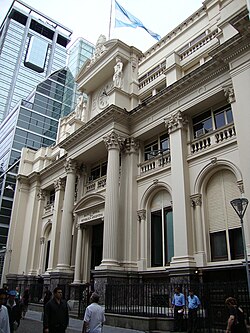
The bank's headquarters are located in the heart of the Buenos Aires financial district. The main building, an Italian Renaissance-inspired structure designed in 1872 by Henry Hunt and Hans Schroeder, originally housed the Mortgage Bank of the Province of Buenos Aires. The BCRA acquired this building in 1940 and expanded the site by constructing a twin building behind it.
Evolution of Monetary Policy and Modern Challenges
Throughout its history, the BCRA has navigated extreme economic volatility. During the Latin American debt crisis in 1980, the bank enacted Circular 1050 to protect the financial sector from peso devaluation. However, this indexed mortgages to the US dollar, leading to widespread bankruptcies for homeowners and businesses until the policy was rescinded by President Domingo Cavallo in 1982.
The Convertibility Era and Its Aftermath
On April 1, 1991, the Convertibility Law established a fixed 1:1 exchange rate between the Argentine peso and the US dollar. During this period, the BCRA's primary role was maintaining foreign currency reserves in synchronization with the monetary base. This system lacked exchange-rate flexibility and eventually collapsed during a severe economic crisis a decade later.
The repeal of the Convertibility Law in January 2002 resulted in a 70% devaluation of the peso. Following this, the BCRA focused on accumulating reserves to control the exchange rate, buying and selling dollars to maintain export competitiveness and encourage import substitution.
Debt Restructuring and Political Influence
In January 2006, the BCRA used approximately US$9.8 billion in reserves to pay off Argentina's debts to the International Monetary Fund (IMF) in a single disbursement. While this reduced reserves by one-third, it was part of a broader effort to exit default. By September 2006, reserves had recovered to US$28 billion.
The bank's independence has often been tested by political administrations. In 2009, President Cristina Fernández de Kirchner ordered the use of reserves to fund public spending and debt service, leading to a conflict with then-President Martín Redrado. Redrado was dismissed by decree in January 2010 and replaced by Mercedes Marcó del Pont. A 2012 charter reform further enabled the government to use BCRA reserves to pay public debt and expanded the bank's lending capacity to the Treasury.
Financial Summary
The following table summarizes the core operational details of the Central Bank of the Argentine Republic.
| Attribute | Detail |
|---|---|
| Legal Status | Autarchic Entity / 100% State Owned |
| Primary Objectives | Monetary stability, financial stability, employment, and social equity |
| Currency Managed | Argentine Peso (ARS) |
| Current Bank Rate | 32% |
| Total Reserves | $28.385 billion |
Frequently Asked Questions
What is the primary goal of the BCRA?
The BCRA aims to promote monetary and financial stability, employment, and economic development with social equity, operating within the policies set by the national government.
When was the Central Bank of Argentina nationalized?
The bank was nationalized on March 24, 1946, by order of President Juan Perón, following issues with inaccessible reserves held at the Bank of England.
What was the Convertibility Law?
Enacted on April 1, 1991, the Convertibility Law fixed the exchange rate of the Argentine peso to the US dollar at a 1:1 ratio, a policy that lasted until January 2002.
How does the BCRA manage the exchange rate today?
The BCRA intervenes in the market by buying and selling US dollars to absorb trade surpluses, maintain competitive export levels, and encourage import substitution.
Who is the current President of the BCRA?
The current President of the Central Bank of the Argentine Republic is Santiago Bausili.