Pilatus PC-21: Global Operational History and Deployment
The Pilatus PC-21 has established itself as a premier choice for modern military pilot training. Designed to bridge the gap between basic flight instruction and high-performance jet operations, this advanced turboprop trainer is utilized by air forces worldwide to prepare pilots for the rigors of frontline combat aircraft.
From its first export success in Singapore to its recent selection for the Royal Canadian Air Force, the PC-21's operational history reflects a global shift toward integrated, cost-effective training systems that maintain high safety and performance standards.
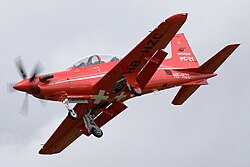
Key Facts
- First Export Customer: The Republic of Singapore Air Force (RSAF).
- Largest Single Order: Saudi Arabia, with 55 aircraft as part of a broader training system.
- Diverse Roles: Used for basic and advanced training, as well as surveillance (France) and air demonstrations (Canada).
- Strategic Replacements: Replacing legacy fleets such as the CT-114 Tutor, CASA C-101 Aviojet, and Pilatus PC-9.
Global Deployment and Adoption
Asia-Pacific Integration
Singapore was the first export customer for the PC-21. In November 2006, the Republic of Singapore Air Force (RSAF) partnered with Lockheed Martin Simulation, Training and Support (LMSTS) to acquire 19 aircraft. These were used for the Basic Wings training course at RAAF Base Pearce in Australia under a public-private partnership (PPP), replacing the SIAI-Marchetti S.211. The first RSAF PC-21 flew in January 2008, with training operations commencing in July 2008.
Australia also adopted the platform through project AIR 5428. In September 2015, "Team 21"—a consortium of Lockheed Martin, Pilatus, and Hawker Pacific—won the bid to provide 49 PC-21s to the Australian Defence Force to replace the aging Pilatus PC-9 fleet.
European Operations
In Europe, the PC-21 has seen significant adoption. The Swiss Air Force began accepting aircraft in April 2008 following the Armament Program 2006, later adding two more aircraft in 2010. France contracted 17 aircraft in January 2017, with the first two arriving in August 2018. Notably, the French Air Force utilized the PC-21 for surveillance during the 2024 Paris Olympics.
Spain has integrated the PC-21 to replace the ENAER T-35 Pillan and CASA C-101 Aviojet. After evaluating several models, Spain ordered 24 aircraft in January 2020, with a second batch of 16 announced in 2023. The fleet handles both basic and advanced training; it was even used for the first solo flight of Her Royal Highness Leonor, Princess of Asturias.
Middle Eastern Training Systems
Several Middle Eastern nations have implemented comprehensive training ecosystems centered on the PC-21. Qatar ordered 24 aircraft in 2012, including ground-based training devices and logistical support, receiving its first batch in October 2014.
Saudi Arabia signed a massive £1.6 billion ($2.5 billion) contract in May 2012. This next-generation system combined 55 PC-21 trainers with 22 BAE Systems Hawk advanced jet trainers. Deliveries began in June 2014, with 46 aircraft delivered by the end of 2015.
The United Arab Emirates Air Force (UAEAF) announced an order for 25 trainers during the 2009 Dubai Airshow to replace its Pilatus PC-7s, with the first maiden flight occurring in November 2010. Additionally, Jordan modified an original order for PC-9Ms in April 2016 to instead acquire eight PC-21s.
North American Expansion
In a significant move for North American aviation, the Royal Canadian Air Force (RCAF) announced on May 19, 2026, the purchase of the CT-157 Siskin II (the Canadian designation for the PC-21). These aircraft will replace the CT-114 Tutor fleet, serving as both trainers and air demonstration aircraft. This transition will eventually replace the Snowbirds air demonstration squadron, with the new fleet based at 15 Wing Moose Jaw, Saskatchewan, becoming operational in the early 2030s.
Operational Summary by Country
| Country | Quantity | Primary Role / Notes |
|---|---|---|
| Saudi Arabia | 55 | Next-gen training system with BAE Hawk |
| Australia | 49 | Replacement for Pilatus PC-9 |
| Spain | 40 | Replacement for CASA C-101 and T-35 Pillan |
| Qatar | 24 | Complete pilot training system |
| UAE | 25 | Replacement for Pilatus PC-7 |
| Singapore | 19 | First export customer; PPP arrangement |
| France | 17 | Training and Olympic surveillance |
| Jordan | 8 | Modified order from PC-9M |
| Switzerland | 6+ | Initial adoption via Armament Program 2006 |
| Canada | TBD | CT-157 Siskin II; replacing CT-114 Tutor |
Frequently Asked Questions
Which country was the first to buy the PC-21 as an export?
The Republic of Singapore Air Force (RSAF) was the first export customer, awarding a contract in November 2006.
What is the CT-157 Siskin II?
The CT-157 Siskin II is the designation given to the Pilatus PC-21 by the Royal Canadian Air Force (RCAF).
How is the PC-21 used in France beyond pilot training?
In 2024, the French Air Force utilized the PC-21 as a surveillance aircraft during the Paris Olympics Games.
What aircraft is the PC-21 replacing in Canada?
The PC-21 (as the CT-157 Siskin II) is replacing the CT-114 Tutor fleet, which includes the aircraft used by the Snowbirds air demonstration squadron.
What was the scale of the Saudi Arabian training contract?
Saudi Arabia signed a £1.6 billion ($2.5 billion) contract for a system comprising 55 PC-21 trainers and 22 BAE Systems Hawk advanced jet trainers.