RAAF F-111C Acquisition and the Phantom II Interim Lease
In the early 1960s, the Royal Australian Air Force (RAAF) faced a critical need to modernize its fleet. The aging English Electric Canberra bombers were becoming obsolete, prompting a comprehensive search for a replacement strike aircraft that could provide the range and performance necessary for Australia's strategic requirements.
The Search for a New Strike Aircraft
In mid-1963, a senior RAAF delegation led by Air Marshal Valston Hancock, the Chief of the Air Staff, conducted an extensive international evaluation. The team traveled to the United States to inspect the General Dynamics F-111 (then known as the TFX), the North American A-5 Vigilante, and the McDonnell Douglas F-4C Phantom II. To ensure these aircraft could be properly supported, the team also evaluated the Boeing KC-135 Stratotanker.
The search extended beyond the U.S., with officers visiting the United Kingdom to evaluate the BAC TSR-2 and France to inspect the Dassault Mirage IV. Upon returning, the team rejected the F-4C, citing insufficient range, poor low-altitude performance, and a lack of necessary reconnaissance capabilities.
While the F-111 was deemed the most suitable overall, the RAAF initially proposed acquiring 36 Vigilantes because they met the requirements and offered a faster delivery timeline. However, the Australian Government overruled this advice and ordered 24 F-111s in late 1963.
Interim Solutions and the F-111 Crisis
The transition to the F-111 was fraught with delays. Originally scheduled for 1967, delivery shifted to 1968 to accommodate the unique F-111C variant. During this gap, the U.S. Government offered to lend Australia 24 Boeing B-47 Stratojet bombers. The Australian Air Board rejected this, viewing the B-47s as obsolete and expensive to operate. They instead suggested leasing a package of F-4C strike aircraft, RF-4C reconnaissance variants, and KC-135 tankers, but the Cabinet rejected both options in 1964.
Despite the lack of a domestic fleet, Australian experience with the Phantom continued through exchange postings; between 1965 and 1970, six RAAF pilots flew Phantoms in combat during the Vietnam War.
By September 1968, the RAAF formally accepted all 24 F-111Cs at Fort Worth, Texas. However, the program immediately entered a crisis. A crash on September 23 revealed severe technical flaws in the wing assembly, leading to a total grounding of the fleet. Further testing showed that various components failed to meet their intended lifespans, forcing the Australian aircraft into storage.
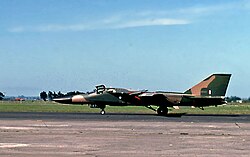
During this period of instability, the RAAF evaluated several alternatives, including the Blackburn Buccaneer, LTV A-7 Corsair II, and Grumman A-6 Intruder. Only the F-4E Phantom II came close to meeting requirements, though it still lacked the terrain-following radar and electronic countermeasures of the F-111.
Project Peace Reef: The F-4E Lease
By 1970, with the F-111Cs still not airworthy, the Australian Government faced immense pressure to find an interim solution. In April 1970, Minister for Defence Malcolm Fraser and U.S. Secretary of Defense Melvin R. Laird reached an agreement. Laird offered to lease 24 F-4E Phantoms at a reduced price.
Although the Air Board maintained that the F-111C would eventually outperform the F-4E by a "decisive margin," they supported the lease to maintain operational capability. Air Vice Marshal Charles Read led the negotiations in May 1970, a move that was highly welcomed by RAAF aircrews and senior officers.
On June 29, 1970, the Cabinet approved the lease of 24 Phantoms for two years at a cost of US$41.554 million. This project, designated Peace Reef, included training, spare parts, and technical advice. The agreement allowed Australia to purchase the aircraft if the F-111C program failed, while the U.S. reserved the right to recall them in a national emergency—though a private commitment from Laird ensured this option would not be exercised.
Key Facts
- Initial Order: 24 F-111C aircraft ordered in late 1963.
- Rejected Alternatives: F-4C Phantom II, A-5 Vigilante, BAC TSR-2, and Dassault Mirage IV.
- Project Peace Reef: A two-year lease of 24 F-4E Phantoms costing US$41.554 million.
- Technical Failure: F-111Cs were grounded in 1968 due to wing assembly flaws and component lifespan issues.
- Combat Experience: Six RAAF pilots flew Phantoms in Vietnam via USAF exchange postings (1965–1970).
| Aircraft | Manufacturer | RAAF Outcome | Primary Reason |
|---|---|---|---|
| F-111C | General Dynamics | Acquired | Most suitable overall requirements |
| F-4C Phantom II | McDonnell Douglas | Rejected | Lack of range and low-altitude performance |
| A-5 Vigilante | North American | Proposed/Rejected | Met requirements and faster delivery |
| F-4E Phantom II | McDonnell Douglas | Leased (Interim) | Urgent need during F-111 grounding |
| B-47 Stratojet | Boeing | Rejected | Obsolete and expensive to operate |
Frequently Asked Questions
Why was the F-4C Phantom II initially rejected by the RAAF?
The RAAF rejected the F-4C because it did not possess the necessary range, reconnaissance capabilities, or performance at low altitudes required for their specific operational needs.
What caused the grounding of the F-111C fleet in 1968?
The aircraft were grounded following a crash on September 23, 1968, which revealed critical design flaws in the wing assembly and components that did not meet their intended operational lifespans.
What was Project Peace Reef?
Project Peace Reef was the formal designation for the lease of 24 F-4E Phantom II aircraft from the United States to Australia for a period of two years, serving as an interim force while the F-111C issues were resolved.
How much did the F-4E lease cost the Australian Government?
The total cost of the lease was US$41.554 million, which covered the aircraft, training, spare parts, and technical advice.
Did the RAAF ever use Phantoms in combat?
While the RAAF did not deploy Phantoms as a national unit, six Australian pilots serving on exchange with the USAF flew Phantoms in combat during the Vietnam War between 1965 and 1970.