OS2U Kingfisher: The Versatile Scout and Rescue Plane of WWII
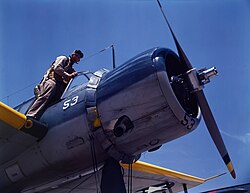
The OS2U Kingfisher was a cornerstone of naval aviation during World War II, serving as a multipurpose aircraft capable of operating from both land and sea. Designed as a catapult-launched scout plane, it provided the U.S. Navy with essential eyes over the horizon, operating from battleships, heavy cruisers, and light cruisers.
Beyond its primary role in reconnaissance, the Kingfisher became legendary for its air-sea rescue capabilities and its ability to operate in challenging maritime environments. Its longevity in service was a testament to its reliability, especially when intended successors failed to meet operational requirements.
Key Facts
- Primary Roles: Shipboard scouting, shore bombardment support, and air-sea rescue.
- Deployment: Used by the U.S. Navy, U.S. Coast Guard, and the Royal Australian Air Force (RAAF).
- Notable Rescue: Recovered WWI ace Eddie Rickenbacker and his crew in November 1942.
- Service Extension: Remained in service longer than planned due to the failure of the Curtiss SO3C Seamew.
- Replacement: Gradually replaced by the Curtiss SC Seahawk starting in October 1944.
Operational History and Deployment
U.S. Navy Integration
The U.S. Navy began receiving the first 54 Kingfishers in August 1940. By the end of that year, six aircraft had already been assigned to the Battle Force based at Pearl Harbor. As production continued, 158 OS2U-2 models were delivered; while many were used for flight training at Naval Air Station Pensacola, Florida, 53 were dedicated to the newly formed Inshore Patrol Squadrons based at Naval Air Station Jacksonville, Florida.
By 1942, the Navy expanded its coastal defenses by establishing nine additional Inshore Patrol Squadrons, which were exclusively equipped with OS2N-1s manufactured by the Naval Aircraft Factory.
Combat and Rescue Missions
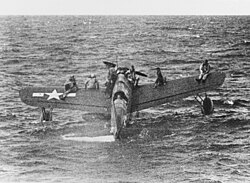
The Kingfisher's versatility made it indispensable for supporting shore bombardments and conducting daring rescue missions. One of its most famous achievements occurred in November 1942, when it recovered World War I ace Eddie Rickenbacker and his crew from the Pacific Ocean.
Another remarkable feat was performed by Lieutenant John A. Burns on April 30, 1944. Burns used his aircraft to taxi ten rescued airmen from Truk Lagoon to the submarine Tang, which was on rescue duty near the atoll. For these two successful trips, Burns was awarded the Navy Cross.
International and Inter-agency Service
U.S. Coast Guard Operations
Starting in 1942, the U.S. Coast Guard operated 76 OS2U-3 Kingfishers. These aircraft were utilized for reconnaissance, search and rescue, and anti-submarine warfare (the practice of hunting and destroying enemy submarines). While the Coast Guard's Kingfishers did not sink any enemy submarines, they were highly effective in rescuing sailors from ships that had been sunk by torpedoes. The Coast Guard retired the aircraft in October 1944.
Australian Service (RAAF)
Australia acquired 18 Kingfishers in 1942 after a shipment originally intended for the Dutch East Indies was diverted. Initially used to train pilots for flying boats, these aircraft were later used to equip No. 107 Squadron of the Royal Australian Air Force (RAAF) for convoy escort duties until October 1945. Interestingly, one Kingfisher continued to serve in a scientific capacity, supporting the Australian National Antarctic Research Expedition between 1947 and 1948.
The Transition to New Aircraft
The OS2U Kingfisher, along with its predecessor, the Curtiss SOC Seagull, remained in service far longer than the Navy had originally intended. This was primarily due to the failure of the planned successor, the Curtiss SO3C Seamew, which suffered from an underpowered engine. It was not until October 1944 that the Curtiss SC Seahawk began arriving to slowly replace the aging Kingfisher fleet.
| Organization | Primary Role | Key Variant/Model | Notable Detail |
|---|---|---|---|
| U.S. Navy | Scouting & Rescue | OS2U-2 / OS2N-1 | Catapult-launched from cruisers/battleships |
| U.S. Coast Guard | ASW & Search and Rescue | OS2U-3 | Operated until October 1944 |
| RAAF (Australia) | Convoy Escort & Training | OS2U | Used in Antarctic research (1947–48) |
Frequently Asked Questions
What was the primary purpose of the OS2U Kingfisher?
The Kingfisher was primarily used as a shipboard, catapult-launched scout plane for U.S. Navy battleships and cruisers, though it also played a critical role in air-sea rescue and shore bombardment support.
Why did the Kingfisher stay in service longer than expected?
The aircraft remained in service because its intended replacement, the Curtiss SO3C Seamew, was a failure due to an insufficiently powerful engine.
Did the U.S. Coast Guard sink any submarines with the Kingfisher?
No, the Coast Guard's Kingfishers are not credited with sinking any enemy submarines, although they were successful in rescuing sailors from torpedoed ships.
Who was Lieutenant John A. Burns?
Lieutenant John A. Burns was a pilot who earned the Navy Cross for rescuing ten airmen from Truk Lagoon and taxiing them to the submarine Tang in April 1944.
Which aircraft eventually replaced the OS2U Kingfisher?
The Kingfisher was slowly replaced by the Curtiss SC Seahawk, which first entered U.S. Navy service in October 1944.