Phytoplankton: The Invisible Engines of Global Ecosystems
Floating silently in the upper reaches of the world's oceans and lakes, phytoplankton are the unsung heroes of life on Earth. Derived from the Ancient Greek words phutón (plant) and planktós (drifter), these "plant drifters" are autotrophic organisms, meaning they produce their own food. While they may be microscopic, their collective impact is planetary in scale.
Unlike land plants, phytoplankton are distributed across a vast surface area and possess remarkably fast turnover rates—often measured in days rather than decades. This agility allows them to respond rapidly to global climate variations, making them critical indicators of planetary health.
![Cycling of marine phytoplankton [28]](/images/13/87/138765e9958925b77287ba25d692c14433f891a74febb27e9dc03f4efbf8623a.png)
Key Facts
- Oxygen Production: Phytoplankton are responsible for at least half of the world's oxygen production.
- Photosynthetic Power: They account for approximately 50% of global photosynthetic activity.
- Biomass Paradox: Despite their massive impact, they represent only about 1% of the global plant biomass.
- Habitat: They reside exclusively in the euphotic zone, the well-lit surface layers of water bodies where sunlight can penetrate.
- Food Web Base: They form the primary foundation for almost all marine and freshwater food webs.
Biological Characteristics and Types
Phytoplankton function similarly to terrestrial trees, utilizing sunlight to convert carbon dioxide and water into energy through photosynthesis. Because they are dependent on light, their distribution is strictly limited to the surface layers of the water column.
Diatoms
One of the most prevalent types of phytoplankton is the diatom. These organisms are distinguished by their unique silica shells, known as frustules. Depending on the species, these shells exhibit either radial (centric) or bilateral (pennate) symmetry, providing structural support and protection.
Ecological Importance and Global Impact
The role of phytoplankton extends far beyond providing food for small aquatic animals. They are central players in the global carbon cycle, acting as a biological pump that captures atmospheric carbon and transports it into the deep ocean.
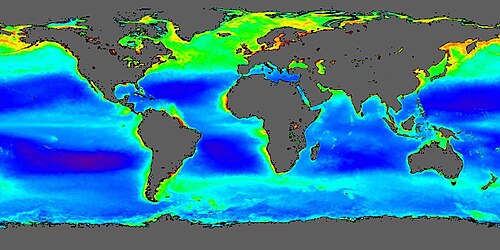
Their presence is often tracked by scientists using satellite imagery to measure chlorophyll, the pigment used in photosynthesis, which serves as a marker for their abundance and distribution across the globe.
![Role of phytoplankton on various compartments of the marine environment [71]](/images/38/46/384655d67a0659f4185b3432ce72100a9b0b23615bd2f7e648639dbcc81b2822.png)
Environmental Influence
Phytoplankton productivity is influenced by a complex interplay of environmental factors, including nutrient availability, water temperature, and light penetration. Some species even exhibit bioluminescence, creating glowing waves when agitated by crashing surf.

Phytoplankton Summary Table
| Feature | Description | Global Impact |
|---|---|---|
| Energy Source | Photosynthesis (Sunlight) | 50% of global photosynthetic activity |
| Primary Habitat | Euphotic Zone (Surface layers) | Widespread distribution in oceans/lakes |
| Key Example | Diatoms (Silica shells) | Major component of marine biomass |
| Atmospheric Role | Carbon sequestration & Oxygen release | >50% of Earth's oxygen production |
Challenges and Anthropogenic Changes
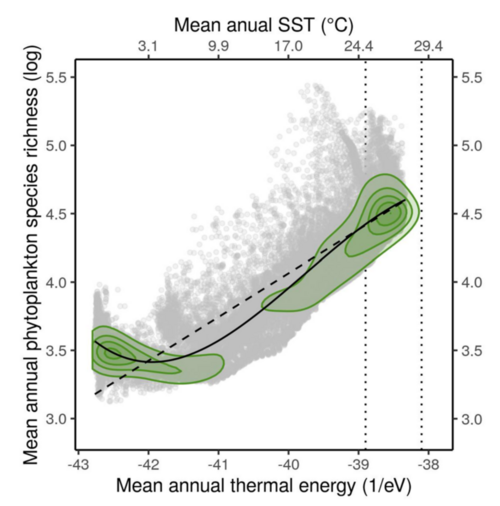
Human activity is altering the chemistry and temperature of the oceans, which in turn affects phytoplankton. Ocean acidification—the decrease in ocean pH levels—and rising temperatures can shift species richness and turnover rates.
While some species may adapt, others struggle, potentially disrupting the biological pump and the food chains that rely on them. Research into iron fertilization explores whether adding nutrients to the ocean could stimulate phytoplankton growth to capture more carbon, though this remains a complex ecological concept.
![Competing hypothesis of plankton variability[58]Figure adapted from Behrenfeld & Boss 2014.[61]Courtesy of NAAMES, Langley Research Center, NASA[62]](/images/c1/da/c1da704321e0467f41d4164611bfab82d17d03aff3a763e0a9020e2c6704371d.png)
![Global patterns of monthly phytoplankton species richness and species turnover (A) Annual mean of monthly species richness and (B) month-to-month species turnover projected by SDMs. Latitudinal gradients of (C) richness and (D) turnover. Colored lines (regressions with local polynomial fitting) indicate the means per degree latitude from three different SDM algorithms used (red shading denotes ±1 SD from 1000 Monte Carlo runs that used varying predictors for GAM). Poleward of the thin horizontal lines shown in (C) and (D), the model results cover only <12 or <9 months, respectively.[63]](/images/86/5d/865d526e0a4cf597f4f761931e48a13c21fe37e07bf3c282dda8967679baa7f2.jpg)
![Environmental factors that affect phytoplankton productivity [64][65]](/images/4f/04/4f0437618a74bf98da57474638cb1ad9bef878916b9709b866238ef7c18948e3.png)
Frequently Asked Questions
What is the euphotic zone?
The euphotic zone is the uppermost layer of a body of water that receives enough sunlight to allow photosynthesis to occur. This is the only region where phytoplankton can survive and thrive.
How do phytoplankton help fight climate change?
Phytoplankton absorb carbon dioxide from the atmosphere during photosynthesis. When they die or are eaten and excreted, some of that carbon sinks to the deep ocean, a process known as the biological pump.
What are diatoms?
Diatoms are a common type of phytoplankton characterized by cell walls made of silica (glass), called frustules, which can be either radially or bilaterally symmetrical.
Why is the "Paradox of the Plankton" significant?
The paradox refers to the observation of high species diversity among plankton despite them competing for the same limited resources in a relatively homogenous environment.
How does ocean acidification affect these organisms?
Ocean acidification changes the pH of the water, which can interfere with the ability of certain phytoplankton to build their shells or maintain their metabolic processes, potentially altering the entire marine food web.