Diamond: The World's Hardest Natural Material
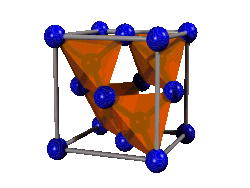
Diamond is a solid form of pure carbon with its atoms arranged in a crystal structure, called diamond cubic. Known for its unmatched hardness and brilliant optical properties, it serves as both a luxury gemstone and a critical tool in heavy industry. From the depths of the Earth's mantle to the vacuum of space, diamonds represent one of the most fascinating intersections of chemistry, geology, and economics.
At its most basic level, a diamond is a native mineral consisting entirely of carbon (C). Its unique properties arise from the way carbon atoms bond, creating a rigid, three-dimensional lattice that resists deformation and scratching better than any other natural substance.
Key Facts
- Chemical Composition: Pure carbon (C).
- Hardness: 10 on the Mohs scale, the highest possible rating.
- Crystal System: Cubic (Hexoctahedral).
- Luster: Adamantine (a brilliant, diamond-like shine).
- Refractive Index: 2.418 at 500 nm.
- Formation: Primarily formed under extreme pressure and temperature in the Earth's mantle.
Physical and Chemical Properties
![Theoretically predicted phase diagram of carbon, from 1989 and updated with newer work[19]](/images/02/d9/02d9f24681024b8536f3eff74d3e0de7187225c98db8020c387b51d5b228e53c.png)
Mechanical Strength and Hardness
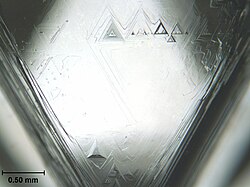
Diamond is the defining mineral for the top of the Mohs scale, meaning it can scratch any other natural mineral. This extreme hardness is due to the tetrahedral structure where each carbon atom is covalently bonded to four others. While incredibly hard, diamonds possess perfect cleavage in four directions (111), meaning they can be split along specific planes if struck correctly.
Optical and Thermal Characteristics
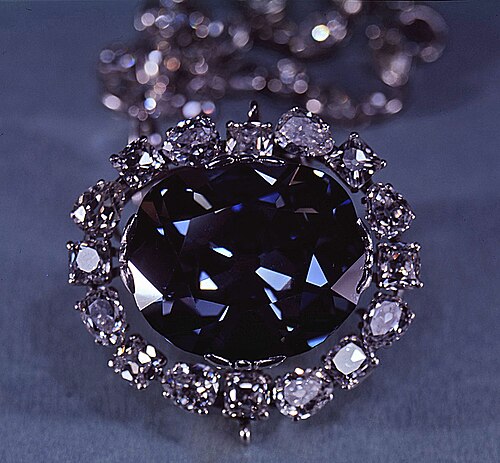
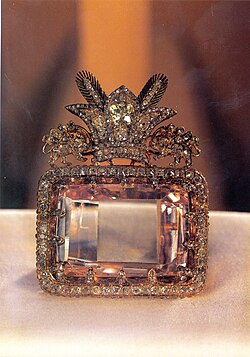
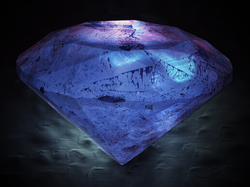
The high refractive index of diamond allows it to bend light significantly, contributing to its characteristic "fire" or dispersion. Most diamonds are colorless, but impurities or structural defects can produce a variety of colors, including blue, pink, and brown.
Beyond aesthetics, diamonds possess exceptional thermal conductivity, allowing them to dissipate heat more efficiently than almost any other material. They are also chemically stable, though they can be flammable under specific high-temperature conditions in oxygen-rich environments.

Geology and Formation
Origin in the Mantle
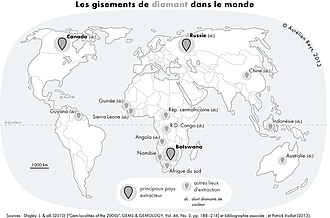
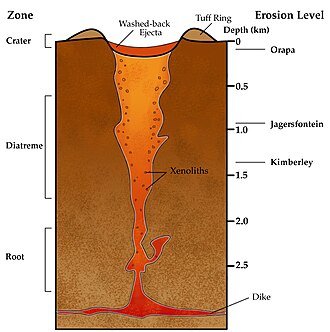
Most natural diamonds form in the Earth's mantle, far below the crust, where pressures and temperatures are sufficient to crystallize carbon. They are often found in cratons—the ancient, stable cores of continental plates.

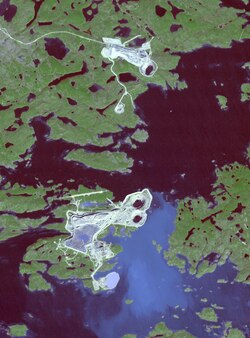
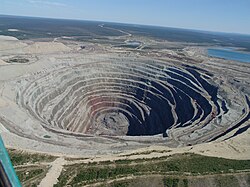
These crystals are transported to the surface via deep-seated volcanic eruptions. The resulting structures are known as volcanic pipes (or kimberlite pipes), which act as the primary source for diamond mining.
Inclusions and Age
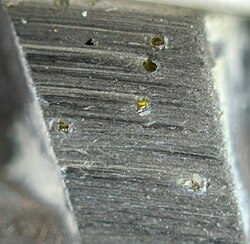
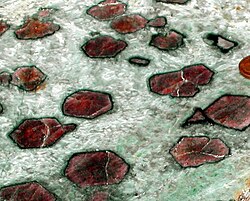
Diamonds often trap other minerals during their growth, known as inclusions. For example, red garnet inclusions can provide clues about the pressure and temperature conditions of the mantle at the time of formation. These inclusions also help geologists determine the age zones of the diamond.
![Red garnet inclusion in a diamond[85]](/images/a9/de/a9de4b63e6d0853dd09e5010489b483b6d02b736e5d6124ef74e44eccfc57454.jpg)
Extraterrestrial Diamonds
Carbon crystallization is not limited to Earth. Scientific evidence suggests that diamonds may form in space, and theoretical models propose that "diamond rain" may occur on ice giants like Uranus and Neptune due to the crushing of methane.
Industrial and Commercial Use

Gem-Grade Diamonds
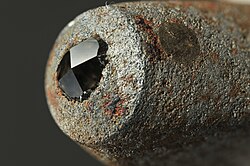
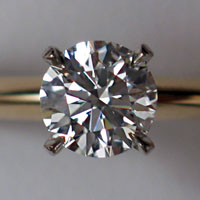
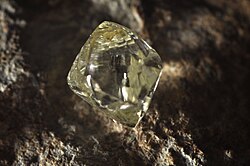
Gem-quality diamonds are valued based on their cut, color, clarity, and carat weight. The process of turning a rough octahedral crystal into a faceted gem requires precision polishing to maximize light reflection.
Industrial-Grade Diamonds
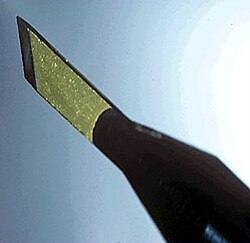
Because of their hardness, industrial diamonds are indispensable for cutting, grinding, and drilling. They are embedded into metal blades and drill bits to penetrate hard rock or steel.
Synthetics and Simulants
Modern technology allows for the creation of synthetic diamonds using two primary methods: High-Pressure High-Temperature (HPHT) and Chemical Vapor Deposition (CVD). These are chemically and physically identical to natural diamonds. In contrast, simulants (like cubic zirconia or silicon carbide) look like diamonds but have different chemical compositions.

Summary of Diamond Specifications
| Property | Value/Description |
|---|---|
| Formula Mass | 12.01 g/mol |
| Crystal Habit | Octahedral |
| Specific Gravity | 3.52 ± 0.01 |
| Density | 3.5–3.53 g/cm³ |
| Dispersion | 0.044 |
| Luster | Adamantine |
Frequently Asked Questions
![Age zones in a diamond[85]](/images/32/0a/320acff46618859030ef05bbfc2c5b5066aa5fbdff2974604e59c1b756eae10f.jpg)


Do diamonds form from coal?
No. This is a common misconception. Most diamonds formed billions of years ago, long before land plants existed to create coal. They form from carbon trapped deep in the Earth's mantle.
What is the difference between a synthetic diamond and a simulant?
A synthetic diamond is chemically identical to a natural diamond, created in a lab. A simulant is a different material entirely (such as moissanite or cubic zirconia) that only mimics the appearance of a diamond.
Can a diamond be destroyed?
While diamonds are the hardest natural substance (resistant to scratching), they are not indestructible. They can be shattered with a hammer due to their cleavage planes, and they can burn if exposed to extreme heat in the presence of oxygen.
What causes diamonds to have different colors?
Color is usually caused by impurities. For example, nitrogen can create yellow tones, while boron creates blue diamonds. Some colors result from structural defects in the crystal lattice rather than chemical impurities.