Philippe, Duke of Orléans: The Power and Legacy of the French Regent
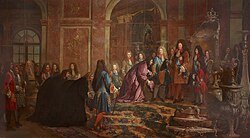
Philippe, Duke of Orléans (1674–1723), known to history as le Régent, was a pivotal figure in the transition of power within the French monarchy. A prince, soldier, and statesman, he steered the Kingdom of France through the delicate period known as the Regency, governing on behalf of his young great-nephew, King Louis XV.
Born at the Château de Saint-Cloud as Philippe Charles, Duke of Chartres, he was the son of Philippe I, Duke of Orléans, and Elizabeth Charlotte of the Palatinate. His life was defined by the rigid expectations of the Versailles court, the brutality of European warfare, and the complex political maneuvering required to maintain authority during a royal minority.
Key Facts
- Role: Served as Regent of France from September 1, 1715, to February 15, 1723.
- Family: Son of Philippe I and Elizabeth Charlotte; husband of Françoise Marie de Bourbon.
- Military Service: Fought in the Nine Years' War and the War of the Spanish Succession.
- Cultural Contribution: An accomplished musician and composer of operas.
- Notable Acquisition: Purchased the 141-carat "Le Régent" diamond for the French crown.
Early Life and Education
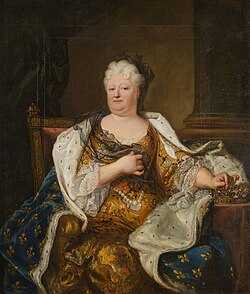
Philippe's path to leadership was cemented early when his older brother, the Duke of Valois, died in 1676. This made Philippe the heir to the House of Orléans, and he subsequently bore the title of Duke of Chartres. He maintained a lifelong close bond with his sister, Élisabeth Charlotte.
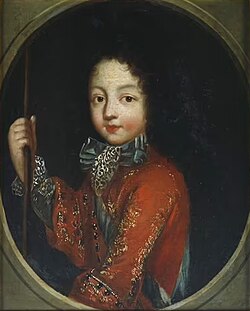
His education was meticulously planned by his preceptor, Guillaume Dubois. Beyond standard princely training in diplomacy and riding, Philippe developed a profound passion for the arts. He studied physics and music, exploring the mathematical principles of vibrating strings and the Galilean pendulum. Under the guidance of Marc-Antoine Charpentier, he composed several operas, including Philomèle, Penthée, and Suite d'Armide. He also mastered the viol under Antoine Forqueray the elder.
Military Career and Marriage
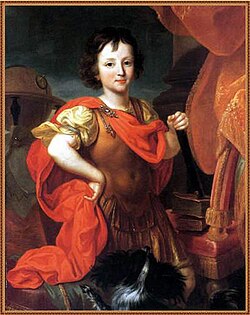
Philippe proved himself a capable soldier, following in the footsteps of his father. He saw his first action at the siege of Mons in 1691 and distinguished himself at the Battle of Steenkerque and the Siege of Namur in 1692. Later, during the War of the Spanish Succession, he held commands in Italy and Spain, contributing to the Battle of Turin (1706) and the Battle of Almansa (1707).
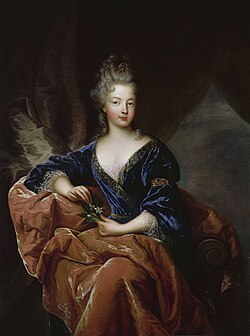
In 1692, Philippe married his first cousin, Françoise Marie de Bourbon, the legitimized daughter of King Louis XIV and Madame de Montespan. The marriage was a political arrangement pushed by the King, who provided a dowry of two million livres and the Palais-Royal. The union was initially met with hostility by Philippe's mother, Elizabeth Charlotte, who famously slapped her son in public upon learning of the agreement.
The Path to the Regency
The years leading up to the Regency were marked by tragedy and suspicion. Following the deaths of the Dauphin and several heirs to the throne, rumors circulated that Philippe had poisoned his relatives to accelerate his own ascent to power. While historical evidence suggests these deaths were caused by smallpox and measles, the rumors tarnished his reputation for years.
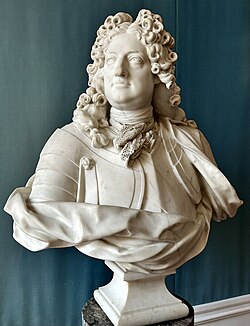
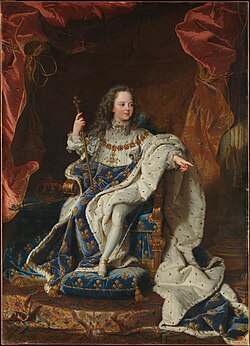
When Louis XIV died on September 1, 1715, he left the throne to the five-year-old Louis XV. However, a codicil in the King's will attempted to limit the power of the regency. Philippe successfully petitioned the Parlement of Paris to annul this codicil, restoring his full rights as Regent.
Governance and the "Le Régent" Diamond
Philippe governed from the Palais-Royal in Paris, moving the young Louis XV to the Tuileries Palace. His tenure was marked by a shift in court culture and significant financial ventures. In 1717, he persuaded the Regency Council to purchase a massive 141-carat cushion brilliant diamond from Thomas Pitt for £135,000, which became known as Le Régent.
Final Years and Legacy
As Louis XV approached adulthood, the political landscape shifted. In 1722, the court returned to Versailles. Upon the King reaching his majority on February 15, 1723, Philippe stepped down as Regent. He briefly served as First Minister of State following the death of Cardinal Dubois in August 1723.
Philippe died on December 2, 1723, at the Palace of Versailles at the age of 49. He was buried in the Basilica of St Denis.
| Category | Details |
|---|---|
| Born | August 2, 1674, Château de Saint-Cloud |
| Died | December 2, 1723, Palace of Versailles |
| Regency Period | 1715 – 1723 |
| Spouse | Françoise Marie de Bourbon |
| Key Title | Regent of France (le Régent) |
| Successor (as PM) | Louis Henri, Duke of Bourbon |
Frequently Asked Questions
Why was Philippe called "le Régent"?
He was given this title because he served as the de facto ruler of France from 1715 to 1723 during the minority of King Louis XV, who was too young to govern.
What was the controversy surrounding Louis XIV's will?
Louis XIV added a codicil to his will that sought to restrict the Regent's power. Philippe successfully had the Parlement of Paris annul this codicil to ensure he had full governing authority.
Did Philippe actually poison the royal family?
While rumors persisted that he poisoned the Dauphin and other heirs to secure the throne, historical records indicate they died of natural causes, specifically smallpox and measles.
What was Philippe's contribution to the arts?
Philippe was a talented musician and composer who wrote several operas, including Philomèle, and studied the viol and the mathematical relationship between physics and music.
Who was the "Le Régent" diamond?
It was a 141-carat cushion brilliant diamond purchased by Philippe in 1717 for £135,000 to be added to the French crown jewels.