Perfect Fourth: History, Theory, and Application in Music
In the architecture of Western music, the perfect fourth is a fundamental building block that defines melody, harmony, and the very way we tune our instruments. Spanning four staff positions in standard notation, the perfect fourth is an interval consisting of five semitones. A classic example is the ascending leap from C to the next F.
While it may seem straightforward, the perfect fourth occupies a unique and sometimes contradictory space in music theory. Depending on the era and the musical context, it has been viewed as a stable consonance or a tension-filled dissonance requiring resolution.

Key Facts
- Interval Size: 5 semitones (half steps).
- Frequency Ratio: 4:3 in just intonation; 500 cents in 12-tone equal temperament.
- Greek Name: Historically referred to as the diatessaron.
- Common Examples: The opening of Wagner's "Bridal Chorus" and the first two notes of "Hark! The Herald Angels Sing."
- Instrument Tuning: Standard for adjacent strings on double basses, bass guitars, and most guitar strings.
Technical Foundations
The perfect fourth is categorized as a perfect interval, meaning it is neither major nor minor. It can be derived from the harmonic series as the interval between the third and fourth harmonics.
Tuning and Measurement
The perception of a fourth varies slightly based on the tuning system used:
- Just Intonation: Based on the natural physics of sound, a perfect fourth has a pitch ratio of 4:3 (approximately 498 cents).
- 12 Equal Temperament: The modern standard for keyboards, where the fourth is exactly 500 cents.
Variations of the Fourth
While the perfect fourth is the most common, two other variations exist that span the same number of staff positions but different semitone counts:
- Diminished Fourth: Spans four semitones.
- Augmented Fourth: Spans six semitones.
| Interval Type | Semitones | Cents (Equal Temp) | Character |
|---|---|---|---|
| Diminished Fourth | 4 | 400 | Dissonant |
| Perfect Fourth | 5 | 500 | Perfect/Consonant |
| Augmented Fourth | 6 | 600 | Dissonant (Tritone) |
Historical Evolution
The role of the perfect fourth has shifted dramatically from the Middle Ages to the modern era.
Middle Ages and Early Polyphony
In early Western music, fourths and fifths were used in parallel to thicken melodic lines. In the 13th century, they were known as concordantiae mediae (middle consonances). The 10th-century Musica enchiriadis described singing in parallel fourths, a practice that reached its peak with the Notre Dame school and composers like Pérotin.
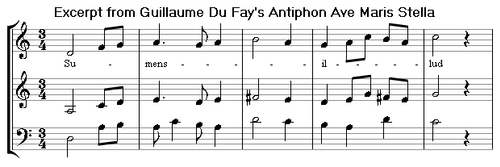
Another significant technique was Fauxbourdon, a three-voice style where lower voices moved in parallel fourths and sixths below the melody. This served as a precursor to the triadic harmony used in later centuries.
Renaissance and Baroque Transitions
By the 15th century, theorists like Johannes Tinctoris began classifying the fourth as a dissonance. In the Renaissance and Baroque periods, the fourth was increasingly viewed as an interval that needed to be resolved, often appearing as a suspension—a note held over from a previous chord that creates tension before resolving downward.
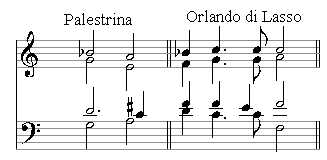
During the Baroque era, composers like Monteverdi and Gesualdo used the fourth for "word painting," using the delayed resolution of a fourth to highlight emotional intensity in the text.
Classical and Romantic Eras
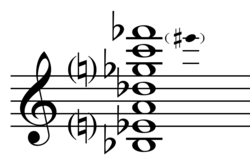
In the Classical period, triadic harmony (built on thirds) dominated, and quartal structures were largely suppressed. However, composers like Mozart and Beethoven still used fourths melodically to create drive or tension. By the late Romantic period, Richard Wagner pushed boundaries with the "Tristan chord," moving away from traditional functional harmony toward a focus on the sound structure itself.
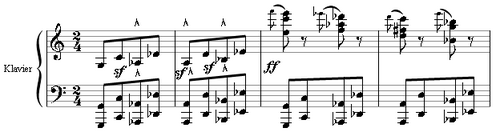
Slavic and Scandinavian composers, including Mussorgsky and Sibelius, integrated "unvarnished" fourth-based harmonies to evoke folk traditions and archaic sounds.
![Quartal harmony in "Laideronnette" from Ravel's Ma Mère l'Oye. The top line uses the pentatonic scale[5] Playⓘ](/images/42/17/42175f8a211a981cd40e78c1e34db29e5fef278270e666c0800d1b47d47501f1.png)
Modern Applications: 20th Century and Beyond
The 20th century saw the rise of quartal harmony (chords built on fourths) and quintal harmony (chords built on fifths). This approach discarded classical rules of tonality.
Western Classical Innovation
French composers like Debussy and Ravel incorporated fourth-based chords alongside the whole tone and pentatonic scales to create atmospheric, non-traditional textures. Bartók also utilized a three-note basic cell involving a perfect fourth combined with a minor second.
![Bartók's music, such as the String Quartet No. 2, often makes use of a three-note basic cell, a perfect fourth associated with an external (C, F, G♭) or internal (C, E, F) minor second, as a common intervallic source in place of triadic harmonies.[6]](/images/e1/a4/e1a407d479ca3cca0e05bcdecf94b8fe8872a9dc29e80549e171ea70b0c417b2.png)
![During Schoenberg's middle period he favoured a chord composed of two fourths, one perfect and one augmented (C, F, B or C, F♯, B).[7][8][failed verification]](/images/93/1d/931d5b40b43e5e131525d7e5ec0cfb73a9da9bf35ff7dbbfbfb8e6115c0f2d64.png)
The Influence on Jazz
In jazz, quartal harmony is frequently used in "voicings." Rather than building chords in thirds, musicians stack fourths to create a more open, ambiguous sound. This is often heard in altered cadences and suspended chords (sus-chords), where the fourth remains unresolved above the bass.
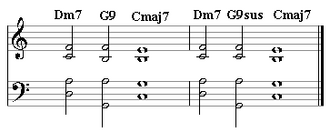
![Fourths in Herbie Hancock's Maiden Voyage[citation needed]](/images/69/0b/690b0fa6c47fa61bb9ad5fbbf79522f7cd5f6a743b7e288c5b9f25ddaa902045.png)
Frequently Asked Questions
Is a perfect fourth a consonance or a dissonance?
It depends on the context. Acoustically, it is a sensory consonance due to its simple frequency ratio. However, in common practice harmony, it is treated as a stylistic dissonance when it occurs above the bass in a chord of three or more notes, requiring resolution.
What is a suspended fourth?
A suspended fourth (or "sus4" chord) occurs when the fourth of a chord temporarily replaces the third. This creates a tension that typically resolves downward to the third.
How does a perfect fourth differ from an augmented fourth?
A perfect fourth consists of five semitones, while an augmented fourth consists of six semitones. The augmented fourth is much more dissonant and is commonly known as a tritone.
Where can I hear a perfect fourth in popular music?
You can hear it in the opening notes of the "Bridal Chorus" (Wagner) or the first two notes of "Hark! The Herald Angels Sing." In jazz, it is a staple of the "modern" sound found in the voicings of artists like Herbie Hancock.