Musical Notes: The Fundamentals of Pitch, Duration, and Notation
In the world of music, notes are the most basic building blocks. They are distinct, isolatable sounds that allow musicians to perform, comprehend, and analyze compositions. While we often think of a note as a single sound, it actually conveys several layers of information: the pitch (how high or low), the duration (how long it lasts), and the dynamics (how loud it is). For unpitched percussion, notes distinguish between different instruments or striking methods rather than frequency.
Notes can be communicated visually through musical notation, allowing a composer's intent to be preserved across time and geography. Whether referring to a specific musical event—such as the first two identical notes of "Happy Birthday to You"—or a general class of identically sounding events, the note is the primary unit of musical language.
Key Facts
- Pitch Class: A group of notes that sound the same but may exist in different octaves.
- Middle C: A standard reference point with a frequency of 261.626 Hz.
- A440: The modern tuning standard where the A above middle C is exactly 440 Hz.
- Semitone: The smallest interval in Western music (a half step), with a frequency ratio of approximately 1.0595.
- Chromatic Scale: A 12-note scale consisting of all available pitches in an octave.
Distinguishing Duration
A note's value indicates its duration relative to the musical meter. As the value changes, the duration is typically halved at each step. Different regions use different terminology to describe these values.
| American Name | British Name |
|---|---|
| Double note | Breve |
| Whole note | Semibreve |
| Half note | Minim |
| Quarter note | Crotchet |
| Eighth note | Quaver |
| Sixteenth note | Semiquaver |
| Thirty-second note | Demisemiquaver |
| Sixty-fourth note | Hemidemisemiquaver |
Distinguishing Pitch
In English, Dutch, and German traditions, pitch classes are typically represented by the first seven letters of the Latin alphabet: A, B, C, D, E, F, and G. These correspond to the A minor scale. Other cultures use different systems, such as the svaras (Sa, Re, Ga, Ma, Pa, Dha, Ni) in traditional Indian music or the Byzantine system (Pa–Vu–Ga–Di–Ke–Zo–Ni).

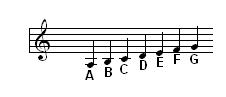
Accidentals and the Chromatic Scale
Notes belonging to the primary scale of a piece are called diatonic notes. Those outside this scale are chromatic notes, modified by symbols called accidentals:
- Sharp (♯): Raises a note by one semitone (half step).
- Flat (♭): Lowers a note by one semitone.
- Natural (♮): Cancels previous accidentals.
- Double-sharp/Double-flat: Raises or lowers a pitch by two semitones.
A key signature provides a systematic set of alterations for all occurrences of specific pitch classes within a piece. When assuming enharmonicity—the idea that two different names can represent the same pitch (e.g., B♯ and C)—the 12-tone chromatic scale is formed by adding five accidentals to the seven natural letters.
Octaves and Reference Pitches
Two pitches are perceived as very similar if their frequencies are in a ratio that is a power of two. This interval is called an octave. The top note of a scale is the second harmonic of the bottom note, meaning it has double the frequency.
Middle C
Middle C serves as a universal reference point, positioned between the treble and bass staves. It is accessible to most instruments and singers and sits near the center of a standard 88-key piano.

Pitch Notation Systems
To distinguish between the same pitch class in different octaves, musicians use several systems:
- Scientific Pitch Notation: Uses a letter followed by a number (e.g., Middle C is C4).
- Helmholtz Pitch Notation: Uses case (upper/lower) and prime symbols (e.g., Middle C is c′).
- MIDI Standard: Assigns sequential numbers to pitches. MIDI note 0 is C−1, and the standard 440 Hz tuning (A4) is MIDI note 69.

The Physics of Pitch
In the 12-equal temperament system, the frequency of a note is calculated based on its distance from a reference pitch (usually A4 = 440 Hz). Because the human ear perceives pitch logarithmically, the relationship between notes is multiplicative rather than additive. A semitone corresponds to a frequency multiplier of the 12th root of 2 (approximately 1.0595).
For even finer measurements, musicians use cents. One semitone equals 100 cents, meaning an entire octave consists of 1,200 cents.
Frequently Asked Questions
What is the difference between a note and a pitch class?
A pitch class refers to all notes that sound the same regardless of the octave (e.g., all "C"s), while a note refers to a specific musical event with a defined frequency and duration.
Why do some countries use 'H' instead of 'B'?
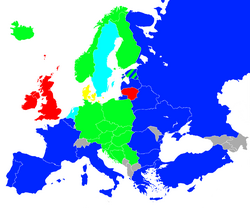
In several European countries, including Germany and Czechia, the Gothic letter 'b' evolved into 'h'. Consequently, H is used for B-natural, and B is used for B-flat.
What is the origin of the 'do-re-mi' system?
This system, known as solfège, was developed by Guido d'Arezzo based on the first syllables of a Gregorian chant melody called Ut queant laxis. The original 'ut' was later changed to 'do' for easier singing.
How does MIDI numbering work?
MIDI assigns a unique integer to every possible pitch. It starts at 0 for C−1 and goes up to 127 for G9, allowing electronic instruments to communicate pitch without needing traditional musical notation.