Johann Faulhaber: The Rechenmeister of Sums and Secrets
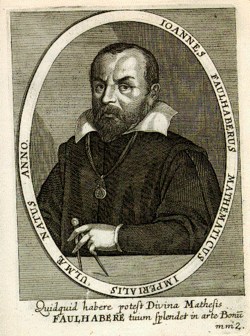
Johann Faulhaber (1580–1635) was a multifaceted German mathematician and Rechenmeister—a traditional term for a professional calculator. Born in Ulm, Faulhaber's life was a unique blend of practical engineering, high-level mathematics, and mystical exploration. From designing military fortifications to calculating the sums of powers, his work bridged the gap between the artisanal skills of his youth and the academic rigor of the early scientific revolution.
Faulhaber began his professional life as a trained weaver before transitioning into the role of a city surveyor in Ulm. His intellectual curiosity led him to collaborate with some of the most prominent minds of his era, including Johannes Kepler and Ludolph van Ceulen. It is also believed that René Descartes corresponded with Faulhaber around 1620 to discuss algebraic solutions for polynomial equations.
Key Facts
- Primary Mathematical Legacy: Developed the standard formula for the sums of powers of integers, now known as Faulhaber's formula.
- Professional Roles: Served as a fortification engineer in Basel and Frankfurt, and worked under Maurice, Prince of Orange.
- Musical Contribution: Credited with the first printed solution for equal temperament (a system of tuning where the octave is divided into twelve equal semitones).
- Scientific Outreach: Published the first German edition of Henry Briggs's Logarithms.
- Mystical Interests: Member of the Rosicrucians with interests in alchemy, astrology, and numerology.
Mathematical and Engineering Contributions
Faulhaber's most enduring contribution to mathematics is his work on the sums of powers of integers. This research was so significant that Jacob Bernoulli later referenced Faulhaber in his influential work, Ars Conjectandi. Today, the general formula for these sums is universally recognized as Faulhaber's formula.
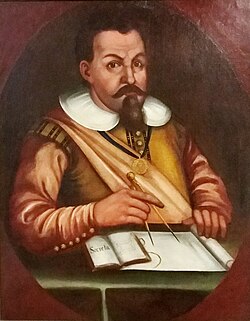
Beyond pure mathematics, Faulhaber applied his knowledge to practical engineering. He designed water wheels in Ulm and created specialized geometrical instruments for military use. His expertise in defense led him to work as a fortification engineer in various cities, most notably in Basel between 1622 and 1624, and later in Frankfurt.
Diverse Technical Works
Faulhaber's bibliography reflects his wide-ranging interests. He wrote on algebra, perspective, and mechanical improvements. In 1617, he published a work improving upon an invention by Albrecht Dürer regarding a perspective table. His later works, such as Academia Algebrae (1631), continued to push the boundaries of algebraic exploration.

Mysticism and the Ulm Comet Dispute
Parallel to his scientific pursuits, Faulhaber was deeply immersed in the occult. As a member of the Rosicrucians, he explored alchemy and numerology. This intersection of science and mysticism became public during the Ulm comet dispute of 1618. The debate centered on whether the comets appearing that year were natural phenomena or divine signs sent by God.
In 1619, Faulhaber published Fama Syderea Nova, a work containing prophecies linked to the Great Comet of 1618 and the onset of the Thirty Years' War. This period of his life highlights the common 17th-century overlap between mathematical precision and spiritual prophecy.
Summary of Faulhaber's Career
| Category | Details |
|---|---|
| Lifespan | May 5, 1580 – September 10, 1635 |
| Key Formula | Faulhaber's formula (sums of powers of integers) |
| Engineering Roles | City Surveyor, Fortification Engineer, Water Wheel Builder |
| Notable Collaborators | Johannes Kepler, Ludolph van Ceulen, René Descartes (correspondence) |
| Mystical Affiliations | Rosicrucians, Alchemist, Astrologer |
Frequently Asked Questions
What is Faulhaber's formula?
Faulhaber's formula is the standard mathematical expression used to calculate the sum of the powers of a sequence of integers.
What was a Rechenmeister?
A Rechenmeister was a professional calculator in the German tradition, specializing in arithmetic and practical mathematical applications.
How did Faulhaber contribute to music?
Faulhaber is credited with providing the first printed solution for equal temperament, which is a method of tuning musical instruments to allow playing in any key.
What was the Ulm comet dispute?
It was a theological and scientific debate regarding whether the comets of 1618 were natural astronomical events or divine omens.
Which famous mathematicians were associated with him?
He collaborated with Johannes Kepler and Ludolph van Ceulen, and likely corresponded with René Descartes regarding polynomial equations.