Johann Christoph Heilbronner and the Origins of Mathematical History
The study of how mathematical thought evolved over time is a discipline we often take for granted today. However, the formalization of this field owes much to the work of Johann Christoph Heilbronner, an 18th-century German scholar who bridged the worlds of theology and mathematics to document the intellectual heritage of humanity.
Born on March 13, 1706, in Ulm, Heilbronner spent his life pursuing academic excellence, eventually passing away in Leipzig on January 17, 1745 (though some records suggest a date around 1747). While he was a theologian by training, his lasting legacy lies in his role as a Mathematikhistoriker (mathematical historian), a role he helped define through his pioneering publications.
Key Facts
- Full Name: Johann Christoph Heilbronner.
- Lifespan: 1706–1745 (or c.1747).
- Nationality: German.
- Professions: Theologian and mathematical historian.
- Major Contribution: Coined and utilized the terms for "mathematical history" in printed literature.
Pioneering the Field of Mathematical History
Before the mid-18th century, the history of mathematics existed primarily as fragmented references within larger scientific texts. Heilbronner changed this trajectory by treating the progression of mathematics as a subject worthy of its own dedicated study. He is credited with being the first to explicitly name and use the phrase "mathematical history" (known in German as Geschichte der Mathematik and in Latin as Historia matheseos).
Major Literary Contributions
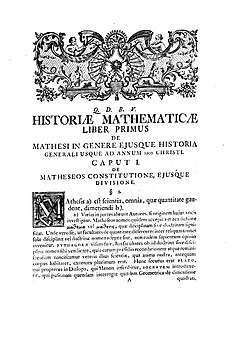
Heilbronner's influence is most evident in two seminal works. In 1739, he published Versuch einer Geschichte der Mathematik and Arithmetik, which served as an early attempt to categorize the development of mathematics and arithmetic.
He followed this in 1742 with his more comprehensive work, Historia matheseos universae a mundo condito ad seculum post Chr. Nat. XVI (also referred to as Historia matheseos universae). This text aimed to provide a universal history of mathematics from the creation of the world up to the 16th century after the birth of Christ.
Summary of Works
| Year | Title | Language | Significance |
|---|---|---|---|
| 1739 | Versuch einer Geschichte der Mathematik and Arithmetik | German | Early use of the term "mathematical history." |
| 1742 | Historia matheseos universae | Latin | Comprehensive universal history of mathematics. |
Frequently Asked Questions
Who was Johann Christoph Heilbronner?
Johann Christoph Heilbronner was a German theologian and mathematical historian born in Ulm in 1706 and active in Leipzig.
Why is Heilbronner important to mathematics?
He is significant because he was the first author to name and use the specific phrase "mathematical history" (Geschichte der Mathematik / Historia matheseos) in his published books.
What were his primary publications?
His primary works include the 1739 Versuch einer Geschichte der Mathematik and Arithmetik and the 1742 Historia matheseos universae.
When did Johann Christoph Heilbronner die?
Records indicate he died on January 17, 1745, although some sources suggest the date may have been around 1747.
What was the scope of Historia matheseos universae?
The work attempted to document the universal history of mathematics from the beginning of the world up to the 16th century AD.