Pedro IEmperor of BrazilPedro IV of PortugalHouse of BraganzaBrazilian Independence

Pedro I: The Liberator and First Emperor of Brazil

Pedro I: The Liberator and First Emperor of Brazil Dom Pedro I remains one of the most pivotal figures in the history of the Lusophone world. Known as the Liberator in Brazil and the Sold...

Pedro I: The Liberator and First Emperor of Brazil

Dom Pedro I remains one of the most pivotal figures in the history of the Lusophone world. Known as the Liberator in Brazil and the Soldier King in Portugal, he holds the unique distinction of founding the Empire of Brazil while also briefly reigning as the King of Portugal. His life was a whirlwind of political upheaval, dynastic struggle, and a relentless pursuit of constitutional governance.

Born into the House of Braganza, Pedro's trajectory was shaped by the Napoleonic Wars and the shifting tides of colonial autonomy. From his early years in the Queluz Palace to his final days in Portugal, his legacy is defined by his decision to break the bonds between Brazil and its mother country, forever altering the map of South America.
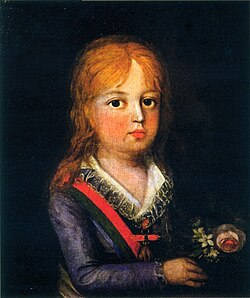
Painting with a half-length portrait of a young child with wavy auburn hair, wearing a blue jacket, open-necked lace-trimmed shirt, and striped sash, and holding a small bouquet of flowers
Pedro around age 2, c.1800, by Agustín Esteve

Key Facts

  • Full Name: Pedro de Alcântara Francisco António João Carlos Xavier de Paula Miguel Rafael Joaquim José Gonzaga Pascoal Cipriano Serafim.
  • Primary Role: Founder and first Emperor of Brazil (1822–1831).
  • Secondary Role: King of Portugal as Pedro IV (1826).
  • Key Achievement: Declared Brazil's independence from Portugal on September 7, 1822.
  • Dynasty: House of Braganza.
  • Death: Passed away at age 35 in Queluz Palace, Portugal.

Early Life and Education

Pedro was born at 8:00 AM on October 12, 1798, at the Queluz Royal Palace near Lisbon. As the fourth child of King John VI of Portugal and Queen Carlota Joaquina of Spain, he was granted the honorific Dom (Lord) from birth. Following the death of his elder brother, Francisco António, in 1801, Pedro became the heir apparent and the Prince of Beira.

His childhood was marked by familial instability; his parents were estranged, living in separate palaces. Pedro and his siblings were largely raised by their grandmother, Queen Maria I, seeing their parents primarily during formal state occasions.
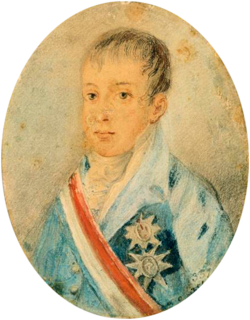
Painting showing the head and shoulders of a boy wearing a high collar and a coat adorned with medals and a striped sash of office
Pedro around age 11, c.1809, by Francesco Bartolozzi

The course of Pedro's life changed drastically in 1807 when French troops invaded Portugal. To preserve the monarchy, the royal family fled to Brazil, Portugal's wealthiest colony. This move effectively shifted the center of the Portuguese Empire to the Americas, providing Pedro with a deep connection to the land he would eventually lead.
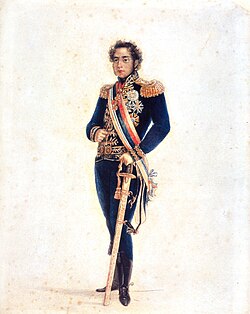
Colored full-length portrait showing a young man with curly hair and long sideburns who is wearing an elaborate gold-embroidered blue military tunic with gold epaulets and medals, blue trousers, black boots, a striped sash of office and gold belt, with his left hand resting on a sheathed sword
Portrait by Jean-Baptiste Debret of Pedro around age 18, c.1816

The Path to Brazilian Independence

By 1821, the Liberal Revolution in Lisbon forced King John VI to return to Portugal. Pedro was left behind to rule Brazil as regent (a person appointed to administer a state because the monarch is absent or incapacitated). While he successfully managed internal rebellions and insubordination among Portuguese troops, tensions rose as the Portuguese government attempted to revoke Brazil's political autonomy.

The crisis peaked when the Portuguese Cortes (parliament) dissolved the government in Rio de Janeiro and ordered Pedro's immediate return. On January 9, 1822, in an event now known as the Dia do Fico ("I am staying" day), Pedro defied the orders of Lisbon after receiving a petition with 8,000 signatures urging him to remain.
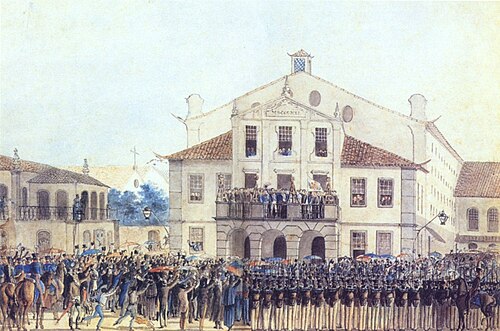
Colored sketch depicting a crowd of civilian and military figures standing and waving before the crowded balcony of a pedimented building with people looking on from its windows
Pedro, in his father's name, makes an oath of obedience to the Portuguese Constitution on 26 February 1821. He can be seen at the middle of the balcony raising his hat. Painting by Félix Taunay, Baron of Taunay.

On September 7, 1822, Pedro officially declared Brazil's independence. He was acclaimed Emperor on October 12, 1822, and by March 1824, he had defeated the remaining Portuguese loyalist armies. He further solidified his control by crushing the Confederation of the Equator, a secessionist movement in Brazil's northeast.
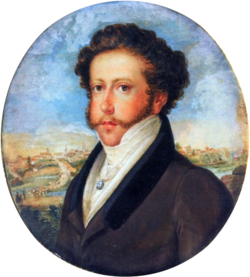
Painted head and shoulders portrait showing a young man with curly hair and mustachios who is wearing a formal black coat, high collar and cravat with a city scene in the distant background
Pedro at age 23 with the town of São Paulo in the background, August 1822 by Simplício Rodrigues de Sá

Reign as Emperor and the Portuguese Succession

As the first Constitutional Emperor, Pedro I navigated a complex political landscape. His reign was characterized by a struggle to balance imperial authority with the demands of a new constitution. However, his attention was frequently divided by the affairs of his homeland.
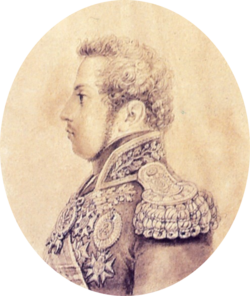
Half-length pencil or silverpoint sketch showing a young man with curly hair and long sideburns facing left who is wearing an elaborate embroidered military tunic with heavy gold epaulets, sash and medals
Profile view of Pedro I at age 25 by Debret, 1823

Upon the death of his father on March 10, 1826, Pedro succeeded him as King Pedro IV of Portugal. Recognizing that a dual monarchy would be rejected by both nations, he abdicated the Portuguese throne on May 2, 1826, in favor of his eldest daughter, Maria II. This abdication was conditional upon Portugal accepting a constitution drafted by Pedro and the marriage of Maria II to his brother, Miguel.
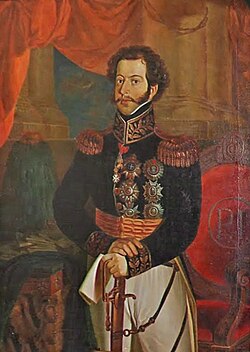
Painted half-length portrait showing a young man with curly hair and mustachios who is wearing an elaborate embroidered military tunic with gold epaulets and medals
Pedro I at age 27 during his trip to Salvador, Bahia province, March 1826, by Antônio Joaquim Franco Velasco [pt]

Despite his abdication, Pedro remained an active figure in Portuguese politics, acting as an absentee king and intervening in diplomatic and internal matters to protect his daughter's interests.
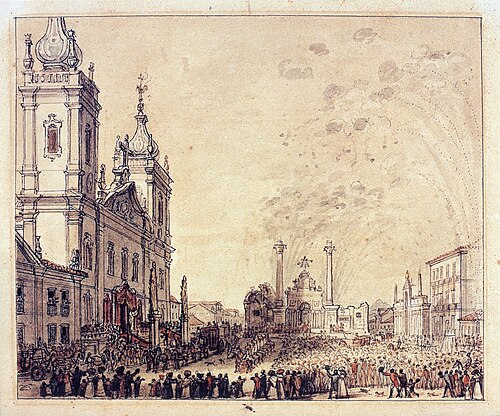
A large crowd of people and mounted horsemen fill a large public square before the steps of a twin-spired baroque church
Celebration in São Francisco de Paula square, Rio de Janeiro city, for the return of Pedro I from Bahia, 4 April 1826 by Debret

Personal Life and Later Years

Pedro's personal life was as turbulent as his political career. He was first married to Maria Leopoldina of Austria in 1817, with whom he had several children, including the future Emperor Pedro II. Following Leopoldina's death in 1826, he married Amélie of Leuchtenberg in 1829.
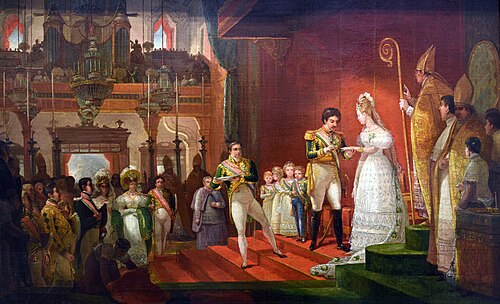
Under a red canopy in a baroque church, a man in uniform places a ring on the finger of a woman in an elaborate white dress, attended by 4 small children, bishops and other onlookers
Marriage of Pedro I to Amélie of Leuchtenberg. Next to him, in order of precedence, are his children with Maria Leopoldina: Pedro, Januária, Paula and Francisca. Painting by Debret.

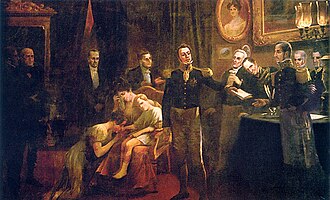
The mounting political pressure in Brazil eventually became untenable. On April 7, 1831, Pedro I delivered his abdication letter, stepping down from the Brazilian throne in favor of his son, Pedro II.
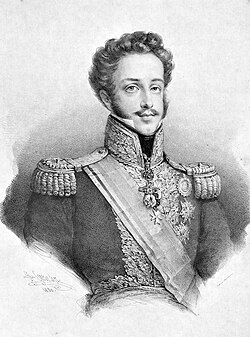
Engraved half-length portrait showing a young man with curly hair who is wearing an elaborate brocade military tunic with epaulets, a striped sash of office and medals
Pedro I at age 32, 1830
A painting showing a crowded room in which a uniformed man hands a sheaf of papers to another uniformed man while in the background a weeping woman sits in an armchair holding a young boy before whom a woman kneels
Pedro I delivers his abdication letter on 7 April 1831, painting by Aurélio de Figueiredo [pt]

Pedro returned to Europe to fight for the rights of his daughter, Maria II, during the Portuguese Civil War. He and his soldiers famously swore not to shave their beards until Maria II was restored to the throne.
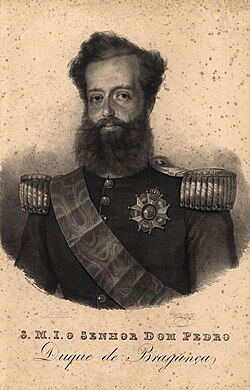
Lithographic half-length portrait depicting a middle-aged man with a full beard and wearing a military tunic with epaulets, sash and large medal
Pedro, Duke of Braganza, at age 35, 1833. After their invasion of Portugal, he and his soldiers swore not to shave their beards until Maria II was restored.[200]

Dom Pedro I died on September 24, 1834, at the age of 35 in the Queluz Palace. His body was eventually moved to the Monument to the Independence of Brazil in 1972, while his heart remains in Porto's Lapa Church.
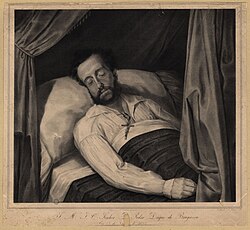
A lithograph depicting a curtained bed on which lies a bearded man with closed eyes and a crucifix lying on his chest
Pedro on his deathbed, 1834

Legacy and Commemoration

Pedro I is remembered as a complex figure who championed constitutionalism in two different hemispheres. His legacy is immortalized through various monuments and official records.
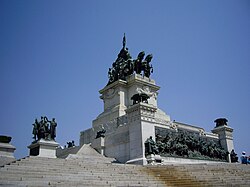
Photograph of a white stone steps leading up to a large, altar-like monument in white marble with bronze sculptural decorations that include bronze braziers at the corners, a bronze frieze in high relief at the base and bronze figures surrounding a chariot on a high, white marble plinth in the center
Monument to the Independence of Brazil where Pedro I and his two wives are buried
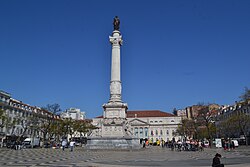
Photograph of a white stone column with a man wearing a laurel wreath and military dress and who holds forth a scrolled sheaf of paper on the top
Column of Pedro IV in Rossio Square, Lisbon, Portugal
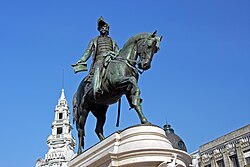
Photograph of a bronze statue with a man on horseback wearing a bicorn hat and military dress and who holds forth a scrolled sheaf of paper
Equestrian statue of Pedro IV in Liberdade Square, Porto, Portugal
 Cursive signed Imperador followed by a script P and 5 dots arranged as a cross
Pedro I's signature in official documents
Cursive monogram or cipher P with flourishes
His signed initials in official documents
Title Country Reign Period Successor
Emperor Pedro I Brazil 1822 – 1831 Pedro II
King Pedro IV Portugal March 1826 – May 1826 Maria II

Frequently Asked Questions

Why is Dom Pedro I called "The Liberator"?

He is called the Liberator because he led Brazil to its independence from Portugal in 1822, ending colonial rule and establishing the Empire of Brazil.

What was the "Dia do Fico"?

The "Dia do Fico" (I am staying day) occurred on January 9, 1822, when Pedro defied the Portuguese government's orders to return to Lisbon, choosing instead to remain in Brazil to support its autonomy.

Did Pedro I rule Portugal and Brazil at the same time?

He briefly succeeded his father as King of Portugal in March 1826 while still Emperor of Brazil, but he abdicated the Portuguese throne in May 1826 to avoid a political union that would have been unacceptable to both populations.

Who succeeded Pedro I as Emperor of Brazil?

He was succeeded by his son, Pedro II, following his abdication on April 7, 1831.

Where is Dom Pedro I buried?

His body is currently interred at the Monument to the Independence of Brazil, although his heart is buried in the Lapa Church in Porto, Portugal.

References

  1. Full name Pedro de Alcântara Francisco António João Carlos Xavier de Paula Miguel Rafael Joaquim José Gonzaga Pascoal Cipriano Serafim.[1][2]
  2. Pedro I became known as "the Liberator" in Brazil for his role in the country's independence.[3] He also became known as "the Liberator" in Portugal, as well as "the Soldier King". Both epithets resulted from his part in the war against his brother, Dom Miguel I.[4]
  3. Of the two eyewitness accounts of 7 September 1822 that mention Prince Dom Pedro's mount, that of Father Belquior Pinheiro de Oliveira on 7 September 1826 and that of Manuel Marcondes de Oliveira e Melo (later Baron of Pindamonhangaba) on 14 April 1862, both say that it was a besta baia (bay beast).[81] In a work published in 1853 and based on an interview with another eyewitness, Colonel Antônio Leite Pereira da Gama Lobo, historian Paulo Antônio do Vale said that it was a zaino (bay horse).[82] The words used, "bay beast" and "bay horse", are at first glance, both similar and confusingly vague. In Portuguese, as in English, a beast is any non-human animal especially a large four-footed mammal. However, formerly in Brazil beast also meant "mare" (a female horse) as may be seen in dictionaries published in 1946[83] and 1968,[84] although this usage has since been discontinued except in Brazil's northeast and northern regions.[85] The use of besta to refer to a mare is still in use in Portugal.[86] Thus, the description of a "bay horse" with non-defined sex and "bay beast (mare)" do in fact coincide. Two of Pedro's biographers, Pedro Calmon[87] and Neill Macaulay[88] have identified his horse as a bay mare. Pedro, who was an outstanding horseman and making an average of 108 kilometres (67 mi) per day, was able to ride this animal from the city of São Paulo back to the capital of Rio de Janeiro in just five days, leaving his guard and his entourage far behind.[89] Francisco Gomes da Silva, "the Buffoon", the second person to arrive, lagged behind the Prince by some eight hours.[90]
  4. Pedro I gave up more than just the crowns of Portugal and Brazil. Less known is that he was also offered the crown of Greece in April 1822 (while he was still prince regent) by the Greek government which was embroiled in a fight for national independence. Pedro I declined, and eventually Otto of Bavaria became King of Greece.[119] Pedro I also declined offers of the Spanish crown made in 1826 and 1829 by liberals who rebelled against the absolutist rule of his uncle, Don Ferdinand VII. The liberals in Portugal and Spain agreed in 1830 to make Pedro I the "Emperor of Iberia". He seems to have declined this offer also, since nothing came of it.[120] Brazilian historian Sérgio Corrêa da Costa and Portuguese historian Antônio Sardinha have argued, however, with little supporting evidence, that one of the inducements which prompted Pedro I to abdicate the Brazilian crown was to dethrone his brother and his uncle and rule the entire Iberian Peninsula as its emperor.[121]
  5. Rumors circulated at the time purporting that Pedro I had kicked Maria Leopoldina in the womb during a heated discussion. The quarrel was witnessed by Domitila de Castro and Wenzel Philipp Leopold, Baron von Mareschal. Then serving Maria Leopoldina's father as the Austrian minister in Brazil and thus inclined to reflect her interests, Mareschal was the sole eyewitness who left an account of what actually happened. According to him, the couple had a bitter argument in which they exchanged insults, but there is no mention of physical violence.[141] Historians Alberto Rangel[142], Pedro Calmon,[143] Octávio Tarquínio de Sousa,[144], Sérgio Corrêa da Costa[145] and Roderick J. Barman[30] have rejected the possibility that Pedro I physically harmed his wife and all affirmed that the altercation was limited to harsh language. A later exhumation confirmed that Maria Leopoldina had died of natural causes.[146] As late as 1831, however, aspersions on Pedro's conduct at the time of his wife's death were still being whispered, serving as a lasting reminder of what people actually believed, regardless of the unfounded nature of the allegations.[144] Barman was categorical when he noted that Maria Leopoldina's death stripped Pedro I of "any remaining aura of sanctity, either at home or abroad".[147]