Understanding Paramecium: The "White Rats" of the Microscopic World
In the hidden world of freshwater ponds and stagnant basins, there exists a genus of single-celled organisms that has captivated scientists for centuries. Paramecium are eukaryotic, unicellular ciliates found in freshwater, brackish, and marine environments. Because they are easy to cultivate and their biological processes are readily observable, they have become essential model organisms in laboratories and classrooms, earning them the nickname "white rats" of the phylum Ciliophora.
Key Facts
- Classification: Eukaryotic, unicellular ciliates belonging to the phylum Ciliophora.
- Habitat: Widespread in freshwater, marine, and brackish environments, especially stagnant water.
- Size: Typically range from 0.06 mm to 0.3 mm in length.
- Locomotion: Use coordinated rows of cilia to spiral through water.
- Nutrition: Primarily heterotrophic, feeding on bacteria, algae, and yeasts.
- Reproduction: Asexual reproduction via binary fission, with genetic recombination through conjugation.
A Brief History of Discovery
Paramecia were among the first microorganisms observed by early microscopists in the late 17th century. While likely known to the pioneer of protozoology, Antonie van Leeuwenhoek, they were clearly described by Christiaan Huygens in 1678. The first anonymous illustration of a species appeared in the Philosophical Transactions of the Royal Society in 1703.
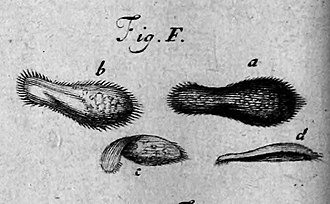
In 1718, Louis Joblot described these organisms as "microscopic poisson" (fish) and dubbed them "Chausson," or "slipper." This led to the colloquial term "slipper animalcule," which remained popular throughout the 18th and 19th centuries.
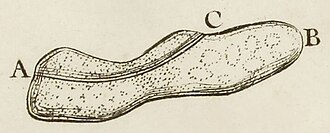
The scientific name "Paramecium"—derived from the Greek paramēkēs, meaning "oblong"—was coined by John Hill in 1752. The name underwent several spelling variations, including Paramæcium by O. F. Müller in 1773 and Paramœcium by Johann Hermann in 1783, before C. G. Ehrenberg restored Hill's original spelling in 1838.
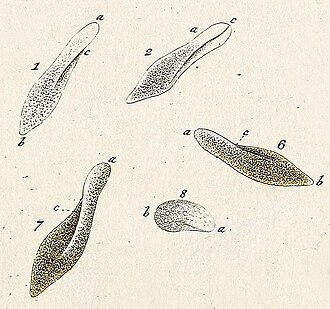
Anatomy and Physical Structure
Paramecia are typically ovoid, cigar-shaped, or foot-shaped. Their body is encased in a pellicle, a stiff yet elastic structure composed of an outer plasma membrane, a layer of membrane-bound sacs called alveoli, and an inner membrane known as the epiplasm. This pellicle is textured with rectangular or hexagonal depressions, each containing a central aperture for a single cilium.
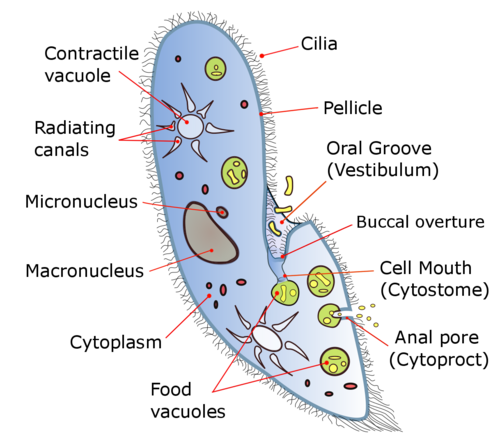
Within the pellicle, most species possess trichocysts. These are spindle-shaped explosive organelles that discharge non-toxic filaments, which the organism often uses for defense. For waste management, an anal pore (cytoproct) is located on the ventral surface in the posterior half of the cell.
To maintain internal balance, Paramecia use contractile vacuoles. These organelles perform osmoregulation by actively expelling excess water that enters the cell via osmosis from the surrounding environment.
Movement and Navigation
Locomotion is achieved through the coordinated beating of cilia arranged in tight rows. Each cilium performs a two-phase movement: a stiff "effective stroke" to propel the cell and a loose "recovery stroke" that sweeps forward counter-clockwise. This creates a wave-like effect across the "ciliary carpet," causing the Paramecium to spiral as it swims.
When a Paramecium hits an obstacle, it performs an avoidance reaction. It reverses the effective stroke of its cilia to swim backward briefly before attempting to move forward again. Interestingly, this method of movement is less than 1% efficient, with the organism spending over half of its energy just to propel itself.
Feeding and Nutrition
Paramecia are primarily heterotrophic, meaning they consume other organisms like bacteria, yeasts, and algae. Some species are mixotrophs, which means they can also derive nutrients from endosymbiotic algae (chlorella) living within their cytoplasm.
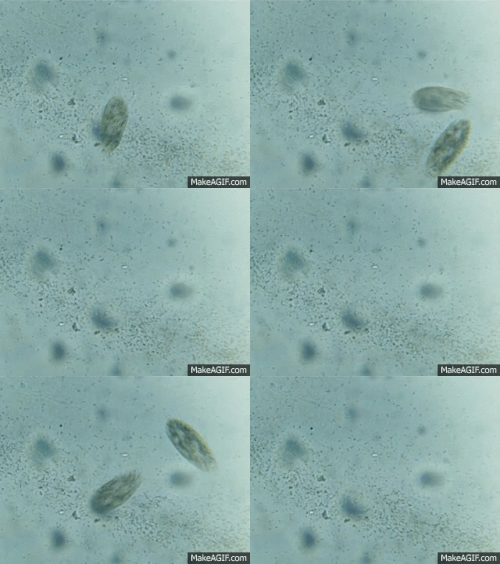
The feeding process follows a specific path:
- Cilia sweep food and water into the oral groove (vestibulum).
- Food moves into the buccal cavity (gullet).
- Particles enter the cell through the cytostome (cell mouth).
- Food is enclosed in food vacuoles, which circulate through the cell via cyclosis (cytoplasmic streaming).
- Enzymes digest the contents, dropping the pH from 7 to 3 within five minutes.
- Waste is expelled through the anal pore.
Symbiosis and Intelligence
Certain species, such as Paramecium bursaria and Paramecium chlorelligerum, maintain mutualistic relationships with green algae. These algae provide nutrients and help protect the Paramecium from predators like Didinium nasutum. Additionally, some carry intracellular bacteria called kappa particles, which enable them to kill other Paramecium strains that lack these particles.
The capacity for learning in these single-celled organisms is a subject of ongoing research. A 2006 study suggested that Paramecium caudatum could be trained to discriminate between brightness levels using a 6.5-volt electric current, hinting at the possibility of epigenetic learning or cell memory in organisms without a nervous system.
Genetics and Reproduction
Paramecia possess a dual nuclear system: a macronucleus (polyploid), which handles daily non-reproductive functions, and one or more micronuclei (diploid), which serve as the germline for genetic inheritance. The genome of Paramecium tetraurelia shows evidence of three whole-genome duplications and a unique genetic code where only UGA serves as a stop codon.
Asexual Reproduction
The primary mode of reproduction is binary fission. During this process, the macronucleus splits via amitosis and the micronuclei undergo mitosis. The cell then divides transversally into two identical daughter cells.
Sexual Recombination: Conjugation
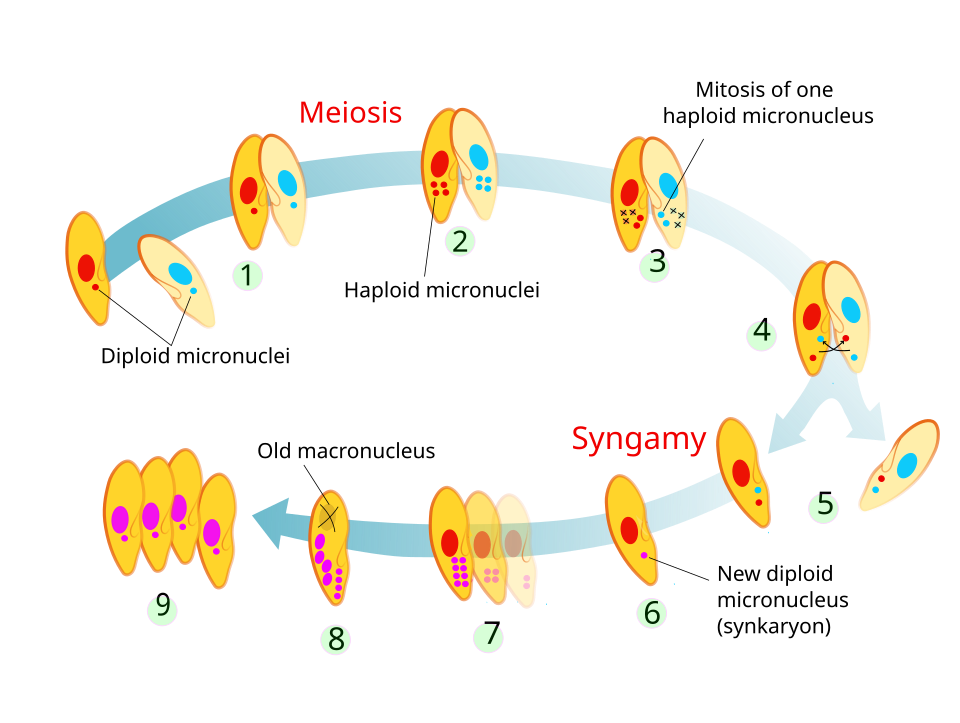
While not increasing the population, conjugation allows for genetic recombination. Two compatible mating types fuse their cytoplasms and exchange haploid micronuclei produced via meiosis. Following the exchange, the old macronuclei disintegrate and new ones are formed from the replicated micronuclear DNA.
Aging and Rejuvenation
In asexual lines, Paramecia experience clonal aging, a gradual loss of vitality. In P. tetraurelia, a line may expire after approximately 200 fissions. Research indicates that this aging is caused by the accumulation of DNA damage within the macronucleus.
However, these organisms can "reset" their biological clock through meiosis, triggered by conjugation or automixis (self-fertilization). This process destroys the damaged macronucleus and creates a new one from the repaired micronuclear DNA, effectively rejuvenating the cell. This process relies on the CtlP protein and the Mre11 nuclease complex to repair double-strand breaks during recombination.
Summary of Paramecium Characteristics
| Feature | Description |
|---|---|
| Body Shape | Ovoid, elongate, or cigar-shaped |
| Outer Layer | Pellicle (plasma membrane, alveoli, epiplasm) |
| Locomotion | Ciliary beating (Effective and Recovery strokes) |
| Feeding Method | Oral groove $\rightarrow$ Buccal cavity $\rightarrow$ Cytostome |
| Nuclear Setup | Macronucleus (somatic) and Micronucleus (germline) |
| Reproduction | Binary fission (asexual) and Conjugation (sexual) |
Frequently Asked Questions
What is a Paramecium?
A Paramecium is a genus of unicellular, eukaryotic ciliates commonly found in freshwater and marine environments. They are widely used as model organisms in biological research due to their ease of cultivation.
How do Paramecia move?
They use thousands of tiny hair-like structures called cilia that beat in coordinated waves. This allows them to spiral through the water and perform an "avoidance reaction" to navigate around obstacles.
What is the difference between the macronucleus and micronucleus?
The macronucleus controls the cell's daily metabolic and non-reproductive functions. The micronucleus contains the genetic material used for reproduction and is passed on to the next generation.
How do Paramecia eat?
They are primarily heterotrophs that use cilia to sweep bacteria and other small organisms into an oral groove. The food is then processed in vacuoles that circulate through the cell via cytoplasmic streaming (cyclosis).
Can a Paramecium "age"?
Yes, they experience clonal aging during asexual reproduction, which is caused by the accumulation of DNA damage in the macronucleus. They can rejuvenate themselves through meiosis during sexual processes like conjugation.
What is the "slipper animalcule"?
This is a historical colloquial name for Paramecium, coined after Louis Joblot described the organism's slipper-like shape in 1718.