Pallets and Skids: The Foundation of Global Logistics
In the world of global trade, the pallet (also known as a skid) is an unsung hero. This flat transport structure supports goods in a stable fashion, allowing them to be lifted and moved efficiently by forklifts, pallet jacks, front loaders, or cranes. By serving as the structural foundation of a unit load—a collection of individual items grouped together for easier handling—pallets have revolutionized how we store and ship products.
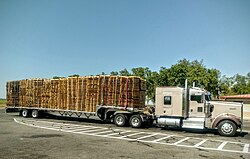
The rise of containerization has further accelerated the adoption of pallets, as the smooth, level surfaces of shipping containers are ideal for their movement. Since their emergence in the twentieth century, pallets have largely replaced traditional wooden boxes and barrels, integrating seamlessly with modern corrugated boxes and intermodal containers. As of 2020, approximately half a billion pallets are manufactured annually, with roughly two billion currently in use across the United States alone.
Key Facts
- Load Capacity: Many standard pallets can handle loads up to 1,000 kg (2,200 lb).
- Materials: While wood is most common, pallets are also made from plastic, metal, paper, and recycled materials.
- Global Scale: The U.S. produces approximately 513 million pallets annually as of 2025.
- Standardization: Organizations using standard dimensions reduce handling costs and increase material movement speed.
- Regulatory Compliance: Wood pallets must often follow ISPM 15 standards to prevent the spread of pests.
The Evolution of the Pallet
The history of the modern pallet is marked by a series of twentieth-century patents. One of the earliest precursors was Howard T. Hallowell's "Lift Truck Platform," patented in 1924. However, pallets became commonplace in the late 1930s with the development of new forklift designs. In 1937, George G. Raymond and William C. House patented a pallet designed specifically for a new pallet jack, creating features that remain industry standards today.
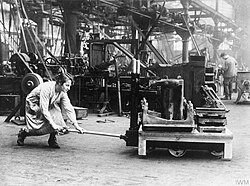
Further innovations followed, including Carl Clark's 1939 patent for steel stringers and Robert Braun's 1945 patent for the four-way pallet. By 1949, Norman Cahners, a U.S. Navy supply officer, introduced the disposable pallet, further increasing the flexibility of military and commercial logistics.
Materials and Manufacturing
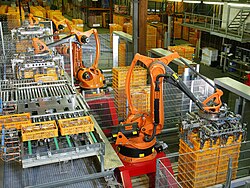
The choice of material depends on the load weight, environment, and disposal requirements.
Wooden Pallets
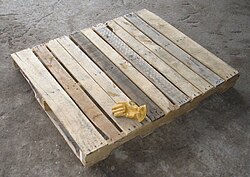
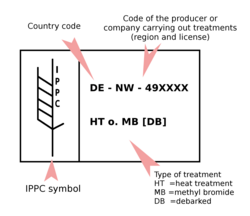
Wood remains the most prevalent material. The manufacturing process involves material selection, cutting, chamfering, notching, and nailing. To meet international shipping standards, wooden pallets undergo specific treatments:
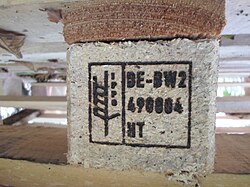
- Heat Treatment (HT): Wood is heated to a minimum core temperature of 56 °C (133 °F) for at least 30 minutes.
- Chemical Fumigation (MB): Treatment with methyl bromide. Note that this method was banned in EU member states starting March 19, 2010, due to its impact on the stratospheric ozone layer.
Plastic and Metal Pallets
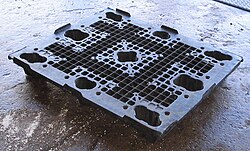
Plastic pallets are manufactured using processes such as high-pressure injection molding, structural foam molding, thermoforming, compression molding, rotational molding, and profile extrusion. They range from lightweight models (3 to 15 lbs) to heavy-duty versions weighing up to 300 lbs.
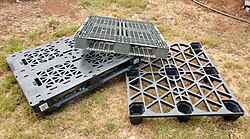
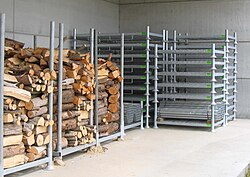
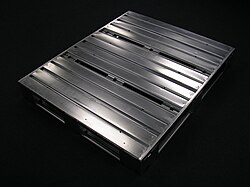
Steel pallets are used for heavy-duty applications and are often fireproof and rust-resistant, particularly when galvanized.
Paper "Ecopallets"
Engineered paper pallets are an eco-friendly alternative used for lighter loads. Some designs consist of just two pieces of corrugated board, weighing as little as 4.5 kg (9.9 lb). These are ISPM 15 exempt, meaning they do not require fumigation, and can be picked up by low-profile pallet trucks as low as 25 mm.
Global Standards and Dimensions
Standardization is critical for efficiency. The International Organization for Standardization (ISO) sanctions six principal dimensions under ISO Standard 6780:2003 to ensure intercontinental compatibility.
| Region/Standard | Dimensions (mm) | Dimensions (in) | Primary Use/Feature |
|---|---|---|---|
| North America (GMA) | 1,016 × 1,219 | 40 × 48 | Grocery and general retail |
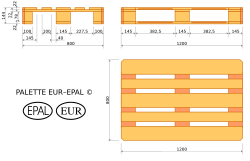
| Europe (EUR 1) | 800 × 1,200 | 31.5 × 47.2 | Standard European logistics |
| Australia | 1,165 × 1,165 | 45.9 × 45.9 | Hardwood; optimized for rail (RACE) |
| Asia | 1,100 × 1,100 | 43.3 × 43.3 | Regional industrial use |
Regional Variations
In North America, the GMA pallet (standardized by the Grocery Manufacturers Association) is the most common. In Europe, the EuroPallet is designed to fit through standard doorways. Australia utilizes a unique square hardwood pallet (1,165 mm) that fits the RACE system used on Australian railways, though it is less compatible with standard ISO shipping containers.
Logistics, Economics, and Safety
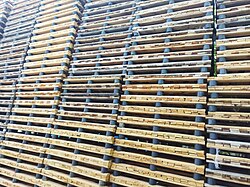
While pallets drive efficiency, they also present economic and safety challenges. Pallet loss is a significant industry issue; for example, in the mid-2000s, Europe reported approximately 14 million missing pallets valued at £140 million.
Safety concerns primarily relate to the chemical treatments used on wood. Inhalation of dust from sanding or sawing treated wood can expose workers to pesticides and fungicides. A notable instance occurred in January 2010, when certain medications were recalled after being stored on pallets treated with 2,4,6-tribromophenol, which produced a musty odor (2,4,6-tribromoanisole) that contaminated the products.
Frequently Asked Questions
What is the difference between a pallet and a skid?
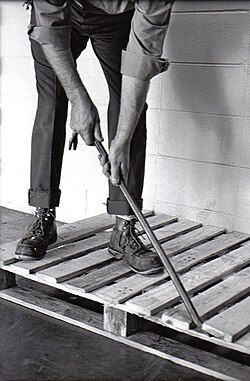
While the terms are often used interchangeably, a pallet typically has a bottom deck, whereas a skid has no bottom boards, making it technically a skid.
What does the "HT" mark on a pallet mean?
The "HT" mark indicates that the wooden pallet has undergone Heat Treatment to kill pests, meeting the requirements of the International Plant Protection Convention (IPPC) and ISPM 15 standards.
Why are some pallets made of plastic instead of wood?
Plastic pallets are often chosen for their durability, ease of cleaning, and consistency in weight. They are also useful in environments where wood is prohibited for hygiene reasons.
Can pallets be repurposed for other uses?
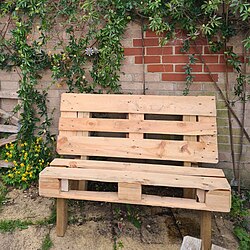
Yes, repurposed pallets are frequently used in DIY projects to create furniture, such as benches or outdoor seating, provided the wood is safe and untreated.