Oxpeckers: The Complex Relationship Between Birds and African Mammals
In the vast savannas of sub-Saharan Africa, a unique sight is common: small, sturdy birds perched atop the backs of massive herbivores. These are oxpeckers, members of the genus Buphagus. Their name, derived from the Ancient Greek words boûs (ox) and phágos (eater), perfectly describes their specialized lifestyle of grazing on the bodies of large mammals.
Once thought to be simple helpers that cleaned animals of pests, oxpeckers are now recognized as fascinating biological anomalies. From their mysterious evolutionary origins to their debated relationship with their hosts, these birds offer a glimpse into the intricate dynamics of African wildlife.
Key Facts
- Species: There are two species: the yellow-billed oxpecker (Buphagus africanus) and the red-billed oxpecker (Buphagus erythrorhynchus).
- Habitat: Endemic to sub-Saharan Africa, primarily in open savanna habitats.
- Diet: They feed on ticks, insects, botfly larvae, earwax, dandruff, and the blood of their hosts.
- Taxonomy: Formerly classified as starlings, they are now in their own family, Buphagidae.
- Behavior: Their relationship with mammals is a mix of mutualism (both benefit) and parasitism (one benefits at the expense of the other).
Taxonomy and Evolutionary History
The genus Buphagus was first introduced in 1760 by French zoologist Mathurin Jacques Brisson. For a long time, these birds were treated as a subfamily of starlings (Sturnidae). However, modern molecular phylogenetic studies—which analyze genetic sequences to determine evolutionary relationships—have revealed that oxpeckers form a separate, ancient lineage.
They are basal to the clades containing both starlings and the Mimidae (mockingbirds and thrashers). Because these related groups likely originated in Eastern or Southeastern Asia, scientists believe oxpeckers may be "living fossils," representing a remnant of an ancient evolutionary path that developed unique adaptations for their specific niche in Africa.
Distribution and Habitat
Oxpeckers are found throughout most open habitats in sub-Saharan Africa, though they avoid rainforests and the driest deserts. Their presence is strictly tied to the availability of their hosts and the specific species of ticks those hosts carry.
In East Africa, the two species are sympatric, meaning they occupy the same geographic area and may even be found on the same individual animal simultaneously.
Feeding Habits and the Mutualism Debate
Oxpeckers are highly selective about their hosts. They frequently perch on cattle, zebras, impalas, hippopotamuses, rhinoceroses, and giraffes. They generally avoid camels and smaller antelope like duikers or reedbuck, preferring animals with higher tick loads, such as the impala.
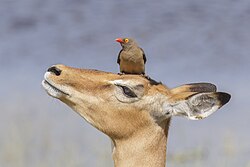
For decades, this relationship was cited as a classic example of mutualism, where the bird gets food and the mammal gets rid of parasites. However, recent research suggests the relationship can be parasitic. While oxpeckers do eat ticks, they often wait until the tick has already fed on the mammal. More concerningly, oxpeckers have been observed opening new wounds or enlarging existing ones to drink the host's blood.
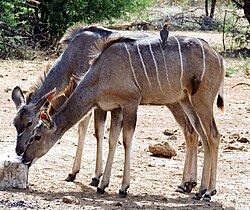
Other behaviors, such as eating earwax and dandruff, also lean toward parasitism. Some animals, including elephants and certain antelope, have been seen actively trying to dislodge the birds, though some elephants do tolerate them for parasite removal.
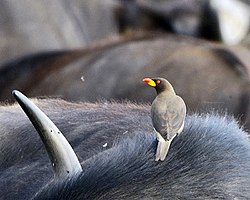
Breeding and Roosting
The breeding cycle of the oxpecker is closely tied to the rainy season, which increases the activity of mammalian hosts and the abundance of ticks. Courtship and mating often take place directly on the backs of their hosts.
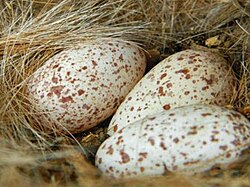
Oxpeckers nest in cavities, typically in trees or walls. Interestingly, they line their nests with grasses and hair plucked from their hosts or nearby livestock. A typical clutch consists of two to three eggs, though red-billed oxpeckers may lay up to five.
When it comes to sleep, red-billed oxpeckers may roost in trees or reeds. However, camera trap studies have revealed a surprising habit: both species, particularly the yellow-billed oxpecker, sometimes roost on the animals themselves, hanging under a giraffe's thighs or resting on the backs of buffalo and impala.
Species Summary
| Common Name | Scientific Name | Primary Range | IUCN Status |
|---|---|---|---|
| Yellow-billed Oxpecker | Buphagus africanus | Most of sub-Saharan Africa | Least Concern (LC) |
| Red-billed Oxpecker | Buphagus erythrorhynchus | Mainly East Africa | Least Concern (LC) |
Frequently Asked Questions
Do oxpeckers actually help the animals they sit on?
While they do eat ticks and other parasites, the benefit to the mammal is debated. Some evidence suggests they may act more as parasites by opening wounds to drink blood rather than significantly reducing the parasite load.
What is the difference between the two oxpecker species?
The primary differences are their bill color (yellow vs. red) and their distribution, with the yellow-billed oxpecker being more widespread across sub-Saharan Africa and the red-billed oxpecker being more common in East Africa.
Why are they called "living fossils"?
They are considered living fossils because they represent an ancient lineage that diverged long ago from the ancestors of starlings and mockingbirds, preserving unique evolutionary adaptations.
Where do oxpeckers build their nests?
They nest in holes, usually found in trees or occasionally in walls, and often use hair from their mammalian hosts to line the nest.
Do all mammals welcome oxpeckers?
No. While many tolerate them, some animals, such as elephants and certain antelope, will actively try to shake the birds off their bodies.