What Exactly is an Organism? Exploring the Boundaries of Life
At first glance, defining an organism seems simple: it is any living thing that functions as an individual. However, for biologists and philosophers, this definition opens a Pandora's box of complexity. What exactly constitutes an "individual"? When does a collection of cells or a group of separate species become a single organism? From the microscopic world of viruses to the complex social structures of ant colonies, the line between a single entity and a collective is surprisingly blurry.
The Origins and Meaning of "Organism"
The word "organism" finds its roots in the Ancient Greek organismos, derived from órganon, meaning an instrument, tool, or organ of sense. It entered the English language in the 1660s, originally referring to an organic structure. By 1790, the philosopher Immanuel Kant expanded this conceptualization, defining an organism as a being that is both "organized and self-organizing."
Key Facts
- Common Criteria: Many scientists define organisms by their ability for autonomous reproduction, growth, and metabolism.
- The Cooperation Theory: Some biologists propose that "organismality" is defined by cooperation without conflict among simpler units.
- The Virus Debate: Viruses are often excluded from the definition of organisms because they lack their own metabolism and cannot reproduce autonomously.
- Biological Diversity: Organisms exist across various levels, from unicellular microorganisms to complex superorganisms.
- Synthetic Life: Modern bio-engineering has created synthetic organisms, including cyborgs and chimaeras, which exhibit goal-seeking (teleonomic) behavior.
Proposed Criteria for Defining an Organism
Because no single definition is universally accepted, several criteria have been proposed to determine if an entity is an organism:
- Autonomous Function: The ability to handle its own reproduction, growth, and metabolism.
- Noncompartmentability: The idea that a structure cannot be divided without losing its functionality. Richard Dawkins described this as being "sufficiently heterogeneous in form to be rendered non-functional if cut in half." However, this is contested by the fact that some organisms can be fragmented and still grow into whole new individuals.
- Individuality: A combination of genetic uniqueness, genetic homogeneity, and autonomy.
- Immune Response: The biological capacity to distinguish "self" from "foreign" entities.
- Anti-entropy: Proposed by Erwin Schrödinger, this is the ability to maintain internal order. Similarly, Claude Shannon's information theory suggests organisms are entities capable of self-maintaining their information content.
![One criterion proposes that an organism cannot be divided without losing functionality.[6] This basil plant cutting is however developing new adventitious roots from a small bit of stem, forming a new plant.](/images/e0/f5/e0f56d761ea44d5cc63b99425b81a025dbe0ce1a2d30b415ce17f86e3aa17d52.jpg)
Levels of Biological Organization
Biological individuality exists on a spectrum. Depending on the level of organization, the nature of the "organism" changes.
Unicellular and Multicellular Organisms
A unicellular organism is a microorganism—such as a bacterium, archaean, or protist—consisting of a single cell that may contain organelles. In contrast, multicellular organisms, including plants, animals, fungi, and algae, are composed of many cells that are often specialized for specific tasks.
Colonial Organisms and Superorganisms
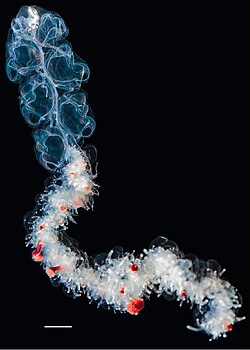
Some entities blur the line between a group and an individual. A colonial organism, such as a siphonophore, consists of communicating individuals (zooids) that collaborate to function as a single animal. A superorganism takes this further; for example, a colony of eusocial insects (like ants) is organized adaptively with "germ-soma specialization," where some individuals reproduce and others do not, mirroring the relationship between cells in a body.
Mutualisms and Partnerships
Some "organisms" are actually partnerships between different species. A mutualism occurs when two or more species provide for each other's needs. A prime example is the lichen, which consists of fungi and algae or cyanobacteria, along with a bacterial microbiome. Together, they can survive in harsh environments, such as dry rocks, where neither could survive alone.
![A lichen consists of a body formed mainly by fungi, with unicellular algae or cyanobacteria (green) interspersed within the structure, and a bacterial microbiome. The species are mutually interdependent, like cells within a multicellular organism.[21]](/images/7b/6b/7b6b436ad2360c953dfff0cc877c089661cc3aaff5a8b6073c91629746c67f47.webp)
| Level | Composition | Example | Defining Characteristic |
|---|---|---|---|
| Unicellular | Single cell | Bacteria | Self-contained single-cell function |
| Multicellular | Many specialized cells | Human, Oak Tree | Cellular specialization and integration |
| Colonial | Communicating individuals | Siphonophore | Individuals functioning as one unit |
| Superorganism | Social colony | Ant colony | Adaptive organization and division of labor |
| Mutualism | Multiple species | Lichen | Interdependent survival partnership |
Boundary Cases: Viruses and the RNA World
The Virus Dilemma
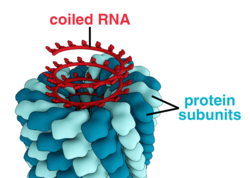
Viruses occupy a contentious space in biology. They possess genetic material and evolve, but they lack autonomous reproduction, growth, metabolism, and homeostasis. Because they rely entirely on a host's cellular machinery to replicate and cannot synthesize their own organic compounds, many scientists view them as similar to inanimate matter. Some argue that viruses do not evolve independently but are "evolved by their host cells" through co-evolution.
The RNA World Hypothesis
To understand how the first organisms emerged, scientists propose the RNA world hypothesis. This suggests that before DNA and proteins, self-replicating RNA molecules existed. These early "organisms" would have initiated Darwinian selection through heritability, variation, and differential reproductive output, relying on the folded configurations of their nucleotide sequences to process resources and resist decay.
The Future: Synthetic Organisms
Modern science is pushing the boundaries of "organismality" through bio-engineering. Researchers are developing various synthetic organisms, including:
- Chimaeras: Entities composed of cells from two or more different species.
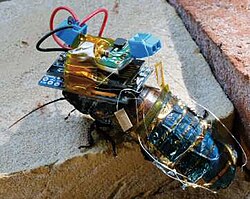
- Cyborgs: Organisms integrated with electromechanical limbs.
- Hybrots: Systems containing both biological and electronic elements.
Unlike evolved organisms, which are shaped by evolutionary developmental biology, synthetic organisms are often designed for teleonomic (goal-seeking) behavior. This allows them to correct errors to achieve a specific designed result, a trait that mimics the embodied cognition and intelligence found in natural organisms.
Frequently Asked Questions
Are viruses considered living organisms?
Most scientists do not classify viruses as organisms because they lack a metabolism of their own and cannot reproduce or grow without a host cell. While they possess genes and evolve, their dependence on host machinery places them in a biological boundary zone.
What is a superorganism?
A superorganism is a colony of individuals—such as ants or naked mole-rats—that works together as a single functional or social unit. They often exhibit a division of labor similar to the specialization of cells in a multicellular body.
What is the "cooperation" theory of organismality?
Proposed by evolutionary biologists David Queller and Joan Strassmann, this theory suggests that an entity becomes an organism when groups of simpler units (like cells) evolve to cooperate without conflict. In this view, cooperation is the defining trait of an organism.
What is the RNA world hypothesis?
The RNA world is a hypothetical stage in early evolution where self-replicating RNA molecules performed the functions of both genetic storage (like DNA) and catalytic activity (like proteins) before the emergence of modern cellular life.
What are synthetic organisms?
Synthetic organisms are engineered entities that combine biological and non-biological components. Examples include chimaeras (multi-species cells), cyborgs (biological-mechanical hybrids), and hybrots (biological-electronic hybrids).