Ovipositors: The Specialized Biological Tools for Egg Laying
In the natural world, the survival of a species often depends on the precise placement of the next generation. Many animals have evolved highly specialized organs to ensure their eggs are deposited in the safest, most nutrient-rich environments possible. One of the most fascinating of these biological tools is the ovipositor—a tube-like organ used primarily by insects to lay eggs.
While the basic purpose is egg deposition, the morphology (the study of the form and structure of organisms) of an ovipositor varies wildly across different species. Depending on the animal's life cycle, an ovipositor might function as a simple attachment tool, a powerful drill, or even a sophisticated piercing weapon.
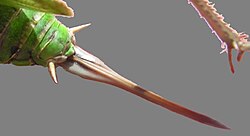
Key Facts
- Primary Function: Used by various animals to prepare a site, transmit, and place eggs.
- Insect Diversity: In insects, ovipositors can consist of up to three pairs of appendages.
- The Oviscape: The visible, non-retractable basal part of some ovipositors is known as the oviscape or scape.
- Evolutionary Shift: In many stinging Hymenoptera (wasps, bees, ants), the ovipositor has evolved into a stinger used for defense or paralyzing prey.
- Beyond Insects: Ovipositors are also found in certain fish species and amphibians.
Ovipositors in the Insect World
Insects exhibit the most diverse range of ovipositor adaptations. For many, the organ is used to attach eggs to a surface, but for parasitic species, it becomes a complex tool for penetrating hosts or substrates.
Drilling and Piercing Mechanisms
Some insects use their ovipositors to physically alter their environment. Grasshoppers use them to force burrows into the earth, while cicadas use them to pierce the wood of twigs. Similarly, sawflies and certain long-horned grasshoppers use the organ to slit plant tissues.
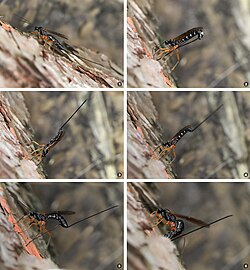
The Megarhyssa genus of ichneumon wasps takes this to an extreme. These wasps possess a slender organ called a terebra that can reach several inches in length. They use this to drill through tree trunks to reach the larvae of horntail wasps, depositing their eggs directly into the host's body.
Parasitism and the Evolution of the Stinger
In the order Hymenoptera, there is a fascinating evolutionary distinction between egg-laying and defense. In the group known as Aculeata (which includes bees, wasps, ants, and hornets), the ovipositor has been highly modified into a stinger equipped with venom glands. These are used to paralyze prey or for defense, meaning the organ is no longer used for egg-laying in most of these species.
However, some exceptions exist. In the family Chrysididae, such as Chrysis ignita, the stinging apparatus is reduced, and a functional ovipositor remains. Additionally, some wasps use venom to suppress a host's immune system, preventing the host from destroying the newly deposited eggs.
Morphological Variations in Flies and Other Insects
In the Diptera (fly) family, morphology is closely tied to life history. Members of the Tephritidae and Pyrgotidae families have well-developed ovipositors that partially retract, leaving the oviscape exposed. In contrast, the Oestridae family often features much shorter, hairy ovipositors.
Even in wingless insects (Apterygota), the ovipositor serves specialized roles, such as gathering the spermatophore during mating.
Ovipositors in Fish and Amphibians
The use of specialized egg-laying organs is not limited to the insect class. In the aquatic realm, different strategies have emerged to protect offspring.
Aquatic Adaptations
Fish in the genus Rhodeus (bitterlings) possess a tubular extension of the genital orifice used to deposit eggs inside the mantle cavity of freshwater mussels. This provides the developing eggs with a secure environment. Seahorses also utilize an ovipositor to transfer eggs into the male's brood pouch, where he carries them until they are ready to be released.
Amphibians like the marbled newt (Triturus marmoratus) demonstrate high levels of parental investment. Females wrap their eggs in aquatic leaves to protect them from predators. This process requires the female to hold her breath, a physiological cost that is outweighed by the increased survival rate of the eggs.
Summary of Ovipositor Functions
| Animal Group | Example Species/Genus | Primary Function |
|---|---|---|
| Ichneumon Wasps | Megarhyssa | Drilling into wood to reach hosts |
| Aculeata | Bees, Ants, Hornets | Defense and prey paralysis (as stingers) |
| Grasshoppers | Various | Creating burrows in soil |
| Bitterlings | Rhodeus | Depositing eggs in mussel cavities |
| Seahorses | Various | Transferring eggs to male brood pouch |
Frequently Asked Questions
What is the difference between an ovipositor and a stinger?
An ovipositor is primarily an organ for laying eggs. In many stinging insects like bees and ants, the ovipositor has evolved into a stinger used for defense or paralyzing prey, often losing its primary egg-laying function in the process.
What is an oviscape?
The oviscape, also called a scape, is the basal part of an ovipositor that remains visible when the organ is partially retracted.
How do parasitic wasps use their ovipositors?
Parasitic wasps, such as those in the genus Megarhyssa, use long, specialized ovipositors to drill through substrates like wood to deposit eggs directly into or near a host larva.
Do all insects have ovipositors?
While many insects use ovipositors for various tasks like drilling, piercing, or attaching eggs, the structure and presence of the organ vary significantly depending on the species and its evolutionary adaptations.
How do seahorses use an ovipositor?
Female seahorses use an ovipositor to introduce their eggs into the specialized brood pouch of the male seahorse.