Bombyliidae: The Fascinating World of Bee Flies
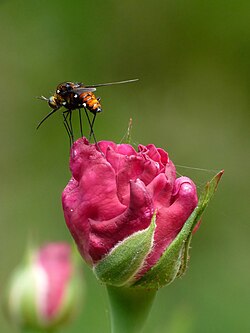
The Bombyliidae, commonly known as bee flies (and occasionally bomber flies), are a diverse family of insects within the order Diptera. These striking flies are often mistaken for bees due to their fuzzy appearance, a form of mimicry that helps them navigate their environments. While adults are frequently seen as gentle pollinators, their larvae lead a much more predatory existence as parasitoids of other insects.
Despite their diversity, bee flies remain one of the most poorly understood insect families relative to their species richness. This is largely because they are less likely to visit urban gardens or public parks compared to other major pollinators, making them elusive subjects for casual observation.
Key Facts
- Species Count: Approximately 4,500 to 4,700 described species across 270 genera.
- Diet: Adults feed on nectar and pollen; larvae are parasitoids.
- Ancient Origins: Fossil records date back to the Middle Cretaceous (approximately 99 million years ago).
- Ecological Role: Many species serve as important pollinators.
- Classification: Belong to the superfamily Asiloidea.
Morphology and Physical Characteristics
Adult Anatomy
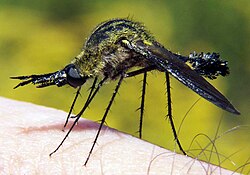
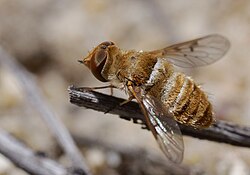
Adult bee flies are characterized by their distinct wing venation and often hairy bodies. Their wing structure is simplified compared to other lower Brachycera (short-horned flies). Key features include a costa that spans the entire margin and a long subcosta. The radius is typically divided into four branches, with the R2 and R3 branches fused.
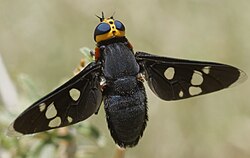
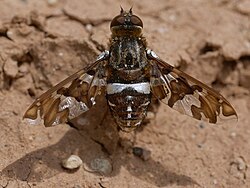
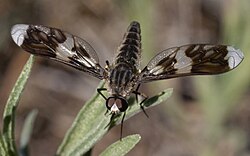
Depending on the species, their appearance can vary wildly. Some possess silvery mirror stripes formed by specialized reflecting scales, while others exhibit slender abdomens and white wing patches, which are less common traits within the family.
Larval Stage
While the adults are nectar-feeders, the larvae are parasitoids—organisms that spend a significant portion of their life cycle attached to or within a single host organism, eventually killing it. This biological strategy is a cornerstone of the Bombyliidae life cycle.
Biology and Behavior
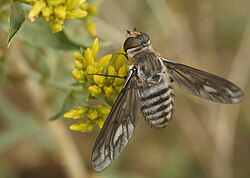
Pollination and Feeding
Adults are primarily nectarivores, using their proboscis to feed on flowers. This behavior makes them valuable pollinators in various ecosystems, from the dry washes of California to the grassy borders of Argentina.
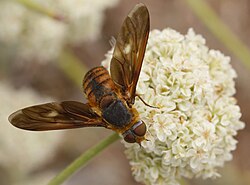
Mating and Reproduction
Reproductive behaviors vary across the family. Some species exhibit patrolling behavior, where males guard specific patches of vegetation to attract mates. Others engage in complex mating rituals to ensure the survival of the next generation.
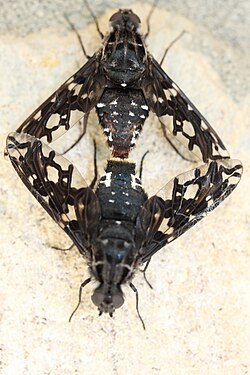
Systematics and Classification
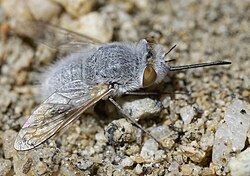
The classification of bee flies is among the most uncertain of the lower Brachycera. Historically, they have been shifted between different superfamilies, such as Nemestrinoidea and Bombyliidea, but are currently positioned within the Asiloidea.
Modern phylogenetic analysis using CAD and 28S rDNA gene sequences suggests that the family may be polyphyletic (meaning they do not all share a single common ancestor). Out of fifteen studied subfamilies, only eight have been confirmed as monophyletic, with the Bombyliinae group showing significant polyphyly.
Taxonomic Summary
| Category | Details |
|---|---|
| Kingdom | Animalia |
| Phylum | Arthropoda |
| Class | Insecta |
| Order | Diptera |
| Superfamily | Asiloidea |
| Temporal Range | Cenomanian–Recent |
Diverse Genera and Global Distribution
Bee flies are found worldwide, with significant populations in the Nearctic, Palaearctic, and Australasian realms. The family is divided into numerous subfamilies, including Anthracinae, Bombyliinae, and Usiinae.
Notable genera include Bombylius, Anthrax, and Exoprosopa. Some species, like Lepidanthrax, are known for having proportionally shorter wings and larger heads, while others, such as Macrocondyla, display more slender body forms.
Frequently Asked Questions
What do bee flies eat?
Adult bee flies feed on nectar and pollen from flowers, while their larvae are parasitoids that feed on other insects.
Are bee flies dangerous to humans?
No, adult bee flies are primarily interested in nectar and do not pose a threat to humans.
How old is the bee fly lineage?
The oldest known species date back to the Middle Cretaceous period, approximately 99 million years ago, as evidenced by Burmese amber fossils.
Why are they called bee flies?
They are called bee flies because their physical appearance—specifically their hairy bodies—mimics that of bees.
How many species of bee flies exist?
There are approximately 4,500 to 4,700 described species distributed among 270 genera.