Otto Stern: Pioneer of Experimental Atomic Physics
Otto Stern was a towering figure in 20th-century science, a German-American experimental physicist whose work laid the groundwork for our modern understanding of atomic structure. Best known for his precision and ingenuity, Stern provided the empirical evidence necessary to validate some of the most complex theories of quantum mechanics.
His career was marked by an extraordinary level of peer recognition; he is the second most nominated person for a Nobel Prize in history, receiving 82 nominations between 1925 and 1945. This persistence in excellence culminated in the 1943 Nobel Prize in Physics.
Key Facts
- Nobel Prize: Awarded in 1943 for the molecular ray method and the discovery of the proton's magnetic moment.
- Major Experiment: Co-conducted the Stern–Gerlach experiment, which demonstrated spin quantization.
- Academic Reach: Held positions at universities in Frankfurt, Rostock, Hamburg, and the Carnegie Institute of Technology.
- Legacy: Developed the molecular beam method, a precursor to modern molecular beam epitaxy.
Early Life and Academic Journey
Born on February 17, 1888, in Sohrau (now Żory, Poland) to a Jewish family, Stern moved to Breslau (now Wrocław, Poland) as a child. His academic path took him through several prestigious institutions, including the universities of Freiburg im Breisgau, Munich, and Breslau.
In 1912, Stern earned his Ph.D. in Physical Chemistry from the University of Breslau. His doctoral thesis focused on the kinetic theory of osmotic pressure in concentrated solutions. Following his graduation, he worked alongside Albert Einstein at Charles University in Prague and later at ETH Zurich, where he served as a Privatdozent (a lecturer who is not yet a full professor) in Physical Chemistry.
Stern's career progressed through several German institutions, including the University of Frankfurt am Main and the University of Rostock, eventually leading to his appointment as Professor of Physical Chemistry and laboratory director at the University of Hamburg in 1923.
Scientific Breakthroughs and the Molecular Beam
Stern's most enduring contribution to physics began in February 1922. Working with Walther Gerlach at the Physikalischer Verein in Frankfurt am Main, he conducted the Stern–Gerlach experiment. This landmark study provided evidence for spin quantization, showing that the angular momentum of an atom is quantized rather than continuous.
Throughout his career, often collaborating with Immanuel Estermann, Stern pushed the boundaries of experimental physics. He demonstrated the wave nature of atoms and molecules and measured atomic magnetic moments. Most notably, he developed the molecular beam method—a technique used to study the properties of atoms and molecules in a vacuum—which is still utilized today in the form of molecular beam epitaxy.
His discovery of the magnetic moment of the proton further solidified his status as a leader in the field, directly leading to his Nobel Prize recognition in 1943.
Migration and Later Years
The political climate of 1930s Germany forced a drastic change in Stern's life. Following the Machtergreifung (the Nazi seizure of power) in 1933, Stern resigned from the University of Hamburg. He sought refuge in the United States, where he became a Professor of Physics at the Carnegie Institute of Technology in Pittsburgh.
Stern had previously established strong ties with the American scientific community, having received an LL.D. from the University of California, Berkeley, and maintaining a close friendship with chemistry dean Gilbert Lewis.
After retiring from the Carnegie Institute of Technology in 1945, Stern moved to Berkeley, California. He remained active in the scientific community as a regular visitor to the UC Berkeley physics colloquium until his death from a heart attack on August 17, 1969, at the age of 81.
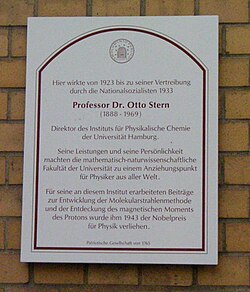
Summary of Otto Stern's Career
| Category | Details |
|---|---|
| Born/Died | 17 Feb 1888 (Sohrau) – 17 Aug 1969 (Berkeley) |
| Education | Ph.D. University of Breslau (1912) |
| Key Discovery | Proton magnetic moment & Spin quantization |
| Major Award | Nobel Prize in Physics (1943) |
| Key Institutions | University of Hamburg, Carnegie Institute of Technology, UC Berkeley |
Frequently Asked Questions
What was the significance of the Stern–Gerlach experiment?
The Stern–Gerlach experiment was crucial because it demonstrated that the magnetic moment of atoms is quantized, providing direct experimental evidence for the concept of electron spin.
Why did Otto Stern move to the United States?
Stern resigned from his position at the University of Hamburg in 1933 due to the Nazi seizure of power in Germany, eventually finding refuge and employment at the Carnegie Institute of Technology.
What is the molecular beam method?
The molecular beam method is an experimental technique developed by Stern to study the properties of atoms and molecules by passing a beam of them through a vacuum, which allows for precise measurements of their interactions and magnetic moments.
How many Nobel Prize nominations did Otto Stern receive?
Otto Stern is the second most nominated person for a Nobel Prize, with a total of 82 nominations between the years 1925 and 1945.
Who was Lieselotte Templeton?
Lieselotte Templeton was a crystallographer and the niece of Otto Stern.