Otis Kerner: A Legacy of Legal Reform and Illinois Governance
Otis Kerner was a pivotal figure in mid-20th century American law and politics, serving in high-ranking judicial and executive roles. From his early days as a federal prosecutor to his tenure as the Governor of Illinois, Kerner focused on systemic reform, economic modernization, and the complex social challenges of the 1960s.
Early Legal Career and Judicial Service
Kerner began his ascent in the legal field in 1947 when he was appointed as the United States Attorney for the Northern District of Illinois. He held this position until 1954, during which time he gained notoriety for prosecuting the famous automobile executive Preston Tucker for fraud, although Tucker was ultimately acquitted. Following this, Kerner transitioned to the bench, serving as a judge in the Illinois Circuit Court of Cook County from 1954 to 1961.
Throughout both his time as a prosecutor and a judge, Kerner was a consistent advocate for the reform of adoption laws and procedures, seeking to improve the legal framework surrounding family stability.
The Governorship of Illinois
In 1960, Kerner entered the gubernatorial race and defeated the incumbent, William G. Stratton, by a significant margin of over 500,000 votes. He secured a second term in 1964 by defeating moderate Republican Charles H. Percy. His administration was characterized by a broad commitment to education, mental health services, and ensuring equal access to housing and employment.
One of Kerner's most enduring achievements in economic development was securing the contract to build the Fermi National Accelerator Laboratory, a major scientific facility that brought prestige and investment to the state.
Expanding Global Trade
Kerner believed that job creation was best achieved through the improvement of international trade. In a 1965 article titled "Illinois Opens the Export Doors," he outlined a vision for full employment through export trade, identifying a potential for 250,000 new jobs. To realize this, he established the Illinois Committee for Trade Expansion.
His efforts yielded tangible results: a 1963 mission to Europe generated an additional $5 million for Illinois agriculturists. Kerner also recognized the strategic importance of Asia, particularly Japan, which was the state's largest trading partner at the time with $145 million in annual trade. He funded the Illinois Far Eastern Movement to strengthen these corporate ties. This relationship was highlighted in 1967 when Japanese Prime Minister Eisaku Sato praised Illinois for its continued trade partnership.
National Leadership and Civil Rights
Beyond the borders of Illinois, Kerner's expertise in welfare and mental health programs gained national attention, eventually serving as a model for federal health reform. He held leadership roles in the National Governors' Conference Executive Committee (1967–1968) and chaired the Midwestern Governors' Conference in 1968.
In July 1967, President Lyndon B. Johnson appointed Kerner as the chairman of the National Advisory Commission on Civil Disorders. In this capacity, Kerner became a critical voice for systemic change. He urged President Johnson to address the severe underrepresentation of Black officers in the U.S. military, noting that they comprised only 1.15% of the Army and 0.6% of the Air Force.
Kerner also pressed Attorney General Ramsey Clark and FCC Chairman Rosel H. Hyde for better police radio equipment and improved riot training. He emphasized that the lessons learned from civil unrest should be used to promote law and order across the nation by addressing the root causes identified by the commission.
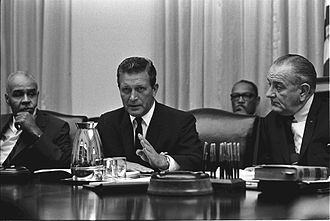
Kerner chose not to run for a third term as governor and resigned on May 20, 1968, to accept a federal judicial appointment.
Key Facts
- Gubernatorial Victories: Defeated William G. Stratton in 1960 (by 500,000+ votes) and Charles H. Percy in 1964.
- Economic Impact: Secured the Fermi National Accelerator Laboratory and expanded trade with Japan and Europe.
- Trade Figures: Managed a trade relationship with Japan valued at $145 million annually.
- Civil Rights Leadership: Chaired the National Advisory Commission on Civil Disorders under President Lyndon B. Johnson.
- Military Advocacy: Highlighted that Black officers made up only 1.15% of the Army and 0.6% of the Air Force.
| Period | Role/Achievement | Key Focus |
|---|---|---|
| 1947–1954 | U.S. Attorney (Northern District of Illinois) | Prosecution and adoption law reform |
| 1954–1961 | Illinois Circuit Court Judge | Judicial oversight and adoption reform |
| 1961–1968 | Governor of Illinois | Economic development, trade, and mental health |
| 1967–1968 | Chairman, National Advisory Commission on Civil Disorders | Civil rights and national law and order |
Frequently Asked Questions
What was the primary goal of Kerner's trade initiatives?
Kerner's primary goal was job creation. He believed that by improving export trade and expanding international partnerships, Illinois could achieve full employment, potentially putting 250,000 workers to work.
Which major scientific facility was brought to Illinois during Kerner's term?
Governor Kerner successfully won the contract to build the Fermi National Accelerator Laboratory, a significant milestone for the state's economic and scientific development.
What did Kerner advocate for regarding the U.S. military?
Kerner urged President Lyndon B. Johnson to increase the number of Black officers in the U.S. Army and Air Force, citing that their representation was drastically low at 1.15% and 0.6%, respectively.
How did Kerner contribute to national health reform?
Kerner implemented successful advances in mental health programs during his governorship that were so effective they became a model for subsequent national health reform efforts.
Why did Otis Kerner leave the governorship in 1968?
Kerner decided not to run for a third term and resigned on May 20, 1968, in order to accept an appointment to a federal judgeship.