Organization of American States
The Organization of American States (OAS) is the premier regional forum for the nations of the Americas. Guided by the motto "Democracy for peace, security and development," the organization serves as a cornerstone for political dialogue, human rights protection, and economic cooperation across North, Central, and South America, as well as the Caribbean.
Headquartered in Washington, D.C., the OAS operates as a multilateral body where member states collaborate to strengthen democratic institutions and maintain regional stability. Its reach extends across a vast geography, covering over 40 million square kilometers and a population exceeding one billion people.
Key Facts
- Established: April 30, 1948, via the Charter of the Organization of American States.
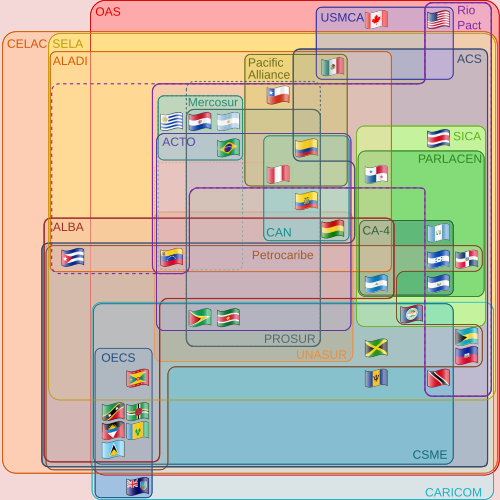
- Membership: 33 member states.
- Official Languages: English, French, Portuguese, and Spanish.
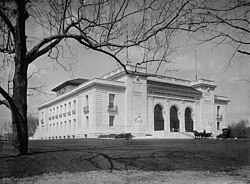
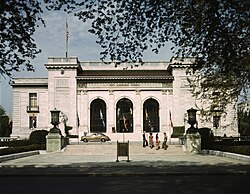
- Headquarters: Washington, D.C., United States.
- Primary Goal: Strengthening democracy, security, and human rights in the Western Hemisphere.
- Current Leadership: Secretary General Albert Ramdin and Assistant Secretary General Laura Gil Savastano.
Historical Evolution
19th Century Foundations
The roots of the OAS date back to the late 19th century. In 1889–1890, 18 nations gathered at the First International Conference of American States in Washington, D.C. This meeting resulted in the creation of the International Union of American Republics and its permanent secretariat, the Commercial Bureau of the American Republics (later renamed the International Commercial Bureau in 1901–1902). These entities provided the foundational framework for regional solidarity.
![The International Union of American Republics' logo in 1909[7]](/images/53/d4/53d431b7af3937be1a15fe9ed3cfe6fd85dbb8507830e8b685ec8ee3608069ba.jpg)
The Birth of the Modern OAS
The contemporary organization was established during the ninth International Conference of American States in Bogotá (March–May 1948). Led by U.S. Secretary of State George Marshall, the conference focused on regional security and a collective pledge to combat communism in the Western Hemisphere. On April 30, 1948, 21 countries signed the Charter of the Organization of American States, which officially took effect in December 1951.
Crucially, this period also saw the adoption of the American Declaration of the Rights and Duties of Man, which stands as the world's first general human rights instrument.
20th and 21st Century Milestones
Throughout its history, the OAS has navigated complex geopolitical shifts. A significant Cold War milestone occurred in 1962 when the organization suspended Cuba, a decision that remained in place until 2009. In more recent years, the organization has faced challenges regarding member state adherence to democratic norms, leading to the suspension of Honduras from 2009 to 2011 following the expulsion of President Manuel Zelaya.
In the 21st century, the organization has seen shifts in membership. Nicaragua initiated its withdrawal process in November 2021 following OAS condemnation of its general elections, officially completing its exit on November 19, 2023.
Organizational Structure and Governance
Administrative Framework
The OAS is organized into several specialized secretariats to manage its diverse mandate:
- Secretariat for Political Affairs
- Executive Secretariat for Integral Development
- Secretariat for Multidimensional Security
- Secretariat for Administration and Finance
- Secretariat for Legal Affairs
- Secretariat for External Relations
Commissions and Specialized Agencies
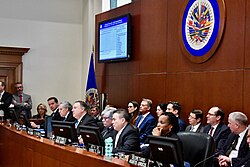
To address specific regional needs, the OAS utilizes various commissions and specialized agencies. Notable commissions include the Inter-American Commission on Human Rights (CIDH) and the Inter-American Commission of Women (CIM). The organization also oversees five specialized agencies:
- Pan American Health Organization (PAHO)
- Inter-American Children's Institute (IIN)
- Inter-American Commission of Women (CIM)
- Pan-American Institute of Geography and History (PAIGH)
- Inter-American Institute for Cooperation on Agriculture (IICA)
Core Goals and Funding
Strengthening Democracy
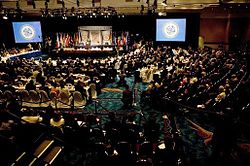
A primary objective of the OAS is the promotion of free and fair elections. Between 1962 and 2002, the organization deployed multinational observation missions on more than 100 occasions. Beyond elections, the OAS works to improve local government efficiency and help member states detect and eliminate official corruption.
Financial Accountability
The OAS is funded through two primary channels: a fund for the General Secretariat and a fund for specific programs. Contributions are based on each member country's capacity to pay. For example, in 2018, the General Secretariat's budget was $85 million, with the United States contributing $50 million.
Membership and Notable Cases
The Case of Canada
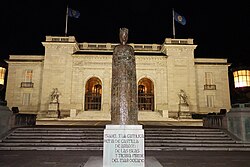
Canada's path to membership was prolonged. Initially, the predecessor Pan American Union was restricted to republics. While the organization expanded its criteria to "American states" in 1936 to accommodate Canada's status as a constitutional monarchy, U.S. opposition—driven by fears of British influence—delayed admission. The U.S. reversed this position in 1947, but Canada only formalized its membership in 1990 after a period of observer status starting in 1972.
Suspensions and Withdrawals
The OAS has used suspension as a tool for upholding its charter. In 1960, the organization unanimously convicted the Dominican Republic for the Rafael Trujillo regime's sponsored attack against Venezuelan President Rómulo Betancourt. More recently, the 2009 suspension of Honduras served as a response to a constitutional crisis.
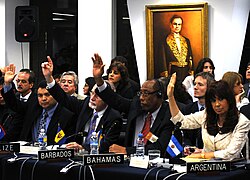
Regarding Cuba, the OAS voted to lift its 1962 suspension in 2009. However, despite the gesture, the Cuban government stated it would not return to the organization.
OAS Summary Profile
| Category | Details |
|---|---|
| Member States | 33 |
| Total Area | 40,275,678 km² |
| Estimated Population (2023) | 1,028,404,247 |
| Official Languages | English, Spanish, French, Portuguese |
| Headquarters | Washington, D.C., USA |
| Key Instrument | Charter of the OAS (1948) |
Frequently Asked Questions
What is the primary purpose of the OAS?
The OAS aims to achieve an order of peace and justice, promote solidarity, and strengthen cooperation among the American states to ensure the security and development of the hemisphere.
How does the OAS support democratic processes?
The organization sends multinational observation missions to oversee elections, helps strengthen electoral agencies, and promotes values that help countries detect and defuse official corruption.
Why did Canada join the OAS so much later than other nations?
Canada's admission was initially blocked by the U.S. due to concerns over British influence. Later, Canada's own foreign policy shifted toward a European focus (Atlanticism), delaying its formal entry until 1990.
What happened to Nicaragua's membership in the OAS?
Nicaragua announced its intention to withdraw in November 2021 following criticism of its general elections. The withdrawal process was completed on November 19, 2023.
Is Cuba currently a member of the OAS?
No. Although the OAS voted to lift Cuba's 1962 suspension in 2009, the Cuban government officially declined to return to the organization.