American Convention on Human Rights
The American Convention on Human Rights (ACHR), widely known as the Pact of San José, is a cornerstone of international human rights law in the Americas. Adopted on November 22, 1969, in San José, Costa Rica, this instrument establishes a legal framework to protect fundamental liberties and promote social justice across the hemisphere within the context of democratic institutions.
The treaty officially entered into force on July 18, 1978, following the ratification by Grenada, which marked the eleventh required instrument of ratification. It is managed by the General Secretariat of the Organization of American States (OAS).
Key Facts
- Adopted: November 22, 1969, in San José, Costa Rica.
- Effective Date: July 18, 1978.
- Overseeing Bodies: The Inter-American Commission on Human Rights (Washington, D.C.) and the Inter-American Court of Human Rights (San José, Costa Rica).
- Core Purpose: To consolidate a system of personal liberty and social justice based on essential human rights.
- Active Parties: 24 member states (as of September 2013).
Structure and Core Provisions
The ACHR is organized into several chapters that define the obligations of member states and the specific rights guaranteed to individuals.
General Obligations and Civil Rights
Chapter I mandates that state parties uphold the rights outlined in the Convention for all persons under their jurisdiction and adapt domestic laws to ensure compliance. Chapter II details 23 articles covering essential civil and political rights, including:
- The right to life, generally protected from the moment of conception.
- The right to humane treatment and a fair trial.
- Freedoms of conscience, assembly, movement, and privacy.
- Prohibitions against propaganda for war and advocacy of national, racial, or religious hatred that incites violence.
Economic, Social, and Cultural Rights
While Chapter III briefly addresses economic, social, and cultural rights, these were later expanded through the Protocol of San Salvador. This additional protocol, opened for signature on November 17, 1988, and effective since November 16, 1999, protects "second-generation rights" such as the rights to work, health, food, and education.
Suspension of Rights and Individual Duties
Chapter IV outlines the strict formalities for temporarily suspending certain rights during states of emergency. However, several non-derogable rights can never be suspended, including the right to life, freedom from slavery, freedom of conscience and religion, and the rights of the child.
Additionally, Chapter V emphasizes that individuals possess responsibilities as well as rights, reflecting the balance found in the earlier American Declaration of the Rights and Duties of Man.
The Inter-American System of Oversight
Compliance with the Convention is monitored by two primary organs of the OAS:
- Inter-American Commission on Human Rights: Based in Washington, D.C.
- Inter-American Court of Human Rights: Headquartered in San José, Costa Rica.
The Inter-American Court employs a pro homine principle—an interpretive approach that favors the most extensive protection of the individual. This evolutive interpretation allows the Court to adapt the Convention's application using other treaties and soft law (non-binding guidelines).
Additional Protocols and Ratification
Beyond the main treaty, two significant protocols have been introduced to strengthen human rights protections:
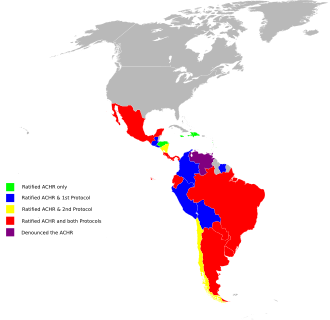
- Protocol of San Salvador: Focuses on economic, social, and cultural rights (ratified by 16 nations).
- Protocol to Abolish the Death Penalty: Adopted on June 8, 1990, in Asunción, Paraguay, this formalizes a state's commitment to refrain from capital punishment in peacetime (ratified by 13 nations).
While 25 of the 35 OAS member states have ratified the Convention, some notable exceptions exist. The United States signed the treaty in 1977 but has not ratified it. Canada has declined ratification primarily due to Article 4.1, which protects life from the moment of conception, creating a conflict with Canadian abortion laws. Canada's opposition to making reservations to human rights treaties has prevented a compromise on this point.
| Feature | Details |
|---|---|
| Primary Treaty | American Convention on Human Rights (1969) |
| 1st Protocol | Protocol of San Salvador (Economic, Social, Cultural Rights) |
| 2nd Protocol | Protocol to Abolish the Death Penalty (1990) |
| Enforcement | Inter-American Commission and Court of Human Rights |
| Key Principle | Pro homine (favoring the individual) |
Denunciation and Withdrawal
Under Article 78, a state may denounce (withdraw from) the Convention after five years of it being in force, provided they give one year's advance notice to the Secretary General of the OAS. Crucially, denunciation does not release a state from obligations regarding human rights violations that occurred before the effective date of withdrawal.
Two notable cases of denunciation include:
- Trinidad and Tobago: Denounced the treaty on May 26, 1998, due to issues regarding the death penalty.
- Venezuela: Denounced the treaty on September 10, 2012, citing government interference. However, the convention was re-ratified in 2019 by Juan Guaidó, leading the Inter-American Court to rule that Venezuela remains bound by the treaty.
Frequently Asked Questions
What is the difference between the ACHR and the Protocol of San Salvador?
The ACHR primarily focuses on civil and political rights (first-generation rights), while the Protocol of San Salvador expands these protections to include economic, social, and cultural rights (second-generation rights), such as health and education.
Can a country suspend human rights during an emergency?
Yes, but only under specific formalities described in Chapter IV. Certain fundamental rights, such as the right to life, freedom from slavery, and the right to a name, can never be suspended regardless of the circumstances.
Why has Canada not ratified the American Convention on Human Rights?
Canada has not ratified the treaty because Article 4.1 protects life from the moment of conception, which conflicts with Canadian law regarding abortion. Canada avoids using reservations to human rights treaties, making ratification difficult.
What happens if a country denounces the Convention?
A country must provide one year's notice. After the withdrawal becomes effective, the state is no longer bound by future obligations, but it remains legally responsible for any human rights violations that occurred prior to the effective date of denunciation.