The Fascinating World of Orchids: A Guide to Diversity and Evolution
Orchids are among the most diverse and visually stunning groups of plants on Earth. As one of the two largest families of flowering plants, the Orchidaceae family boasts approximately 28,000 accepted species spread across roughly 700 genera. This massive variety represents between 6% and 11% of all known seed plant species, making them a cornerstone of global biodiversity.
From the tropical rainforests to temperate woodlands, orchids have evolved extraordinary ways to survive, grow, and reproduce. Whether they are growing on the bark of a tree or nestled in the forest floor, their unique biological structures set them apart from almost any other plant family.
Understanding Orchid Anatomy and Growth
Orchids are perennial herbs, meaning they live for more than two years, and they lack any permanent woody structure. To thrive in various environments, they have developed two primary growth patterns: monopodial and sympodial.
- Monopodial growth: The plant grows from a single bud, adding new leaves at the apex (the tip) each year, causing the stem to grow longer over time. An example of this is the Vanda genus.
- Sympodial growth: Growth occurs at the front of the plant, while older growth remains at the back. These orchids often develop pseudobulbs, which are swollen stem segments used for storage.
Their root systems are equally specialized. Terrestrial orchids, which live in the ground, may use rhizomes or tubers for stability and nutrient storage. In contrast, epiphytic orchids grow upon other surfaces, such as tree branches, using aerial roots. These roots are often covered in velamen, a specialized layer of dead cells that helps the plant absorb moisture and protect itself.
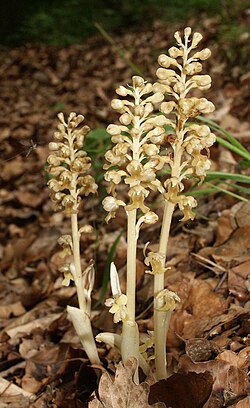
Leaf Arrangement
The way leaves are positioned on an orchid stem can vary. While most species feature leaves arranged in a spiral pattern up the stem, some, such as the Vanda, exhibit distichous arrangement, where leaves grow in two opposite, flat ranks.
The Complexity of Orchid Flowers
Orchid flowers are masterpieces of biological engineering. A typical flower consists of three sepals, three petals, and a three-chambered ovary. While the sepals and two of the petals often look similar, one petal is highly modified into a structure called the labellum, or "lip." This lip serves as a landing platform for pollinators.
In many species, the flower undergoes a process called resupination during development. This involves a 180° twisting motion that ensures the labellum ends up at the bottom of the flower, positioned perfectly to attract insects or act as a trap.
![Orchid reproductive anatomy, illustrated with a Brassia[27]](/images/d6/7c/d67cf42dceb9b260d5b9d8a5158caa24ed35bf5e0229296827158d737256a799.webp)
Reproduction and Pollination Strategies
The reproductive mechanics of orchids are highly specialized. Unlike many other flowers, the stamens (male parts) and the style (female part) are fused into a single, central structure known as the column. This unique feature is central to their pollination process.
Charles Darwin famously investigated these complex mechanisms in his 1862 book, Fertilisation of Orchids. One fascinating example of co-evolution involves neotropical orchid bees. Male bees, such as those in the Euglossa genus, visit certain orchids to collect volatile chemicals. They use these aromatic compounds to synthesize pheromones, which they then use to attract females.
Beyond sexual reproduction, some orchids can reproduce asexually. In genera like Phalaenopsis, Dendrobium, and Vanda, new plantlets called keiki can form from nodes along the stem due to an accumulation of growth hormones. These small offshoots can eventually be separated and planted as individual orchids.
Evolutionary History and the Fossil Record
While the fossil record for orchids is relatively sparse, scientists have gained significant insights through amber discoveries. A Miocene-era fossil of a stingless bee trapped in amber was found carrying the pollen of Meliorchis caribea, providing the first direct evidence of orchid pollination from 15–20 million years ago. Even older specimens, such as Succinathera baltica from the Eocene epoch (40–55 million years ago), have been identified.
!["Orchideae" in Ernst Haeckel's 1899 Kunstformen der Natur[89]](/images/02/fc/02fccb6715ef4fd73eb691051f41214fcc5893f801bb960b544c7a4dddbe3427.jpg)
Genetic sequencing suggests the family may be even older. While some studies place their origin around 76 to 84 million years ago during the Late Cretaceous, other phylogenetic patterns suggest they may date back roughly 100 million years. Despite this ancient lineage, much of the modern diversity we see today likely emerged within the last 5 million years, with the highest rates of new species formation occurring in the American and Asian tropics.
Orchids in Human Culture and Industry
Orchids are highly valued in horticulture. While many tropical species require indoor cultivation in temperate zones, some, like Cypripedium, can thrive outdoors. The global orchid community is supported by numerous societies, such as the American Orchid Society and the Orchid Society of Great Britain, and new hybrids are registered annually through the International Orchid Register.
Beyond their beauty, orchids have significant commercial utility. The most notable is the genus Vanilla. The dried seed pods of Vanilla planifolia are a vital global commodity, used extensively in baking, perfumery, and aromatherapy.
Key Facts
- Species Count: Approximately 28,000 accepted species.
- Etymology: The name comes from the Greek órkhis, referring to the shape of certain species' tubers.
- Growth Types: Includes monopodial (single stem) and sympodial (branching/pseudobulb) patterns.
- Unique Anatomy: Features a fused reproductive structure called a column.
- Commercial Use: Vanilla planifolia is a major source of flavoring and fragrance.
Summary of Orchid Growth Habits
| Growth Habit | Stem Structure | Key Characteristics |
|---|---|---|
| Monopodial | Single stem | Grows from a single bud; leaves added at the apex. |
| Sympodial | Multiple segments | Growth occurs at the front; often features pseudobulbs. |
| Epiphytic | Aerial roots | Grows on supports (like trees); uses velamen for moisture. |
| Terrestrial | Ground-based | Grows in soil; may utilize rhizomes or tubers. |
Frequently Asked Questions
What does the name "orchid" mean?
The name is derived from the Ancient Greek word órkhis, which means "testicle." This refers to the shape of the twin tubers found in some species of the genus Orchis.
What is the difference between monopodial and sympodial orchids?
Monopodial orchids grow upward from a single point or bud, adding leaves at the top of the stem. Sympodial orchids grow horizontally or in segments, with new growth appearing at the front and older growth remaining at the back, often utilizing pseudobulbs for storage.
What is a "keiki"?
In horticulture, a keiki is an asexual plantlet that forms at a node along the stem of certain orchid genera, such as Phalaenopsis. These can be removed and planted as new, independent orchids.
How do orchids attract pollinators?
Orchids use various methods, including visual cues from their highly modified petals (the labellum) and chemical signals. Some species even use scents to attract specific insects, such as male orchid bees that collect aromatic compounds for pheromone production.
What is resupination?
Resupination is the process where an orchid flower twists 180 degrees as it develops. This movement positions the labellum (the lip) at the bottom of the flower, creating a landing platform for pollinators.