Understanding Neofinetia: The History and Taxonomy of a Beloved Orchid Genus
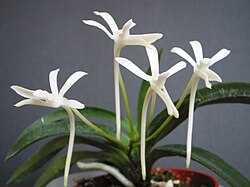
In the world of horticulture, few plants have captured the imagination of enthusiasts quite like the former genus Neofinetia. Belonging to the diverse Orchidaceae (orchid) family, these plants were once celebrated as a distinct group of flowering plants. Today, however, botanical classification has evolved, and Neofinetia is now recognized as a synonym of the genus Vanda.
Despite this taxonomic shift, the legacy of Neofinetia remains significant. Known for their compact size, pleasant scents, and relative hardiness, these orchids became staples in hybridizing programs during the late 20th century, helping to create many of the beautiful vandaceous orchids seen in collections today.
Taxonomic History and Naming
The journey of Neofinetia in Western science began in 1784, when the botanist Carl Peter Thunberg introduced the type species from Japan, originally placing it within the genus Orchis. It wasn't until 1925 that H. H. Hu established Neofinetia as a monotypic genus (a genus containing only one species).
The name itself carries historical weight. It was created to honor Achille Eugène Finet, a French botanist and author of Contributions à la Flore de L'Asie Orientale. To distinguish this group from a previously existing plant genus also named in Finet's honor, the Greek prefix neo, meaning "new," was added.
Species Profiles
While the genus is now folded into Vanda, three specific species were historically categorized under Neofinetia. These plants are primarily distributed across China, Korea, and Japan.
Vanda falcata (formerly Neofinetia falcata)
As the type species, Vanda falcata is the most prominent member of the group. It holds various regional names: fēng lan (风兰) in China, pungnan (풍란) in Korea, and fũran (風蘭) in Japan. Its natural habitat spans several regions, including Honshu (from the Kantō region westward), Shikoku, Kyushu, and the Ryukyu Islands in Japan, as well as various provinces in China.
Vanda richardsiana (formerly Neofinetia richardsiana)
This species closely resembles V. falcata but can be distinguished by its shorter nectar spurs (the tubular part of a flower that holds nectar). In China, it is known as duan ju feng lan (短距风兰) and is found in the Chongqing region.
Vanda xichangensis (formerly Neofinetia xichangensis)
Found in SW Sichuan, China, this species is known locally as xi chang feng lan (西昌风兰). It is worth noting that there is ongoing botanical controversy regarding whether V. xichangensis is a distinct species or simply a large-form variation of V. richardsiana.
Key Facts
- Current Classification: Neofinetia is now considered a synonym of the genus Vanda.
- Geographic Range: Primarily found in China, Korea, and Japan.
- Horticultural Appeal: Valued for their scent, compact size, and ease of culture.
- Etymology: Named after French botanist Achille Eugène Finet.
- Species Count: Historically contained three recognized species.
Intergeneric Hybrids and Obsolete Names
Because Neofinetia was once treated as a separate genus, many hybrid names created during the 20th century are now considered obsolete. In modern botany, these hybrids are reclassified under the Vanda umbrella. For example, the hybrid × Aeridofinetia is now correctly referred to as × Aeridovanda.
These hybrids were highly sought after because Neofinetia provided a hardy, easy-to-grow base for creating complex new varieties. Below is a summary of some historical hybrid classifications.
| Historical Hybrid Name | Parental Genus Combination |
|---|---|
| Aeridofinetia | Neofinetia × Aerides |
| Neograecum | Neofinetia × Angraecum |
| Ascofinetia | Neofinetia × Ascocentrum |
| Phalanetia | Neofinetia × Phalaenopsis |
| Neostylis | Neofinetia × Rhynchostylis |
| Vandofinetia | Neofinetia × Vanda |
| Moonara | Neofinetia × Aerides × Ascocentrum × Rhynchostylis |
| Darwinara | Neofinetia × Ascocentrum × Rhynchostylis × Vanda |
Frequently Asked Questions
Is Neofinetia still a separate genus?
No. In modern botanical taxonomy, Neofinetia is regarded as a synonym of the genus Vanda.
Where can these orchids be found in the wild?
They are native to East Asia, specifically within parts of China, Korea, and Japan.
Why were Neofinetia hybrids so popular?
They were highly valued in horticulture due to their compact size, pleasant fragrance, relative hardiness, and ease of cultivation.
What is the difference between Vanda falcata and Vanda richardsiana?
While they look very similar, Vanda richardsiana is characterized by having shorter nectar spurs than Vanda falcata.
What does the name "Neofinetia" mean?
The name honors botanist Achille Eugène Finet, with the prefix "neo" (meaning new) added to distinguish it from an earlier genus named after him.