Ophelia: The Tragic Figure of Shakespeare's Hamlet
Ophelia is one of the most poignant and enduring characters in William Shakespeare's tragedy Hamlet (1599–1601). A young noblewoman of Denmark, she is the daughter of Polonius, the sister of Laertes, and the romantic interest of Prince Hamlet. Her journey from a dutiful daughter to a woman consumed by madness and grief has made her a central figure in literary study and artistic inspiration for centuries.
Key Facts
- Role: Noblewoman of Denmark and daughter of Polonius.
- Fate: Descends into madness and dies by drowning.
- Etymology: Her name likely derives from the Ancient Greek ōphéleia, meaning "benefit."
- Literary Function: Serves as a foil to Hamlet and Laertes, contrasting their behaviors.
- Historical Link: Her death may have been inspired by the 1569 drowning of Jane Shaxspere.
Origins and Etymology
While the character of Ophelia is an original creation by Shakespeare, she is believed to be inspired by the Amleth legend from Saxo Grammaticus (c. 1200). In that source, Prince Amleth's unnamed foster-sister is offered to him as a temptation while he feigns idiocy.
The name "Ophelia" is not Danish. It first appeared in Jacopo Sannazaro's 1504 poem Arcadia as "Ofelia." Historians have also noted a striking real-world parallel: a 1569 coroner's report describes the accidental drowning of 2.5-year-old Jane Shaxspere in Upton Warren. Jane fell into a water channel while picking corn marigolds; given the spelling variations of the time, she may have been a relative of the playwright.
Character Arc and Plot
Ophelia is defined by her obedience. Throughout the play, she adheres strictly to the wishes of her father, Polonius. When he forbids her from seeing Hamlet, she complies; when he asks her to help spy on the Prince, she agrees. This submission highlights her vulnerability within the patriarchal structure of the Danish court.
Her relationship with Hamlet is fraught with tension. During the "Mousetrap Play," Hamlet treats her with cruelty, making sexually suggestive remarks and claiming that a woman's love is brief. The psychological toll of Hamlet's erratic behavior, combined with the death of her father, eventually leads to her mental collapse.
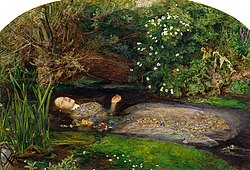
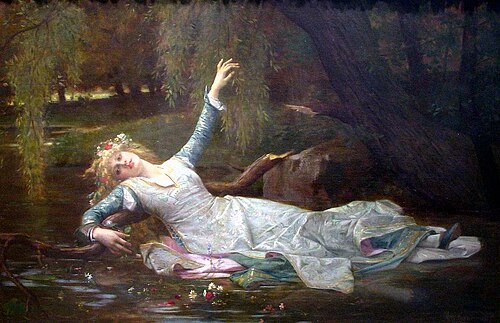
In Act 4, Scene 7, Queen Gertrude delivers a poetic account of Ophelia's death. She describes how Ophelia climbed a willow tree that grew aslant a brook; a branch broke, dropping her into the water, where she drowned, seemingly "incapable of her own distress." While Gertrude describes it as an accident, a sexton later suggests that Ophelia may have taken her own life.
Portrayals in Theatre and Film
The Elizabethan Stage
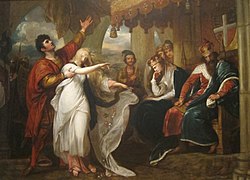
In Shakespeare's time, professional actresses were not permitted on the public stage, meaning Ophelia was originally played by boy players. These actors required musical training, as the role involves singing ballads and playing the lute.
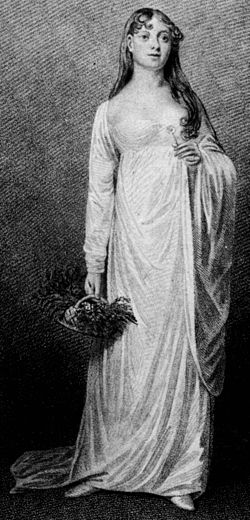
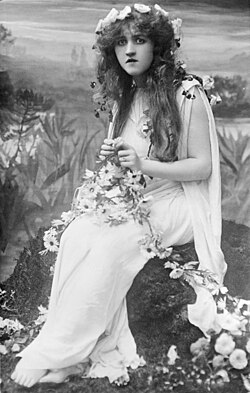
Early modern audiences recognized madness through specific visual cues: dishevelled hair, white clothing, and the carrying of wild flowers. This contrast—Ophelia's "virginal white" against Hamlet's "solemn black"—conveyed gendered associations of the era. While Hamlet's madness was viewed as a male intellectual disease (melancholy), Ophelia's was seen as erotomania, a biological and emotional malady.
Evolution of Performance
By the 18th century, portrayals became more sentimental and decorous. Actresses like Sarah Siddons brought a "classical dignity" to the role. In the 19th century, the character continued to evolve through performers such as Helen Faucit and Peg Woffington.
Modern Screen Adaptations
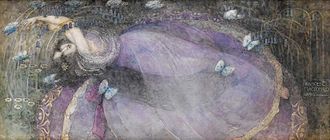
Ophelia has transitioned seamlessly to film, from Dorothy Foster in 1912 to Jean Simmons in 1948, who received an Academy Award nomination for her performance. Modern interpretations often emphasize her tragedy or shift the perspective entirely, as seen in Claire McCarthy's 2018 film Ophelia, which tells the story from her point of view.
Artistic and Cultural Legacy
Ophelia's image—particularly her drowning—has become an icon in art history. Painters such as John Everett Millais and Alexandre Cabanel have captured her final moments, influencing how the character is visualized in cinema today.
Beyond the visual arts, Ophelia appears frequently in music and pop culture. She is mentioned in songs by Bob Dylan, The Lumineers, and Taylor Swift. Her influence even extends to astronomy, with one of the moons of Uranus bearing her name.
Summary of Ophelia's Profile
| Attribute | Detail |
|---|---|
| Nationality | Danish |
| Social Status | Noblewoman |
| Family | Polonius (Father), Laertes (Brother) |
| Key Relationship | Prince Hamlet |
| Defining Trait | Obedience / Fragility |
| Cause of Death | Drowning |
Frequently Asked Questions
Why does Ophelia go mad?
Ophelia's madness is the result of extreme emotional trauma, specifically the erratic and cruel treatment she receives from Prince Hamlet and the devastating loss of her father, Polonius.
Was Ophelia's death an accident or suicide?
The play leaves this ambiguous. Queen Gertrude describes it as an accident caused by a breaking willow branch, but the sexton at the graveyard suggests she may have killed herself.
What is the significance of the flowers Ophelia carries?
In the context of the play and early modern stage conventions, the wild flowers symbolize her fragmented state of mind and, according to some scholars, a symbolic deflowering.
Who played Ophelia in the original Elizabethan productions?
Because women were not allowed to act professionally in Elizabethan England, the role of Ophelia was played by young boys.
What does the name Ophelia mean?
The name is likely derived from the Ancient Greek word ōphéleia, which translates to "benefit."