Opatija History: From Ancient Liburnia to the Austrian Riviera
Nestled along the stunning Adriatic coast, Opatija is a town where imperial elegance meets ancient heritage. Once a quiet collection of hamlets and a Benedictine abbey, it evolved into the premier seaside destination for the European aristocracy. Its journey from a pre-Roman settlement to a modern Croatian gem is a story of strategic geography, railway innovation, and high-society luxury.
Ancient Roots and Medieval Transitions
Long before it became a tourist hub, the territory of Opatija was inhabited by the Liburni, a pre-Roman Illyrian tribe. During the Roman era, the region was characterized by the presence of patrician villas linked to Castrum Laureana, known today as Lovran.
The demographic landscape shifted around 700 AD with the arrival of Croats. The region saw various shifts in power: it was conquered by King Pepin of Italy in 789 and incorporated into the Carolingian March of Friuli by 803. By 925, the nearby medieval Kingdom of Croatia was established by King Tomislav. Later, King Otto of Germany integrated the Istrian lands into the March of Verona and Aquileia, with the Patriarchs of Aquileia managing the Imperial estates from the 11th century onward.
During the Middle Ages, the area was split between Kastav and Veprinac, the latter likely serving as a small fishing port. The village of Opatija itself grew around a Benedictine abbey dedicated to Saint Jacob, first documented in 1453. While the Republic of Venice claimed western Istria by 1420, Opatija remained under the House of Habsburg and eventually became part of the Austrian Littoral.
The Rise of the Austrian Riviera
The transformation of Opatija into a luxury destination began in 1844 when Iginio Scarpa, a wealthy merchant from Rijeka, constructed the Villa Angiolina. This manor and its expansive park became a gathering place for the elite, including Ban Josip Jelačić.
The catalyst for mass tourism arrived in 1873 when the Austrian Southern Railway opened a branch line from Pivka to Rijeka via Matulji. This connectivity allowed the railway company to purchase Villa Angiolina in 1882 to host Crown Prince Rudolf and Stéphanie.
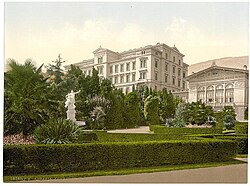
Under the leadership of Friedrich Julius Schüler, the Managing Director of the Southern Railways, the town's infrastructure flourished. Schüler oversaw the construction of the Hotel Quarnero (Kvarner Hotel) and the Hotel Kronprinzessin Stephanie (now the Hotel Imperial). He also commissioned the creation of the town's signature parks and the lungomare (a scenic seaside promenade), utilizing the expertise of park director Carl Schubert.
By 1889, the Cisleithanian government officially designated Opatija as the first Seebad (climatic seaside resort) on the Austrian Riviera, competing with other luxury spots like Brioni, Duino, Grado, and Portorož.
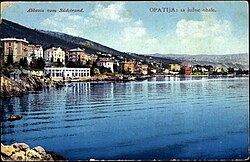
Imperial Guests and Golden Age Glamour
The late 19th and early 20th centuries marked the peak of Opatija's prestige. The town became a winter retreat for Emperor Franz Joseph I, who met German Emperor Wilhelm II there in 1894. The guest list read like a directory of European royalty, including Empress Elisabeth of Austria, King Carol I of Romania, King George I of Greece, and Prince Nikola I Petrović-Njegoš.
Beyond luxury hotels, the town developed specialized amenities. In 1887, the Union Yacht Club Quarnero was established as the first sailing club on the Adriatic coast. By 1908, a tramway connected Matulji station to Lovran via Opatija. The town also gained intellectual fame as the venue for a 1912 chess tournament focused on the King’s Gambit.
Modern Era and Political Shifts
The 20th century brought significant political upheaval. During World War I, the Hotel Icicii served as a military hospital. In 1920, the town was assigned to Italy, and by 1930, Villa Amalia was renovated to serve as the summer residence for the House of Savoy.
Following a 1947 peace treaty, Opatija was transferred to Yugoslavia, leading to the emigration of most Italian speakers. The town entered a new phase of modernization in the 1960s and 80s:
- 1963: Completion of the Hotel Adriatic, the first post-Austro-Hungarian hotel, featuring innovative room designs.
- Casino Rosalia: Opened as the first casino in Eastern Europe.
- 1981: Completion of the Hotel Admiral and a marina featuring 200 berths and 40 dry berths.
Following the breakup of Yugoslavia starting in 1991, Opatija became part of the independent state of Croatia.
Key Facts
- First Seebad: Officially declared the first climatic seaside resort on the Austrian Riviera in 1889.
- Railway Influence: The Austrian Southern Railway was the primary driver of tourism development in the 1870s and 80s.
- Royal Heritage: Hosted numerous monarchs, including the Emperors of Austria and Germany.
- Maritime Firsts: Home to the first sailing club on the Adriatic coast (Union Yacht Club Quarnero, 1887).
- Architectural Legacy: Many 19th-century luxury villas and hotels remain preserved today.
| Period/Year | Key Event/Development | Significance |
|---|---|---|
| Pre-Roman | Liburni Tribe settlement | Earliest known inhabitants |
| 1453 | Benedictine abbey mentioned | Foundation of the small hamlet |
| 1844 | Construction of Villa Angiolina | Beginning of modern luxury era |
| 1873 | Southern Railway branch opens | Enabled mass tourism growth |
| 1889 | Declared a Seebad | Official status as a climatic resort |
| 1920 | Assigned to Italy | Shift in national sovereignty |
| 1947 | Transferred to Yugoslavia | Post-WWII border realignment |
| 1991+ | Part of Croatia | Current political status |
Frequently Asked Questions
What is a Seebad?
A Seebad is a climatic seaside resort. Opatija was the first on the Austrian Riviera to be officially granted this designation in 1889.
Who was responsible for the construction of Opatija's famous hotels?
Friedrich Julius Schüler, the Managing Director of the Southern Railways, was responsible for the Hotel Quarnero and the Hotel Kronprinzessin Stephanie (now Hotel Imperial), as well as the town's parks and lungomare.
Which royal figures visited Opatija?
Notable visitors included Emperor Franz Joseph I of Austria, Emperor Wilhelm II of Germany, Empress Elisabeth of Austria, and King Carol I of Romania, among others.
What is the significance of Villa Angiolina?
Built in 1844 by Iginio Scarpa, it was the first major manor in the area and served as a precursor to the town's development as a luxury destination before being acquired by the railway company.
When did Opatija become part of Croatia?
Opatija became part of Croatia following the breakup of Yugoslavia, a process that began in 1991.