Olympiastadion Berlin: A Century of Sport and History
The Olympiastadion in Berlin stands as one of the most significant architectural landmarks in Germany, embodying a complex history that spans over a century. From its origins as a modest venue for a cancelled Olympic Games to its current status as a world-class multi-purpose arena, the stadium has witnessed the rise and fall of regimes, the scars of war, and the unifying power of global sport.
Key Facts
- Original Name: Known as the Deutsches Stadion (German Stadium) or Grunewaldstadion before 1936.
- Architects: Designed by Otto March and later his sons, Werner and Walter March.
- 1936 Capacity: Reached 110,000 spectators.
- The Maifeld: A massive lawn capable of holding 250,000 people.
- War Survival: The stadium remained largely intact after WWII, though the Bell Tower was destroyed and later rebuilt.
- Modern Use: Home to Hertha BSC and host of major events like the 2006 FIFA World Cup and UEFA Euro 2024.
1916–1934: The Era of the Deutsches Stadion
The story begins in 1912 when the International Olympic Committee (IOC) selected Berlin to host the 1916 Summer Olympics. The city planned a venue in the Grunewald Forest of Charlottenburg, an area already home to a horse racing course owned by the Berliner Rennverein. To avoid disturbing the surrounding forest, the government hired architect Otto March, who designed the stadium as an Erdstadion (earth stadium), meaning it was built partially underground.
However, the outbreak of World War I led to the cancellation of the 1916 Games. Despite this, the site evolved into a hub for sports science. In the 1920s, the "Deutsches Sportforum" was established to train physical education professors. Between 1926 and 1929, Otto's sons, Werner and Walter March, added annexes to these institutions, which were eventually completed in 1936.
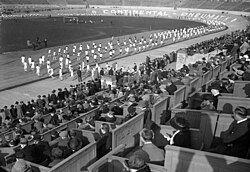
1936–1945: The Nazi Era and the Reichssportfeld
When Berlin was chosen for the 11th Summer Olympics in 1931, the initial plan was simply to restore the existing 1916 structure. However, after the Nazi Party took power in 1933, Adolf Hitler envisioned a much grander project to showcase the regime's power. He ordered the construction of the Reichssportfeld, a massive 132-hectare (330-acre) sports complex.
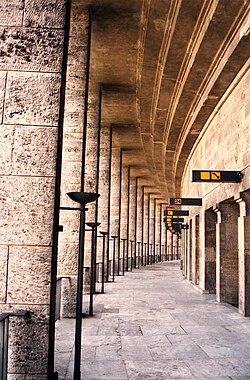
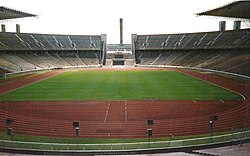
Under the direction of Werner March and his brother Walter, the new Olympiastadion was built between 1934 and 1936 using state funds. The new structure utilized the foundations of the original Deutsches Stadion, keeping the lower half recessed 12 meters (40 feet) below ground. The finished stadium could hold 110,000 people and featured a VIP stand and the iconic Marathon Gate, which housed the Olympic Flame.
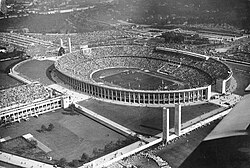
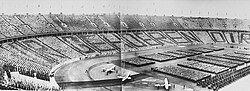
The Maifeld and Langemarck-Halle
Adjacent to the stadium was the Maifeld (Mayfield), an 11.2-hectare lawn designed for massive gymnastic demonstrations and annual May Day celebrations. With a total capacity of 250,000 people, it was surrounded by land elevations reaching 19 meters. Within this area sat the Langemarck-Halle, a series of halls beneath the stands featuring equine sculptures by Josef Wackerle and memorials to the forces that fought in the Battle of Langemark in 1914.
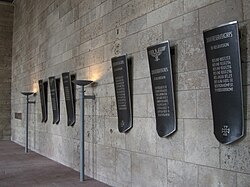
The Bell Tower
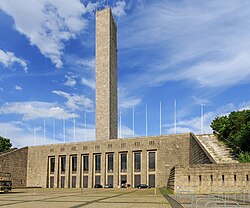
The western end of the complex was crowned by a 77-meter (247 ft) Bell Tower. This tower served as an observation post for officials and media during the 1936 Games. Inside was the Olympic Bell, inscribed with the Olympic rings, an eagle, and the motto "I call the youth of the world." While the stadium survived the war with only minor damage, the Bell Tower was destroyed after Soviet troops accidentally ignited archives stored within it. The tower was later reconstructed between 1960 and 1962 based on original blueprints.
Post-War Transition and West Berlin Era (1945–1990)
Following the defeat of the Third Reich, the Reichssportfeld became the headquarters for the British military occupation forces. The British Army renovated the facilities, converting gymnasiums into dining halls and garages. The Maifeld, once used for Nazi rallies, became a site for the annual celebration of the British monarch's official birthday and a venue for cricket.
During the Cold War, the stadium remained a center for sport and culture. It hosted Bundesliga football matches for Hertha BSC, and in the 1960s, American military teams introduced American football to Berliners through exhibition games. The Waldbühne amphitheater resumed its role as a venue for classical music and cinema.
Modernization and the 21st Century
After German reunification, a debate emerged regarding the stadium's legacy. While some suggested demolition, the city ultimately decided to renovate the site. In 2000, a €45 million renovation project began to prepare the venue for the 2006 FIFA World Cup.
The modernized arena reopened in July 2004 with performances by artists such as Pink and Nena. Since then, it has evolved into a premier multi-purpose venue, hosting the 2015 UEFA Champions League final, the 2018 European Athletics Championships, the UEFA Euro 2024 final, and NFL International Series games in 2025.
| Period | Primary Name/Status | Key Feature/Event | Capacity (Approx.) |
|---|---|---|---|
| 1916–1934 | Deutsches Stadion | Planned 1916 Olympics (Cancelled) | N/A |
| 1936–1945 | Olympiastadion / Reichssportfeld | 1936 Summer Olympics | 110,000 (Stadium) |
| 1945–1990 | British Military HQ | Post-war occupation / Hertha BSC | Variable |
| 2004–Present | Modern Multi-purpose Arena | World Cup 2006 / Euro 2024 | Modernized |
Frequently Asked Questions
Why was the original 1916 stadium built underground?
Architect Otto March designed the stadium as an "Erdstadion" to avoid building directly into the nearby Grunewald forest or destroying existing natural landscapes.
What happened to the original Olympic Bell?
The bell survived the fire that destroyed the tower but cracked during the 77-meter fall when the tower was demolished in 1947. It was later used as a target for anti-tank ammunition practice and now serves as a memorial.
What is the Maifeld used for today?
Originally used for Nazi gymnastic demonstrations, the Maifeld has since hosted British military celebrations and, since 2012, has become the home of Berlin's cricket clubs.
How did the stadium survive World War II?
While the Bell Tower was destroyed by fire, the main stadium structure survived the final battle for Berlin in April 1945 almost untouched, suffering only minor damage from machine gun fire.
Who currently manages the stadium?
The facilities are operated by a consortium including Walter Bau AG and DYWIDAG, in cooperation with the Government of Berlin and the football club Hertha BSC.