German Ice Hockey Bundesliga: A Comprehensive History
Ice hockey in Germany has a rich legacy that spans over a century, evolving from early club formations in Berlin to the professionalized structure of the modern era. The sport's journey is marked by shifts in regional dominance, fluctuating league formats, and the eventual transition to a franchise-style system to ensure financial stability.
The Pre-Bundesliga Era
The roots of German ice hockey date back to 1887 in Berlin, where the first dedicated ice hockey department was established within the Berliner SC. By 1912, the first national championship was held, won by Berliner SC. This club dominated the early years, securing 17 titles by 1937, including a streak of six consecutive wins between 1928 and 1933.
Following a period of disruption during World War II, the sport restarted in 1947 with regional leagues in the north and south. This era saw the rise of Bavarian dominance, led by SC Riessersee. In 1948, the Eishockey-Oberliga (Ice hockey premier league) was formed with six founding clubs. EV Füssen quickly became the powerhouse of this period, winning seven titles in twelve seasons.
The Birth and Growth of the Bundesliga
In autumn 1958, the first Bundesliga was established with eight clubs. Initially, the league operated on a home-and-away format without play-offs, which were not introduced until 1980. EV Füssen won the inaugural season, while the league experienced extreme scorelines, including a record 28–0 victory by EC Bad Tölz over ESV Kaufbeuren.
Throughout the 1960s, the league experimented with various formats to address the skill gap between top and bottom teams. This included splitting the league into top- and bottom-eight groups. In June 1963, the DEB (Deutsche Eishockey-Bund) was formed, separating ice hockey from the broader German Ice Sports Federation.
The late 1960s marked a pivotal shift as dominance moved from small Bavarian towns to larger cities. Düsseldorfer EG broke the Bavarian winning streak in 1967. The league continued to expand, reaching twelve teams by 1969, with EV Landshut claiming its first title that year.
The 1970s: Professionalism and Financial Turmoil
The 1970s introduced the "Friday-Sunday rhythm," where teams played one home and one away game per weekend. This decade saw the emergence of Kölner EC as a powerhouse, though its success was marred by the actions of chairman Jochem Erlemann, who illegally invested third-party funds into the club.
The era also saw the rise of the Deutschkanadier—Canadian players of German descent. This trend, popularized by Mannheimer ERC under coach Heinz Weisenbach, allowed teams to recruit high-quality talent without using limited foreign player slots.
The 1980s: Scandals and Play-offs
The 1980–81 season introduced play-offs for the top eight teams, but the year was overshadowed by a passport scandal. Several players at Duisburger SC and Kölner EC were found to be using fake German passports purchased in Essen, leading to bans and point deductions.
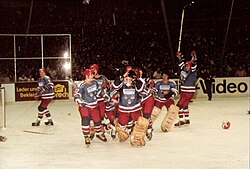
In 1982–83, EV Landshut achieved a surprise championship under Czech coach Karel Gut. This victory was notable for its low budget and reliance on local talent, as 20 of the players were born in Landshut.
The late 80s were characterized by the second golden era of Kölner EC and increasing tension between clubs and the DEB. A notable conflict occurred when ECD Iserlohn attempted to advertise Muammar Gaddafi's "Green Book" on their jerseys, a move quickly outlawed by the federation.
The Transition to the DEL
The 1993–94 season served as the final chapter of the Bundesliga. EC Hedos München won the last title, defeating Düsseldorfer EG in the final. To combat the financial risks associated with relegation, the DEL (Deutsche Eishockey Liga) was formed in 1994.
The DEL adopted a model similar to the National Hockey League (NHL), removing relegation to provide clubs with greater financial stability. The inaugural 1994–95 DEL season included the twelve former Bundesliga clubs and six promoted teams from the 2nd Bundesliga.
Key Facts
- First Club: Berliner SC formed the first ice hockey department in 1887.
- Early Dominance: Berliner SC won 17 of 21 championships between 1912 and 1937.
- Record Score: EC Bad Tölz defeated ESV Kaufbeuren 28–0 in the early Bundesliga era.
- Format Shift: Play-offs were first introduced to the Bundesliga in 1980.
- The DEL Shift: The Bundesliga ended in 1994 to create the DEL, eliminating relegation for financial security.
| Era | Primary Format | Dominant Region/Club | Key Characteristic |
|---|---|---|---|
| Pre-Bundesliga | Championship Tournaments | Berlin / Bavaria | Early club formation and regional growth |
| Early Bundesliga | Home-and-Away / Split Groups | Bavaria (EV Füssen) | Experimental league structures |
| Late Bundesliga | Regular Season + Play-offs | Large Cities (Kölner EC) | Import of Deutschkanadier and professionalization |
| DEL Era | Franchise-style (No Relegation) | Various | Financial stability and commercial growth |
Frequently Asked Questions
When was the first German ice hockey championship held?
The first national championship took place in 1912 and was won by Berliner SC.
What are "Deutschkanadier"?
Deutschkanadier are Canadian ice hockey players of German origin who were eligible to play for the West German national team and did not count toward the limited number of foreign player spots allowed per team.
Why was the Bundesliga replaced by the DEL?
The DEL was created to reduce the financial risk for clubs. Under the Bundesliga system, relegation often led to massive financial losses; the DEL adopted a model without relegation to ensure greater stability.
Which club was the most dominant in the early Bundesliga years?
EV Füssen was the most dominant side of the early era, winning seven titles in twelve seasons, including six in a row from 1953 to 1958.
What was the "passport scandal" of the 1980s?
In the 1980–81 season, it was discovered that several players at Duisburger SC and Kölner EC were using fake German passports purchased from a bar in Essen to bypass foreign player restrictions.