Olsberg: A Historic Swiss Municipality in Canton Aargau
Nestled in the lower Fricktal—the valley of the Frick river—Olsberg is a serene municipality located in the Rheinfelden district of the canton of Aargau, Switzerland. Known for its deep historical roots and lush landscapes, this small community blends agricultural tradition with significant cultural heritage.
Key Facts
- Location: Rheinfelden district, Canton Aargau, Switzerland.
- Total Area: 4.62 square kilometers.
- Population: 356 residents (as of December 2020).
- Primary Land Use: 60% forested and 34.2% agricultural.
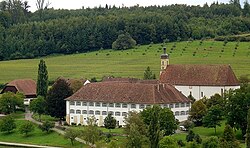
- National Heritage: Home to a former Cistercian convent and church of national significance.
- Cultural Highlight: Host to the Solsberg chamber music festival.
A Journey Through History
The history of Olsberg stretches back to the Neolithic era, with evidence of early settlements in the vicinity. By the 1st century AD, the area hosted a Roman farm, signaling its long-standing appeal as a place of habitation.
The modern village first appeared in records in 1236 as Olsperg. The settlement evolved from the courtyard of a convent, which maintained ownership of the land and held low justice rights (the authority to handle minor legal disputes) until 1790.
Political boundaries shifted frequently over the centuries. From 1330 to 1797, the area to the right of the Violenbach stream was part of the Austrian district of Rheinfelden. Following a period as a French protectorate after 1797, it joined the newly formed Canton of Aargau in 1803. Conversely, the land to the left of the stream belonged to the city of Basel from 1461 and later to Canton Basel-Country, now part of Arisdorf.
The Abbey Church serves as a focal point of the village's spiritual history. Renovated between 1670 and 1707, it transitioned from a branch of the Kaiseraugst parish to its own parish in 1786. In 1872, it achieved a unique milestone by becoming the first Christian Catholic parish church in Switzerland.
Geography and Land Use
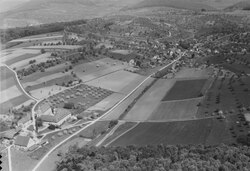
Olsberg covers a total area of 4.62 square kilometers. The landscape is dominated by nature, with 60% of the land consisting of heavy forests and 34.2% dedicated to agriculture. Within the agricultural sector, pastures account for 18.2%, crop cultivation for 10.6%, and orchards or vine crops for 5.4%.
Human settlement and infrastructure occupy a small fraction of the land, with buildings and roads making up approximately 5.4%. Water features are limited to local rivers and streams, comprising only 0.2% of the total area.
Demographics and Community Life
As of December 2020, Olsberg has a population of 356. The community is predominantly German-speaking (96.3%), with small minorities speaking French and Italian. The population shows a significant senior presence, with over 21% of residents aged between 60 and 69.
Housing in Olsberg is characterized by a high rate of homeownership, with 76.7% of households being owner-occupied. Single-family homes are common, representing 56.4% of all residential units as of 2008.
Education and Culture
The municipality places a strong emphasis on education; approximately 90.7% of adults aged 25 to 64 have completed upper secondary or higher education. The village provides a local primary school and the Schul-u.Gde.Bibliothek Olsberg, the combined school and municipal library.
Culturally, Olsberg is recognized for the Solsberg chamber music festival, organized by renowned cellist Sol Gabetta since 2005.
Economy and Infrastructure
Olsberg maintains a very low unemployment rate, recorded at 0.75% in 2007. The economy is split between the primary sector (agriculture) and the tertiary sector (services). A significant portion of the working population commutes, with 74.5% of residents working outside the municipality.
Transportation is primarily car-dependent, with 54.1% of workers using private vehicles, while 11.1% utilize public transportation.
| Category | Detail |
|---|---|
| Canton | Aargau |
| District | Rheinfelden |
| Elevation | 377 m |
| Postal Code | 4305 |
| Main Language | German |
| Forest Cover | 60% |
Frequently Asked Questions
What is the historical significance of the Abbey Church in Olsberg?
The Abbey Church is notable for its architectural renovations between 1670 and 1707 and for becoming the first Christian Catholic parish church in Switzerland in 1872.
What is the Solsberg festival?
Solsberg is a chamber music festival organized in Olsberg by the cellist Sol Gabetta, which has been running since 2005.
How is the land in Olsberg primarily used?
The majority of the land is forested (60%), followed by agricultural use (34.2%), with only a small percentage used for settlements and water bodies.
Which political party was most popular in the 2007 federal election?
In the 2007 federal election, the SVP was the most popular party in Olsberg, receiving 30.14% of the vote.
What heritage sites are found in Olsberg?
The former Cistercian convent, along with its church and outbuildings, are listed as Swiss heritage sites of national significance.