Aarau: The Historic Capital of Canton Aargau
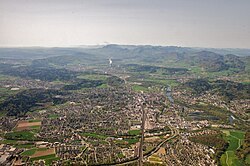
Nestled on the right bank of the Aare river, Aarau serves as the capital of the northern Swiss canton of Aargau and the district of the same name. Situated on the Swiss plateau at the southern foot of the Jura Mountains, this German-speaking municipality is a hub of culture and administration. Strategically located west of Zurich, it sits 58 kilometers south of Basel and 65 kilometers northeast of Bern.
Key Facts
- Role: Capital of Canton Aargau and the district of Aarau.
- Population: 21,726 (as of December 2020).
- Geography: Located in the Aare valley, bordering the canton of Solothurn to the west.
- Economy: Predominantly tertiary sector with over 20,000 jobs.
- Notable Residents: Former home to Albert Einstein.
Geography and Climate
Aarau is characterized by its varied elevation, ranging from 365 meters at the Aare river to 471 meters at Hungerberg. The town experiences a temperate climate with an average annual precipitation of 919.7 mm. Summers are mild to warm, with July seeing the highest mean daily maximum of 25.6°C, while winters are cool, with January averaging a daily mean of 1.2°C.
History and Evolution
Founding and Middle Ages
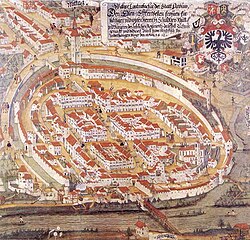
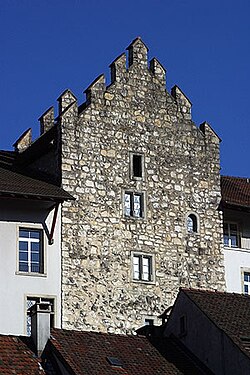
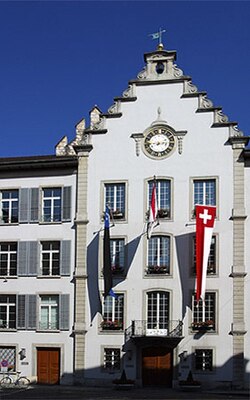
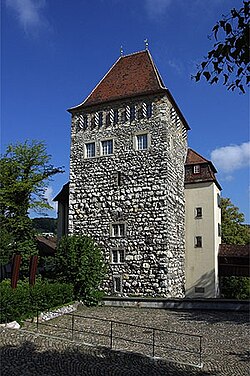
The town was founded around AD 1240 by the counts of Kyburg and first appeared in records as "Arowe" in 1248. By 1256, it had grown into a city-sized settlement. Historically, the town was governed from the Rore tower, a structure that has since been integrated into the modern city hall.
Political Significance
Aarau played a pivotal role in Swiss political history. On December 27, 1797, it hosted the final Tagsatzung (Federal Diet) of the Old Swiss Confederacy. Shortly after, in March 1798, the city was occupied by French troops, leading to its tenure as the capital of the Helvetic Republic.
Modern Development
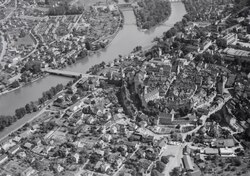
Infrastructure evolved significantly in the 19th and 20th centuries. A medieval wooden bridge across the Aare, plagued by floods, was replaced by a steel suspension bridge in 1851 and later a concrete bridge in 1952. The city joined the Swiss Central Railway network in 1856. Cultural growth followed with the opening of a Theatre and Concert Hall in 1883 and the Aargau Nature Museum in 1922.
City Landmarks and Culture
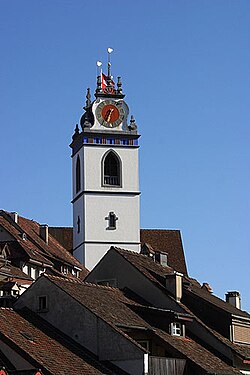
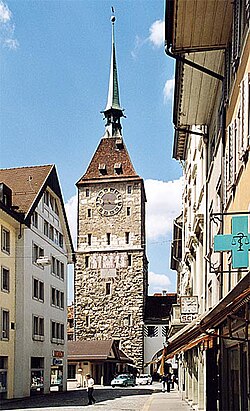
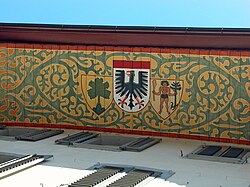
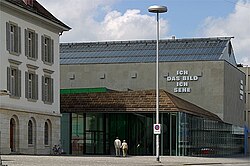
The old town of Aarau is renowned for its preserved architecture, including the Schlössli and the Upper Gate Tower. The city's artistic spirit is reflected in its painted gables and the Kunsthaus Museum.
Religion and Society
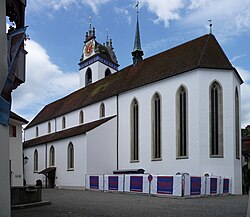
Aarau is predominantly Protestant. According to census data, the Swiss Reformed Church is the largest denomination (43.6%), followed by Roman Catholics (28.9%).
Economy and Demographics
Aarau is a significant employment center, offering over 24,000 jobs. The economy is heavily weighted toward the tertiary sector (services), which employs 20,186 people across 1,461 businesses. The secondary sector employs 4,181 people, while the primary sector remains minimal. Historically, the town was home to Kern & Co., a world-renowned geodetic instrument manufacturer founded in 1819.
Population Trends
The population grew steadily until 1960, peaking at 17,045. A subsequent slight decline occurred due to a lack of new land development and a decrease in average household size. However, recent trends show growth, reaching 21,726 by 2020. German is the primary language (84.5%), followed by Italian and Serbo-Croatian.
| Year | Total Population | % German Speaking | % Protestant | % Roman Catholic |
|---|---|---|---|---|
| 1850 | 4,657 | 99.2% | 81.9% | 17.4% |
| 1910 | 9,593 | 90.6% | 71.7% | 26.6% |
| 1950 | 14,280 | 93.8% | 70.4% | 27.9% |
| 1990 | 16,481 | 81.7% | 49.7% | 33.0% |
| 2010 | 19,497 | 85.0% | 44.4% | 28.8% |
Sports and Notable Figures
Football is a prominent sport in the city, with FC Aarau playing at the Stadion Brügglifeld. The club has a storied history, winning the Swiss Cup in 1985 and claiming the Swiss championship three times (1912, 1914, and 1993).
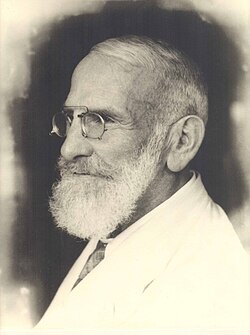
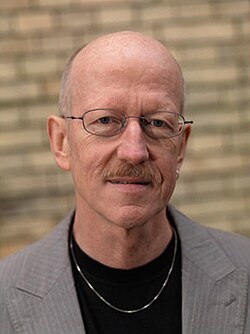
Aarau has been home to many distinguished individuals. Notable born residents include nutritionist Maximilian Bircher-Benner and musician Martin Schlumpf. The city also hosted world-renowned physicist Albert Einstein during his time as a technical assistant at the Swiss Patent Office.
Frequently Asked Questions
What is the significance of Aarau in Swiss history?
Aarau served as the capital of the Helvetic Republic starting in 1798 and hosted the final Tagsatzung of the Old Swiss Confederacy in 1797.
Which famous scientist lived in Aarau?
Albert Einstein lived in Aarau while working as a technical assistant at the Swiss Patent Office.
What is the main economic driver of the city?
The tertiary (service) sector is the dominant economic driver, employing over 20,000 people and supporting more than 1,400 businesses.
What are the twin towns of Aarau?
Aarau is twinned with Neuchâtel (Switzerland), Delft (Netherlands), and Reutlingen (Germany).
What are the primary languages spoken in Aarau?
The vast majority of the population speaks German (84.5%), with Italian and Serbo-Croatian being the next most common languages.