Nuucichthys: A Rare Glimpse into Cambrian Vertebrate Evolution
The early history of vertebrates is a puzzle composed of rare, soft-bodied fossils that offer a window into how complex life evolved. One such piece of the puzzle is Nuucichthys, an extinct genus of stem-group vertebrates from the Cambrian period. Discovered in the Marjum Formation of Utah, this creature represents the first Cambrian vertebrate found in the Great Basin region of North America.
Nuucichthys provides critical data on the diversity of early vertebrates in Laurentian deposits (ancient North American landmasses), where such fossils are notably rare. By studying its unique anatomy, paleontologists can better understand the transition from simple chordates to the complex vertebrates that dominate the animal kingdom today.
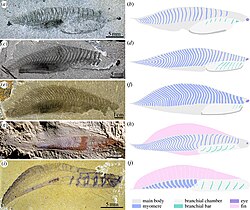
Key Facts
- Scientific Name: Nuucichthys rhynchocephalus
- Time Period: Cambrian (Drumian stage, Miaolingian series)
- Location: Marjum Formation, Utah, USA
- Distinguishing Feature: An elongated cephalic (head) region lacking myomeres.
- Lifestyle: Likely a planktonektonic suspension feeder.
- Size: Approximately 32.4 mm in length.
Etymology and Discovery
The holotype specimen (UMNH.IP.6084) was recovered from the House Range of Utah and is currently housed at the Natural History Museum of Utah. The fossil is laterally flattened and likely originates from the Ptychagnostus punctuosus biozone within the middle of the Marjum Formation.
The name Nuucichthys is a blend of "Núu-ci" (the Ute tribe's name for "the people") and the Greek word ichthys ("fish"), honoring the indigenous lands where the fossil was found. The species name, rhynchocephalus, comes from the Greek rhynchos ("beak" or "snout") and kephale ("head"), describing the animal's prominent projecting snout.
Anatomical Description
Nuucichthys measured roughly 32.4 millimeters (1.28 inches) long and 7.9 millimeters (0.31 inches) tall. Its body was fusiform (spindle-shaped), characterized by approximately 40 myomeres—the V-shaped muscle segments found in early chordates—running along its length.
The most striking feature of Nuucichthys is its elongated head. Unlike the rest of the body, this cephalic region lacks noticeable myomeres and shows a sudden change in elevation. This area housed a pair of well-developed camera-type lenses, similar to those found in modern lampreys and the related Cambrian chordate Metaspriggina.
Internally, the ventral plane reveals a large branchial chamber (the area containing the gills) and organs interpreted as the liver, intestine, and anus. The caudal (tail) region lacks a fin but possesses a spiniform (spine-like) structure, a trait also seen in Yunnanozoon.
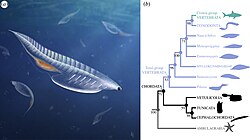
Classification and Evolutionary Relationships
Research published in 2024 classifies Nuucichthys as a stem-group vertebrate. It is closely related to other Laurentian stem-vertebrates, specifically Metaspriggina and Emmonsaspis, and shows a close relationship to the myllokunmingiids.
This taxonomic research also clarifies the broader chordate tree, suggesting that conodonts (jawless vertebrates) are a sister clade to crown-group vertebrates, while vetulicolians are basal chordates related to tunicates and cephalochordates.
| Feature | Description |
|---|---|
| Body Shape | Fusiform, laterally flattened |
| Head Region | Elongated, no myomeres, projecting snout |
| Vision | Paired camera-type lenses |
| Locomotion | No fins; likely non-active swimmer |
| Feeding | No known apparatus; likely microphagous |
Paleoecology and Lifestyle
Because Nuucichthys lacked fins, researchers hypothesize that it was not an active swimmer. Instead, its laterally facing eyes and body plan suggest it occupied a planktonektonic niche, meaning it lived within the water column but drifted rather than swimming purposefully.
The absence of a preserved feeding apparatus suggests that Nuucichthys was microphagous, likely acting as a suspension feeder that filtered small particles from the water. This lifestyle is consistent with other closely related Cambrian chordates.
Frequently Asked Questions
What makes Nuucichthys different from other Cambrian chordates?
Its most distinguishing feature is the elongated cephalic region, which lacks the muscle segments (myomeres) found in the rest of its body and features a distinct projecting snout.
Where was Nuucichthys discovered?
The holotype was found in the Marjum Formation of the House Range in Utah, United States, making it the first Cambrian vertebrate discovered in the Great Basin region.
How did Nuucichthys move through the water?
Since it lacked fins, it is believed that Nuucichthys was not an active swimmer but instead lived a planktonektonic existence, drifting in the water column.
What did Nuucichthys eat?
While no feeding organs were fossilized, its lifestyle and anatomy suggest it was a microphagous suspension feeder, filtering food from the surrounding water.
How large was Nuucichthys?
The holotype specimen is approximately 32.4 millimeters (1.28 inches) long, excluding the eyes and the tail region.