North West Point Immigration Detention Centre
The North West Point Immigration Detention Centre, originally known as the Christmas Island Immigration Reception and Processing Centre, is an Australian immigration facility located on Christmas Island in the Indian Ocean. Designed to manage the processing of asylum seekers, the facility has a complex history of expansion, closure, and repurposing.
As of December 31, 2023, the centre is unoccupied. The last recorded detainees were held there in August 2023, with a population of 36 individuals.
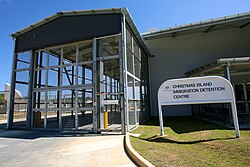
Key Facts
- Location: A 40-hectare former phosphate mining lease on Christmas Island.
- Construction Cost: A$208 million, completed in 2008.
- Management: Operated by private contractor Serco, with property services by CI Resources.
- Capacity: Regular operating capacity of 1,094, with a contingency capacity of 2,724.
- Current Status: No detainees held as of December 31, 2023.
Development and Infrastructure
The need for a formal facility arose in late 2001 when temporary asylum seeker housing at Phosphate Hill was deemed inadequate for security and amenity. On March 12, 2002, the Australian Government announced a purpose-built Immigration Reception and Processing Centre (IRPC) with an initial planned capacity of 1,200 people.
Due to a decrease in boat arrivals during 2001 and 2002, the project was scaled back in February 2003 to 800 places. By September 2003, the plan was finalized to include 416 purpose-built units and 384 contingency accommodation spots. The facility was eventually built by Baulderstone between 2005 and 2007, reaching completion in 2008.
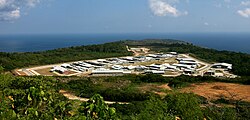
Facility Layout and Capacity
The centre is situated adjacent to the Christmas Island National Park. Its infrastructure includes eight accommodation units, a medical centre, a conference centre, and various recreational facilities such as tennis courts and a central sports area. To handle surges in arrivals, the capacity was increased multiple times between 2009 and 2010, eventually reaching over 2,200 places. In June 2013, the facility exceeded its designed capacity, holding 2,960 irregular maritime arrivals.
Civil Unrest and Legal Challenges
The centre has been the site of significant protests regarding living conditions and the duration of detention.
- 2011 Riot: Over 250 detainees damaged an accommodation block. Authorities used tear gas and bean bag rounds—one of the first instances of such munitions being used in Australia—to subdue the crowd.
- 2014 Hunger Strike: Approximately 375 detainees participated in a hunger strike, with some stitching their lips together in solidarity with Iranian asylum seeker Reza Barati.
- 2014 Maternal Protests: Mothers at the Construction Camp protested living conditions for their children. Following reports that they would never be settled in Australia, some threatened to burn the camp, leading to arrests and reports of self-harm.
- 2015 Riot: Following the death of an asylum seeker who was found at the bottom of a cliff, a riot occurred involving individuals facing deportation. Damage was estimated at A$10 million.
- 2022 Allegations: Footage emerged showing New Zealand detainees, facing deportation under section 501 of the Migration Act 1958 (the character test), allegedly being beaten and tied to furniture by an Emergency Response Team.
Legal Proceedings
In August 2014, the law firm Maurice Blackburn filed a class action in the Supreme Court of Victoria on behalf of a six-year-old girl. The suit alleged negligence in healthcare, claiming the child suffered a dental infection, separation anxiety, and a stammer during her year-long detention.
Closures and Repurposing
The facility was officially closed in October 2018 after a decline in the asylum seeker population. However, in February 2019, the Morrison government announced plans to reopen the centre, citing the potential for increased boat arrivals following the passage of the Medevac bill—legislation allowing medical professionals to influence the transfer of sick asylum seekers from Nauru and Manus Island.
The reopening cost A$180 million and saw 140 Serco employees deployed in April 2019, even before refugees arrived. In May 2019, 20 Sri Lankan asylum seekers were briefly held before being returned to their home country.
COVID-19 Quarantine Use
In February 2020, the centre was repurposed as a quarantine facility for Australian citizens evacuated from Wuhan and Hubei Province during the coronavirus pandemic. Approximately 275 Australians, including children and infants, spent 14 days at the facility under medical supervision.
| Year | Event | Details |
|---|---|---|
| 2002-2008 | Construction | Built by Baulderstone for A$208 million. |
| 2010-2013 | Capacity Peaks | Reached a high of 2,960 detainees in June 2013. |
| 2018 | First Closure | Facility closed in October. |
| 2019 | Re-opening | Reopened for A$180 million due to border policy changes. |
| 2020 | Pandemic Use | Used as a COVID-19 quarantine site for Wuhan evacuees. |
| 2023 | Current Status | No detainees held as of December 31. |
Frequently Asked Questions
Who manages the North West Point Immigration Detention Centre?
The facility is managed by Serco, a private contractor, on behalf of the Australian Government, with property services provided by CI Resources.
What is the maximum capacity of the centre?
While the regular operating capacity is 1,094 people, the facility has a contingency capacity of 2,724. At its peak in June 2013, it held 2,960 people.
Why was the centre used in 2020?
The centre was repurposed as a 14-day quarantine facility for Australian citizens being evacuated from Wuhan and Hubei Province during the initial COVID-19 outbreak.
What was the Medevac bill's role in the centre's history?
The Medevac bill allowed medical professionals to recommend the transfer of sick asylum seekers from Nauru and Manus Island. The Australian government cited the potential for increased boat arrivals following this bill as a reason to reopen the Christmas Island facility in 2019.
What is the "character test" mentioned in the 2022 riots?
The character test refers to section 501 of the Migration Act 1958, which allows the government to refuse or cancel visas on character grounds, often leading to the deportation of non-citizens.