Non-denominational Christianity: History, Growth, and Characteristics
Non-denominational Christianity is a movement, primarily originating in the United States within the broader context of Evangelicalism, where churches and individual believers choose not to formally align with a specific Christian denomination. By distancing themselves from confessionalism—the creation of fixed identities and systems of beliefs for separate churches—these communities seek to avoid the creedal restrictions often associated with traditional denominational structures.
This approach to faith emphasizes a direct relationship with the teachings of the New Testament over man-made traditions. While these churches are autonomous, they often share common theological leanings, such as those found in Evangelicalism or Charismatic Christianity.
Key Facts
- Market Position: As of 2020, non-denominational Christianity is the largest Protestant movement in the United States.
- Origins: Rooted in the 19th-century Stone-Campbell Restoration Movement.
- Growth Drivers: Expanded significantly during the 20th-century Jesus movement and into the 21st century.
- Governance: Typically utilizes congregationalist polity (local church autonomy) or governance by elders.
- Global Reach: While centered in North America, there is a growing presence in Asia, particularly in Singapore and Malaysia since the 1990s.
The History and Evolution of the Movement
The Restoration Movement
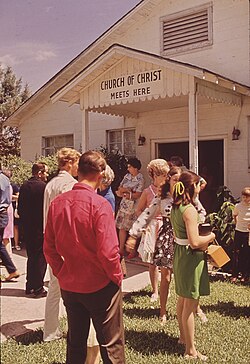
The foundations of non-denominationalism were laid in the 18th and 19th centuries through the Stone-Campbell Restoration Movement. Followers sought to restore the primitive church to its New Testament form, organizing themselves simply as "Christians" or "Disciples of Christ." Many of these congregations today are known as Churches of Christ or Christian churches.
To distinguish themselves from the Christian Church (Disciples of Christ)—which eventually evolved into a formal denomination—some congregations adopted the label "Independent Christian Church."
20th Century Expansion and the Jesus Movement
The movement gained significant momentum during the 20th century, particularly during the Jesus movement. This era helped integrate contemporary Christian music and media into global pop culture, making the non-denominational style of worship more accessible and appealing to younger generations.
Modern Growth and Statistics
In the 21st century, non-denominational churches have seen continuous growth. In 2010, the U.S. had 35,496 such churches with over 12 million congregants. At that time, they were the third-largest Christian grouping in the U.S., trailing only the Roman Catholic Church and the Southern Baptist Convention. By 2020, they ascended to the second-largest position, surpassing the Baptists.
Core Characteristics and Governance
Organizational Structure
Non-denominational churches are defined by their lack of affiliation with a specific denominational stream. However, this does not mean they exist in total isolation. Many operate through loose associations or networks, such as:
- Calvary Chapel Association: Established by Chuck Smith.
- Acts 29: A modern network of church planting.
- Churches of Christ: A cooperative but non-denominational association.
Theology and Demographics
While autonomous, many of these churches align with Pentecostalism or Evangelicalism. Some have grown into megachurches (exceptionally large congregations), while others remain small, local gatherings. Research by political scientist Ryan Burge suggests that non-denominational Christians are demographically similar to Southern Baptists but tend to be younger, more racially diverse, and slightly more moderate in their theological positions regarding the Bible.
| Feature | Non-denominational | Denominational |
|---|---|---|
| Affiliation | Independent or loose networks | Formal hierarchy/central body |
| Governance | Congregationalist or Elder-led | Episcopal, Presbyterian, or Connectional |
| Identity | Often identify simply as "Christian" | Identify by specific tradition (e.g., Baptist, Methodist) |
| Accountability | Local board or spiritual mentors | National/Regional organizational oversight |
Critical Perspectives and Challenges
Theological and Literacy Concerns
Some scholars argue that the "non-denominational" label creates a veneer of unity that masks deep theological divisions. Stephen Prothero suggests this can lead to a "general moralism" and a decline in religious literacy, as believers may ignore the complex scriptural debates that originally formed Christian traditions.
Theologian Steven R. Harmon argues that a truly non-denominational church is an impossibility; he posits that once a church decides how to handle baptism, communion, and ministry, it has effectively entered a specific denominational tradition, whether it admits it or not.
Accountability and Governance Risks
A significant point of criticism involves the lack of centralized oversight. Ryan Burge and Matthew D. Taylor have noted that without a national organization to monitor conduct, non-denominational churches may be less equipped to report or handle cases of sexual abuse. Critics argue that this lack of hierarchy can attract authoritarian leaders who exert excessive control over congregants, as their only accountability is often to a board of friends or close associates.
Frequently Asked Questions
What does it mean for a church to be non-denominational?
It means the church is not formally affiliated with a larger denominational body or hierarchy. They are autonomous in their governance and do not adhere to a centralized set of denominational rules or creeds.
Is non-denominational Christianity a specific denomination?
No. By definition, it is the absence of denominational affiliation. However, many non-denominational churches share similar theological views, often falling under the umbrella of Evangelicalism or Charismatic Christianity.
How do non-denominational churches differ from Southern Baptists?
While similar in politics and attendance rates, non-denominational churches are typically younger and more racially diverse. They also tend to hold slightly more moderate theological positions regarding the Bible than the Southern Baptist Convention.
Why are some critics concerned about non-denominational governance?
Critics argue that the lack of a national organizational structure reduces accountability. This can make it harder to monitor abuse or prevent authoritarian leadership, as there is no external hierarchy to provide oversight.
Where did the non-denominational movement start?
It primarily arose in the United States, with early roots in the 18th and 19th-century Stone-Campbell Restoration Movement, which sought to return to the practices of the early New Testament church.