New York City's Historic Moving Day: The May 1st Chaos
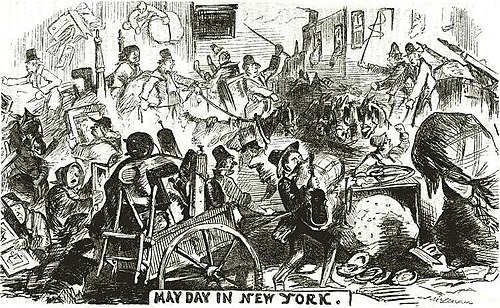
For decades in the 19th century, the city of New York experienced a phenomenon so overwhelming that observers compared it to a population fleeing a plague. Known simply as Moving Day, every May 1st saw a massive, synchronized migration of tenants shifting from one rental to another, turning the city's streets into a chaotic sea of furniture, carts, and desperate homeowners.
This tradition was rooted in the standard practice of letting houses for a fixed term of one year, starting on May 1st. Because many residents desired variety in their living arrangements and rarely stayed in the same home for two consecutive years, a significant portion of the city's population attempted to relocate simultaneously.
Key Facts
- Date: The primary migration occurred annually on May 1st.
- Lease Cycle: Houses were typically let for one-year terms.
- Logistics: The city relied on carmen (professional carters) using drays, wagons, and hand barrows.
- Social Pressure: The custom was so pervasive that some residents pretended to move just to avoid social stigma.
- Economic Impact: The high demand for transport allowed carmen to inflate prices and ignore standard ordinances.
The Experience of the Streets
Contemporary accounts describe a city in total uproar. Frances Trollope, writing in 1832, noted that the streets from east to west and north to south were occupied by packers, porters, and draymen. The sheer volume of goods—ranging from rich furniture to ragged belongings—rendered sidewalks nearly impassable.
Even famous visitors were stunned by the spectacle. In 1834, frontiersman Davy Crockett witnessed the event and remarked that it looked like a "frolic," as if people were changing houses simply for fun, though he noted it would take a great deal to lure him from his own log house.
The Physical Toll of the Move
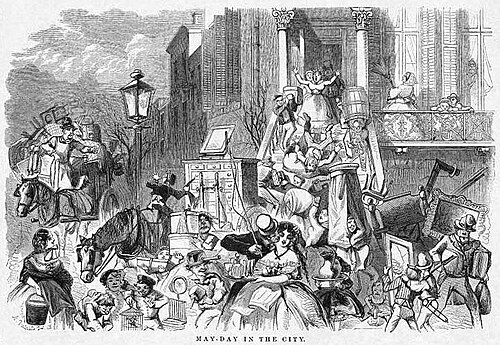
The haste of Moving Day often led to significant property damage. The New York Times reported in 1855 that the day was a "muddle" of smashing mirrors and bruised furniture. Sofas entered new homes "maimed," tables lost their castors, and china sets were frequently broken by nightfall. The newspaper advised citizens to keep their tempers and use glue, putty, and varnish to rejuvenate their damaged belongings.
The Role of the Carmen
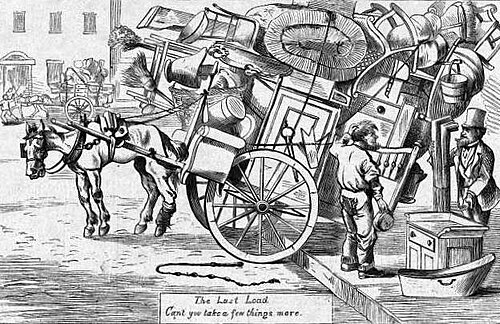
The carmen—the drivers of the transport carts—held immense power on May 1st. By 1865, the Times described the carman as the "lord of the ascendant," noting that they often laughed at standard payment offers and refused previous engagements to hold out for the highest possible bidder. For one day a year, these workers operated above city ordinances, only returning to their law-abiding status on May 2nd.
Societal Perspectives on the Custom
While some viewed the day as an absurd necessity, others saw it as a reflection of American character. John Pintard, co-founder of the New-York Historical Society, noted that while the practice seemed absurd to strangers, it provided tenants with a greater choice of abodes during the February leasing period.
Lydia Maria Child observed the psychological grip of the tradition, recounting a story of a lady who closed her shutters on May 1st solely so her neighbors would believe she was moving, as she was "ashamed" not to be participating in the universal transit.
| Observer | Perspective | Key Observation |
|---|---|---|
| Frances Trollope | Critical/External | Compared the scene to fleeing a plague. |
| Davy Crockett | Amazed/Outsider | Viewed it as a strange, city-wide "frolic." |
| John Pintard | Analytical/Local | Highlighted the advantage of more housing choices in February. |
| George Templeton Strong | Intellectual/Legal | Compared the nomadic behavior to the Tartar Steppes. |
| Lydia Maria Child | Sociological | Noted the "despotic sway" of public opinion and custom. |
Frequently Asked Questions
Why did everyone move on the same day?
It was an established custom where houses were let for one-year terms starting on May 1st. This synchronization allowed for a concentrated period of house-hunting and leasing, typically occurring in February.
What were the main difficulties of Moving Day?
The primary issues included impassable sidewalks, extreme traffic congestion from carts and drays, high costs for transportation, and frequent damage to furniture and household goods due to the rush.
Who were the carmen and why were they important?
Carmen were professional transporters who operated carts and wagons. Because they were the only means of moving large furniture, they held a monopoly on May 1st, allowing them to charge premium prices and ignore typical city regulations.
Did everyone in New York participate in Moving Day?
No. Some wealthy residents built or bought their own homes specifically to avoid the annual inconvenience. However, the social pressure was so high that some people pretended to move to avoid appearing out of step with fashion.
How did the move affect children and pets?
Children often viewed the day as an adventure, exploring cellars and roofs. Conversely, observers like Lydia Maria Child noted that pets, particularly cats and dogs, seemed bewildered by the universal migration.