Tin Pan Alley: The Birthplace of American Popular Music
Long before the digital era of streaming and the golden age of radio, the heart of the American music industry beat in a small section of Manhattan. Tin Pan Alley was a dense collection of music publishers and songwriters who dominated the popular music landscape of the United States from the late 19th century through the early 20th century.
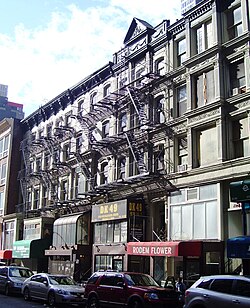
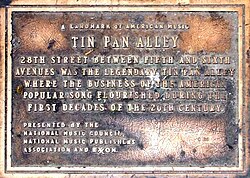
Originally centered on West 28th Street between Fifth and Sixth Avenues in the Flower District, this hub transformed how music was created, sold, and consumed. In an era where the piano was a staple of the middle-class home, the primary product of the industry was not a recording, but sheet music—the printed notes that allowed families to perform the latest hits in their own living rooms.
Key Facts
- Location: West 28th Street, Manhattan, New York City.
- Peak Era: Approximately 1885 through the 1930s (with some influence lasting into the 1950s).
- Primary Product: Printed sheet music for home performance.
- Legacy: Five buildings (47–55 West 28th Street) were designated as historic landmarks in 2019.
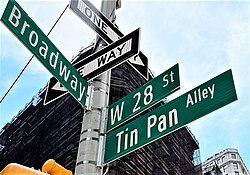
- Official Recognition: The section of 28th Street from Fifth to Sixth Avenue is officially co-named "Tin Pan Alley."
The Origins of the Industry
The roots of New York's music publishing scene date back to the early 1860s. J.N. Pattison, a pianist and composer, began publishing sheet music from a salesroom in Union Square. As the United States emerged from the Civil War and the urban middle class grew, piano ownership became widespread, creating a massive market for accessible, popular melodies.
By 1885, a cluster of publishers had established themselves in the same district of Manhattan, creating a synergistic environment for songwriters and publishers. This concentration of talent and business gave birth to the phenomenon known as Tin Pan Alley.
How it Got Its Name
The colorful name "Tin Pan Alley" is the subject of historical anecdote. According to an account from 1930, songwriter Harry von Tilzer had modified his Kindler & Collins piano by placing strips of paper across the strings to create a more percussive sound. A journalist interviewing him remarked that the piano sounded like a "tin can," leading to the title of the article "Tin Pan Alley." By 1905, the name was firmly established in the public consciousness.
The Golden Age and Business Influence
At its height, Tin Pan Alley was the epicenter of the American song. It wasn't just about creativity; it was a sophisticated business operation. On June 11, 1895, several music houses formed the Music Publishers Association of the United States to lobby for better copyright protections, including the Treloar Copyright Bill, which sought to extend copyright terms for published music.
The influence of the Alley extended into the 1960s. While the rise of rock and roll shifted the center of gravity to the Brill Building, songwriter Neil Sedaka noted that the Brill Building was a natural outgrowth of Tin Pan Alley, as many older songwriters continued to work for the original Alley firms while younger writers moved to the new hub.
The era of the dominant music publisher eventually faded as artists began to write and record their own material. Bob Dylan famously proclaimed in 1985 that he had helped put an end to the Tin Pan Alley era by establishing a new norm where performers recorded their own compositions.
Legendary Figures and Hits
Tin Pan Alley produced some of the most enduring names in music history, including George Gershwin, Irving Berlin, Cole Porter, and Jerome Kern. Their work formed the foundation of the Great American Songbook.
| Song Title | Year | Composer/Lyricist |
|---|---|---|
| After the Ball | 1892 | Charles K. Harris |
| Give My Regards to Broadway | 1904 | George M. Cohan |
| Alexander's Ragtime Band | 1911 | Irving Berlin |
| Swanee | 1919 | George Gershwin |
| Stardust | 1927 | Hoagy Carmichael & Mitchell Parish |
Frequently Asked Questions
What exactly was Tin Pan Alley?
Tin Pan Alley was a collection of music publishers and songwriters located in New York City who dominated American popular music in the late 19th and early 20th centuries.
Why was sheet music so important?
Before the widespread use of phonographs and radio, the only way to hear a new popular song at home was to purchase the printed sheet music and perform it on a piano.
When did Tin Pan Alley decline?
The decline is debated; some point to the Great Depression in the 1930s when radio and motion pictures replaced sheet music, while others suggest it lasted until the 1950s when rock and roll became the dominant genre.
Is Tin Pan Alley still a physical place today?
Yes. While the industry has changed, the location is preserved through New York City designated landmarks (47–55 West 28th Street) and an official co-naming of the street.
Who were some of the most famous songwriters from this era?
Some of the most influential figures included Irving Berlin, George and Ira Gershwin, Cole Porter, and Oscar Hammerstein II.