New Orleans Public Library: A History of Resilience and Knowledge
The New Orleans Public Library (NOPL) serves as the intellectual heart of New Orleans, Louisiana. Established in 1897, the system evolved from a series of private collections and municipal efforts into a comprehensive network of branches. Today, it manages a collection of 466,000 items, providing essential resources to the city's residents while preserving the deep historical record of the region.
Key Facts
- Established: 1897
- Current Collection Size: 466,000 items
- Number of Branches: 15
- Main Library Status: Listed on the National Register of Historic Places
- Historical Roots: Began with the Fisk Free and Public Library in 1895
The Evolution of the Library System
The origins of the NOPL date back to 1895 with the Fisk Free and Public Library, located on Lafayette Square. This was made possible by Abijah Fisk, a merchant who bequeathed his home at the corner of Iberville and Bourbon Streets to the city for use as a library. In 1896, Mayor John Fitzpatrick proposed a city ordinance to merge the Fisk collection with a newer municipal library, creating the unified entity known today as the New Orleans Public Library.
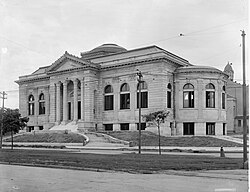
The library officially opened its doors on January 18, 1897, with an initial collection of over 35,000 volumes. The first city librarian, William Beer, managed the system until 1906. The library's growth accelerated in the early 20th century thanks to a $50,000 donation from businessman Simon Hernsheim and a subsequent $250,000 grant from philanthropist Andrew Carnegie in 1902.
These funds enabled the construction of a new main library at Lee Circle and several branch locations. By 1908, branches were operational at Royal Street, Frenchmen Street, Pelican Avenue, and Napoleon Avenue. Further Carnegie-funded branches opened on Canal Street and at the intersection of Dryades and Philip Streets in 1911 and 1915.
Impact of Hurricane Katrina
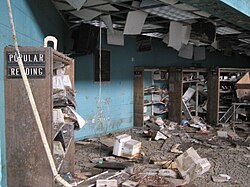
The 2005 landfall of Hurricane Katrina caused catastrophic damage to the NOPL system, with estimated losses between $26 million and $30 million. While the Main Library's basement remained dry, many branches suffered severe flooding and structural failure.
The recovery process was arduous. Some branches, such as the Nix and Hubbell branches, reopened with limited services as early as October 31, 2005. Others, like the Martin Luther King Branch, were completely destroyed and required gutting and rebuilding. The Bill & Melinda Gates Foundation's Gulf Coast Libraries Project provided critical support by funding temporary branches in trailers and storefronts while permanent facilities were restored.
Branch Network and Historic Sites
The NOPL system has shifted from its early 20th-century layout to a modern network of regional, major, and neighborhood branches. Some locations are noted for their unique architecture and history.
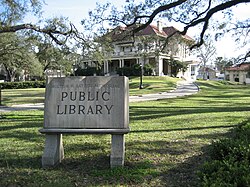
- Milton H. Latter Memorial Branch: Housed in a 1907 mansion once owned by silent film star Marguerite Clark, this branch was established in 1948 as a memorial to the Latter family's son who died during World War II.
- Rosa Keller Branch: Named for the first woman on the Public Library Board of Directors, who is credited with desegregating the library system in 1954.
- Main Library: The current facility on Loyola Avenue opened in 1960 and was designed by Curtis & Davis Architects.
The following table summarizes the status and history of key branches since the 2005 disaster:
| Branch Name | Original Opening | Katrina Impact | Current Status/Resolution |
|---|---|---|---|
| Algiers Regional | 1966 | Severe wind/rain damage | New building opened 2012 |
| Martin Luther King | 1995 | Completely destroyed | Rebuilt and reopened 2007 |
| Nora Navra | 1954 | Major flooding | New construction funded by 2015 tax |
| Robert E. Smith | 1956 | First floor destroyed | New library opened 2012 |
| Rosa Keller | 1993 | Flooding and mold | LEED certified addition opened 2012 |
The City Archives of New Orleans
Since 1947, the NOPL has served as the custodian of the City Archives of New Orleans. These archives, which date back to 1769, include official Spanish records from 1773, court documents, maps, and photographs. The collection is now part of the "City Archives & Special Collections" and utilizes microfilm for preservation.
The archives are particularly noted for the "sketches" of historic city newspapers compiled by Charles F. Youngman in the late 1930s. These sketches document the history of publications such as L'Abeille (The New Orleans Bee) and The Daily Crescent, providing a textual timeline of the city's journalistic evolution.
Frequently Asked Questions
When was the New Orleans Public Library established?
The library system officially opened its doors to the public on January 18, 1897, following a city ordinance that merged the Fisk collection with a municipal library.
How did Andrew Carnegie contribute to the library?
In 1902, Andrew Carnegie provided $250,000 to fund the construction of a new main library and five branch locations.
What happened to the libraries during Hurricane Katrina?
The system suffered $26–30 million in damages. Many branches were flooded or destroyed, leading to a long recovery period involving temporary trailer libraries and eventually new, modernized buildings.
Who was Rosa Keller and why is a branch named after her?
Rosa Keller was the first woman appointed to the Public Library Board of Directors in 1953. She is recognized for her role in the desegregation of the New Orleans Public Libraries in 1954.
What can be found in the City Archives of New Orleans?
The archives contain court documents, maps, photographs, and newspapers dating back to 1769, including official Spanish records from 1773.