Net Migration Rate: Calculation, Drivers, and Economic Impact
Population dynamics are shaped by various flows of people moving across borders. One of the most critical metrics used by demographers and economists to measure this movement is the net migration rate. This figure represents the difference between the number of immigrants (people entering an area) and emigrants (people leaving an area) over a specific period, typically one year, relative to the total population.
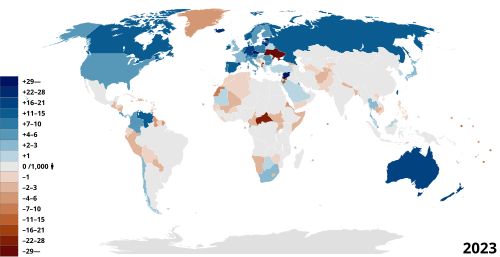
Depending on the flow of people, the rate can be positive, negative, or balanced. A positive rate indicates that more people are entering than leaving, while a negative rate shows that emigration exceeds immigration. When the numbers are equal, the rate is considered balanced.
Key Facts
- Net Migration Rate measures the annual difference between immigrants and emigrants per 1,000 people.
- Positive Rates are typically associated with wealthier, more developed countries offering better opportunities.
- Negative Rates often correlate with political instability, violence, or a lack of resources.
- Calculation requires the number of immigrants, emigrants, and the mid-year population.
- Drivers of migration are categorized into social, political, economic, and environmental factors.
Factors Driving Migration
Migration is rarely random; it is driven by a combination of "push" factors (conditions that force people to leave) and "pull" factors (conditions that attract people to a new location). These are generally divided into four categories:
Social Migration
This occurs when individuals move to reunite with family members or to settle in an area where they feel a stronger cultural or ethnic identification.
Political Migration
Often categorized as forced migration, this happens when individuals become refugees to escape war or political persecution, typically moving to neighboring or more developed nations.
Economic Migration
This is driven by the desire for a higher standard of living. Individuals move to areas with better employment opportunities and economic stability.
Environmental Migration
This occurs when natural disasters or environmental degradation force populations to relocate to safer areas.
Calculating the Net Migration Rate
To determine the net migration rate, researchers use a specific formula based on the mid-year population—the average population of an area halfway through the calendar year.
The Formula
The standard formula is expressed as:
N = (I - E) / M × 1,000
- N = Net migration rate
- I = Number of immigrants entering the area
- E = Number of emigrants leaving the area
- M = Mid-year population
Step-by-Step Example
Consider Country A, which starts the year with 1,000,000 people. During the year, 200,000 people immigrate, 100,000 emigrate, 100,000 are born, and 100,000 die.
- Find the Mid-Year Population (M): Calculate the average of the starting population and the ending population. Ending Population = 1,000,000 + 200,000 - 100,000 = 1,100,000. M = (1,000,000 + 1,100,000) / 2 = 1,050,000.
- Find the Net Migration: Subtract emigrants from immigrants. 200,000 - 100,000 = 100,000.
- Calculate the Rate (N): Substitute the values into the formula. N = (100,000 / 1,050,000) × 1,000 = 95.2.
The result of 95.2 per 1,000 people indicates that for every 1,000 residents, the population grew by 95.2 people due to migration flows.
Economic and Social Implications
Net migration significantly impacts a nation's economy and infrastructure. While a stable flow of people is ideal for economic health, extremes in either direction present challenges.
| Rate Type | Common Characteristics | Potential Challenges |
|---|---|---|
| High Positive | Wealthier, developed, high opportunity | Public congestion, higher demand for government resources |
| High Negative | Undeveloped, political instability, resource scarcity | Loss of production, decreased consumerism |
One significant concern for countries with high net migration is the dependency ratio—the ratio of those typically not in the labor force (the elderly and children) to those typically in the labor force. If the elderly population increases while the fertility rate decreases, the labor force shrinks, potentially slowing economic growth. To mitigate this, some countries increase the retirement age to keep experienced workers in the economy.
Modern technology and efficient transportation have made migration easier than ever, increasing opportunities for movement. The United States serves as a primary example of a country where growing opportunities continue to drive migration increases.
Frequently Asked Questions
What is the difference between immigration and emigration?
Immigration refers to people moving into a specific area, while emigration refers to people leaving that area.
Why is the mid-year population used in the formula?
The mid-year population provides a more accurate average of the total population over the course of the year, accounting for changes that occur between the start and end dates.
What is a dependency ratio?
The dependency ratio is the proportion of the population that is not in the labor force (such as the elderly or children) compared to the working-age population.
Can a net migration rate be negative?
Yes. A negative net migration rate occurs when the number of people leaving a country (emigrants) is greater than the number of people entering (immigrants).
How does environmental migration differ from economic migration?
Environmental migration is forced by natural disasters or ecological changes, whereas economic migration is a choice made to seek better financial opportunities and a higher standard of living.