Naval Gold Medal: The Royal Navy's Elite Command Award
Established in 1794, the Naval Gold Medal was a prestigious campaign award presented by the United Kingdom of Great Britain and Ireland. Unlike general service medals, this honor was reserved exclusively for senior officers—specifically admirals and captains—of the Royal Navy who demonstrated conspicuous courage and leadership in battle.
The medal was instituted following the Battle of the Glorious First of June in 1794 to reward those who had distinguished themselves in that action and to provide a standard of merit for future naval engagements. Because a separate medal was struck for each specific action, high-achieving officers could earn and wear multiple medals throughout their careers.
Key Facts
- Eligibility: Restricted to admirals, commodores, and captains of the Royal Navy.
- Total Issued: 139 medals in total (22 large and 117 small).
- Timeframe: Awarded between 1793 and 1815.
- Primary Conflicts: French Revolutionary Wars, Napoleonic Wars, and the War of 1812.
- Discontinuation: Replaced after 1815 by the enlargement of the Order of the Bath.
Design and Appearance
The Naval Gold Medal was produced in two distinct sizes to denote the rank of the recipient. The large medal, measuring 2 inches (51 mm) in diameter, was reserved for flag officers (admirals), commodores, and captains of the fleet. The small medal, measuring 1.3 inches (33 mm), was awarded to captains.
Both versions featured a gold frame glazed on both sides. The obverse depicted Britannia standing on the prow of an ancient galley, holding a spear and being crowned with a laurel wreath by Victory, with a Union Flag shield in the background. The reverse was personalized, engraved with the recipient's rank, name, and the specific date and event of the action. Large medals were further distinguished by a surrounding wreath of oak and laurel.
The ribbons were white with dark blue edges, with the large medal's ribbon measuring 1.75 inches (44 mm) and the small medal's measuring 1.5 inches (38 mm). This specific ribbon design was later adopted for the Naval General Service Medal in 1847.
Suspension methods also differed by rank: large medals were worn around the neck via a ring suspension (though six medals from the Glorious First of June used gold chains), while small medals were worn on the left chest using a straight bar suspender, typically attached to a buttonhole.
Notable Recipients and Achievements
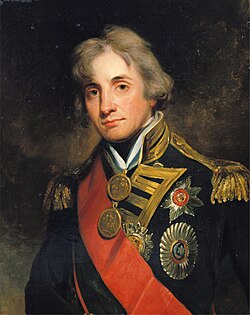
Due to the rarity of the award, only three officers in history earned three gold medals. Viscount Nelson was the most distinguished, being the sole recipient of three large gold medals for his victories at St. Vincent, the Nile, and posthumously for Trafalgar.
Other triple-recipients included Lord Collingwood, who received small medals for the Glorious First of June and St Vincent, and a large medal for Trafalgar, and Sir Edward Berry, who earned three small medals for the Nile, Trafalgar, and San Domingo.
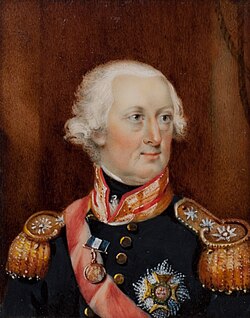
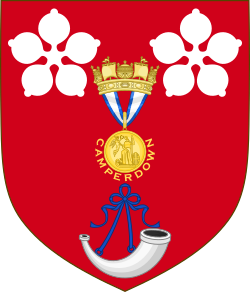
Other prominent figures awarded the medal include Viscount Duncan (large medal for Camperdown), Earl Howe (large medal for the Glorious First of June), and Philip Broke, who received a small medal for the capture of the USS Chesapeake during the War of 1812.
Summary of Awards by Action
The distribution of medals varied by the scale of the engagement. While most captains in a major battle typically received a medal, some actions—such as the Glorious First of June—only awarded medals to selected captains mentioned in official reports.
| Conflict / Action | Date | Large Medals | Small Medals |
|---|---|---|---|
| French Revolutionary Wars | 1793–1802 | - | - |
| Battle of the Glorious First of June | 1 June 1794 | 8 | 17 |
| Battle of Cape St Vincent | 14 Feb 1797 | 6 | 15 |
| Battle of Camperdown | 11 Oct 1797 | 2 | 15 |
| Battle of the Nile | 1 Aug 1798 | 1 | 14 |
| Recapture of HMS Hermione | 25 Oct 1799 | 0 | 1 |
| Napoleonic Wars | 1803–1815 | - | - |
| Battle of Trafalgar | 21 Oct 1805 | 3 | 27 |
| Battle of San Domingo | 6 Feb 1806 | 2 | 8 |
| Battle of Lissa | 13 Mar 1811 | 0 | 4 |
| War of 1812 | 1812–1815 | - | - |
| Capture of USS Chesapeake | 1 June 1813 | 0 | 1 |
| Capture of USS President | 15 Jan 1815 | 0 | 1 |
| Total | - | 22 | 117 |
Frequently Asked Questions
Who was eligible to receive the Naval Gold Medal?
The medal was exclusively available to senior officers of the Royal Navy, specifically admirals, commodores, and captains, who showed exceptional courage in battle.
Why were there two different sizes of the medal?
The size denoted the rank of the recipient: large medals (2 inches) were for flag officers, commodores, and captains of the fleet, while small medals (1.3 inches) were for captains.
Could an officer receive more than one Naval Gold Medal?
Yes. Because a separate medal was issued for each specific action, officers could earn multiple medals. For example, Viscount Nelson earned three large medals.
Why was the medal discontinued after 1815?
The award was discontinued because eligible recipients could instead be appointed to the Order of the Bath, which had been expanded to include three classes.
Was a medal awarded for the Battle of Copenhagen?
No. Despite requests from Nelson, no medal was authorized for the Battle of Copenhagen due to concerns that it might offend the Danes.