Haitian Revolution: The Struggle for Independence and the End of Slavery
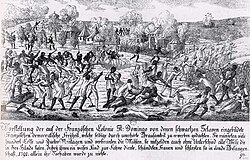
The Haitian Revolution (1791–1804) stands as a watershed moment in global history. It was the only successful slave revolt in history that resulted in the creation of an independent state. Part of the broader Atlantic Revolutions and the French Revolutionary and Napoleonic Wars, this conflict transformed the colony of Saint-Domingue on the island of Hispaniola into the sovereign nation of Haiti.
The revolution was not a single event but a complex series of conflicts involving enslaved people, free people of color, and the competing imperial interests of France, Spain, and Great Britain. Its success fundamentally challenged the institution of slavery across the Americas and redefined the concepts of liberty and human rights.
Key Facts
- Duration: August 21, 1791, to January 1, 1804.
- Outcome: Haitian victory and the establishment of the Empire of Haiti.
- Key Figures: Toussaint Louverture, Jean-Jacques Dessalines, and Henri Christophe.
- Human Cost: Approximately 200,000 Haitians and 100,000 British personnel died or were wounded.
- Significance: The first state to permanently abolish slavery and the first independent Black republic in the world.
The Colonial Powder Keg: Saint-Domingue
Before the revolution, Saint-Domingue was known as the "Pearl of the Antilles," the wealthiest French colony in the world. However, this wealth was built on a brutal system of enslaved labor. By 1789, the colony's demographics were starkly divided: roughly 452,000 enslaved Black people, 28,000 Mulattoes (people of mixed French and African ancestry) and free Blacks, and 40,000 white colonists.
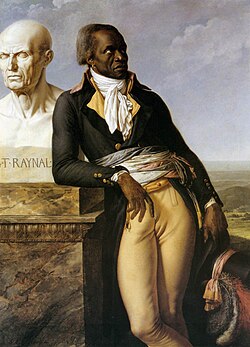
The enslaved population outnumbered the white and free colored populations by nearly eight to one. Tensions escalated in 1790 when Vincent Ogé led a revolt by free Mulattoes, pressuring the French government to grant them citizenship. While the French government complied in May 1791, the resulting instability provided the spark for a much larger uprising.
The Outbreak of Rebellion (1791–1798)
The revolution began in earnest on August 21, 1791, with a massive slave rebellion. Early leaders such as Dutty Boukman, Jean-François Papillon, and Georges Biassou led the initial onslaught against white civilians and plantations.
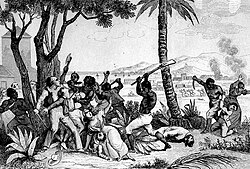
The conflict quickly became an international struggle. Spain and Great Britain entered the fray, seeking to seize the colony from France. In a strategic move to secure the colony and combat foreign invaders, French commissioner Léger-Félicité Sonthonax proclaimed the abolition of slavery on August 29, 1792.
The Rise of Toussaint Louverture
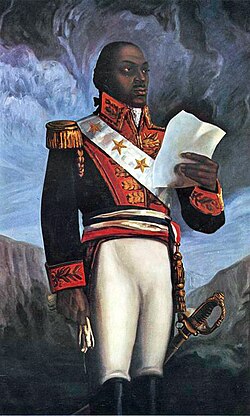
Among the most capable leaders to emerge was Toussaint Louverture, a self-educated former domestic slave. Initially aligned with the Spanish, Louverture switched his allegiance to France on May 6, 1794, after the French government committed to the abolition of slavery. Louverture became a brilliant military strategist and political leader, consolidating control over the island and organizing the revolutionary forces.
The Napoleonic Invasion and the War of Independence
The fragile peace ended when Napoleon Bonaparte sought to restore French authority. In 1802, Napoleon dispatched the Leclerc Expedition to reclaim the colony and, crucially, to re-establish slavery.
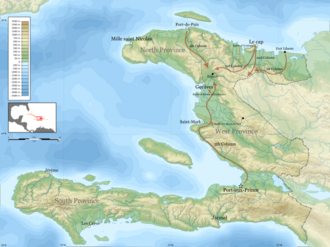
The French forces faced a dual enemy: the Haitian resistance and yellow fever, a devastating tropical disease. By July 1802, yellow fever had killed approximately 10,000 French soldiers. General Charles Leclerc's diary noted that by September, only 8,000 fit men remained in his army.
Following Leclerc, the Vicomte de Rochambeau launched a campaign of extreme brutality. He employed attack dogs to savage Black and Mulatto populations and carried out mass executions, including drowning captives at the Bay of Le Cap.
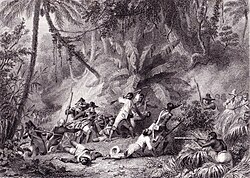
Despite the brutality, the Haitian forces utilized scorched-earth tactics and fortified positions, most notably at the fortress of Crête-à-Pierrot, to exhaust the French army.
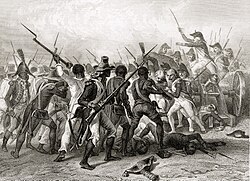
Victory and the Birth of Haiti
With the French army decimated by disease and warfare, Jean-Jacques Dessalines and Alexandre Pétion joined forces to lead the final push for independence. On January 1, 1804, in the city of Gonaïves, Dessalines officially declared independence and renamed the colony Haiti, using the indigenous Arawak name for the island.
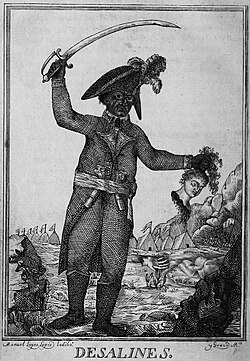
The victory came at a staggering cost. Haiti's economy was in ruins, and the nation struggled to recover from the devastation of the war. Furthermore, in early 1804, Dessalines ordered a massacre of the remaining white French colonists and loyalists, viewing them as barbarians who deserved vengeance for their crimes.
Summary of the Conflict
| Category | Details |
|---|---|
| Primary Belligerents | Haitian Rebels/Armée Indigène vs. France, Great Britain, and Spain |
| Key Leaders | Toussaint Louverture, Jean-Jacques Dessalines, Napoleon Bonaparte, Charles Leclerc |
| Major Casualties | Haitians: ~200,000; British: ~100,000; France: 57,000–75,000 |
| Key Turning Point | Abolition of slavery by France (1792/1794) and the impact of yellow fever |
| Final Result | Independence of Haiti (January 1, 1804) |
Frequently Asked Questions
Who was the most important leader of the Haitian Revolution?
Toussaint Louverture is regarded as the most prominent general and leader. A former slave, he transformed the rebellion into a disciplined army and navigated the complex political landscape between France, Spain, and Britain before his eventual capture by the French.
How did yellow fever affect the outcome of the war?
Yellow fever played a critical role in defeating the French. It decimated Napoleon's expeditionary forces, killing thousands of soldiers and officers, which significantly weakened the French ability to maintain control over the island.
What happened to the French colonists after independence?
Following the declaration of independence, Jean-Jacques Dessalines ordered a massacre of the remaining white French colonists and loyalists between February and April 1804 as an act of vengeance for the atrocities committed during the war.
What was the long-term impact of the revolution on the Americas?
The revolution was a defining moment in the Atlantic World, proving that enslaved people could successfully overthrow their oppressors and establish a sovereign state. It sent shockwaves through other slave-holding societies and influenced subsequent abolitionist movements.
Why was the colony renamed Haiti?
Jean-Jacques Dessalines chose the name "Haiti," which is derived from the indigenous Arawak name for the island, symbolizing a break from European colonial identity and a return to the land's original roots.