Multi-Camera Production: The Evolution of Television and Film Technique
The multi-camera setup is a cornerstone of modern television, particularly within the sitcom genre. By utilizing several cameras to capture a scene simultaneously from different angles, producers can maintain the energy of a live performance while providing the visual variety required for professional broadcasting. This technique has evolved from early silent cinema experiments to the sophisticated digital workflows used in today's hit series.
The Origins of Multiple Camera Use
Long before the era of television, the concept of using multiple cameras emerged during the development of narrative silent films. The earliest known instance was the 1911 Russian feature film Defence of Sevastopol, directed by Vasily Goncharov and Aleksandr Khanzhonkov. As the industry transitioned to sound, multiple cameras became essential for filming various sets simultaneously, especially since early sound was recorded on wax discs that precluded editing.
Television adopted this approach almost immediately. In 1928, the first drama performed for television, The Queen's Messenger, utilized three cameras. While the first British television drama, The Man With the Flower in His Mouth (1930), used only a single camera, the BBC began routinely employing multi-camera setups for live shows starting in 1936.
Development in the United States
In the U.S., early anthology programs during the Golden Age of Television utilized multi-camera methods before pre-recorded series became the standard. While Desi Arnaz, Al Simon, and Karl Freund of Desilu Productions are often credited with pioneering the setup for I Love Lucy in 1951, the technique had been in use for several years prior.
Jerry Fairbanks is recognized by historian Thomas Schatz as the first to develop a 16mm multi-camera system for a made-for-TV show, used for the 1947 pilot of Public Prosecutor. Fairbanks later applied this system to Edgar Bergen's Silver Theater (1949-50) and the pilot for Truth or Consequences (1950). Al Simon later enhanced this system by upgrading to 35mm film and implementing a more advanced intercom system.
Simultaneously, Ray Culley of Cinécraft Productions applied these techniques to commercial and educational content. In 1949, Culley filmed the first TV infomercial, Home Miracles for the 1950s, for Vitamix. He also used the method for Louise Winslow's "how-to" series, including Adventures in Sewing, Food Is Fun, and Kitchen Chats in 1950.
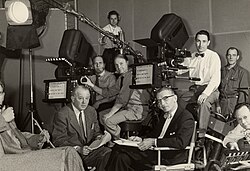
The "X" Camera and the Sitcom Standard
The standard three-camera setup expanded in the late 1970s thanks to Garry Marshall. While filming Mork & Mindy, Marshall found that Robin Williams' improvisational energy often took him off his marks. To ensure the production captured more than just the master shot, Marshall added a fourth camera, known as the "X" or "D" camera. This became the norm for most multi-camera situation comedies (sitcoms).
Comparing Multi-Camera and Single-Camera Formats
The choice between a multi-camera and single-camera setup fundamentally changes the feel of a show. Multi-camera productions are often compared to theater, as they typically use experienced stage actors and a live studio audience. In contrast, single-camera productions allow for tighter editing, more diverse locations, and complex visual effects.
| Feature | Multi-Camera Setup | Single-Camera Setup |
|---|---|---|
| Audience | Typically uses a live studio audience | No live audience |
| Editing | Simplified, theater-like flow | Tightly edited, cinematic sequences |
| Locations | Primarily fixed studio sets | Multiple, varied locations |
| Visual Effects | Limited | Capable of complex effects (e.g., disappearances) |
Notable Examples by Format
- Multi-Camera: I Love Lucy, Cheers, Seinfeld, Friends, The Big Bang Theory, and various Disney/Nickelodeon hits like iCarly and Hannah Montana.
- Single-Camera: Leave It to Beaver, The Andy Griffith Show, Bewitched, and modern revivals like The Office, Modern Family, and Abbott Elementary.
The British Approach and Hybrid Systems
The United Kingdom relied heavily on the multi-camera format for sitcoms and dramas from the 1950s through the early 1990s. However, a "hybrid" form emerged where interior scenes were shot in multi-camera electronic studios, while exterior location work was captured as single-camera filmed inserts (pre-recorded segments integrated into the main program).
By the 1970s, action-oriented series like The Sweeney and The Professionals moved toward 16mm single-camera filming. By the early 1980s, high-budget productions such as Brideshead Revisited shifted exclusively to film. Today, most UK prime-time dramas use single-camera setups, with soap operas remaining the primary users of multi-camera production.
Key Facts
- The first known use of multiple cameras in film was the 1911 Russian movie Defence of Sevastopol.
- Jerry Fairbanks developed the first 16mm multi-camera system for TV in 1947.
- The "X" camera (fourth camera) was introduced by Garry Marshall to capture Robin Williams' improvisations in Mork & Mindy.
- Multi-camera setups are closely linked to theatrical production styles and live audiences.
- The UK utilized a hybrid system of electronic studio multi-cam and filmed location inserts for decades.
Frequently Asked Questions
What is the main difference between a multi-camera and single-camera sitcom?
Multi-camera sitcoms are generally filmed on a stage with a live audience and multiple cameras running simultaneously, resembling a play. Single-camera sitcoms are filmed more like movies, with one camera at a time, allowing for more locations and precise editing without a live audience.
Who is credited with pioneering the multi-camera setup for TV?
While Desilu Productions (Desi Arnaz, Al Simon, and Karl Freund) popularized it with I Love Lucy in 1951, Jerry Fairbanks developed a 16mm multi-camera system as early as 1947 for Public Prosecutor.
Why was a fourth camera added to the standard setup?
Garry Marshall added a fourth camera (the "X" or "D" camera) during the production of Mork & Mindy to keep up with Robin Williams' physically active improvisations, ensuring the production had more than just a master shot.
How did the UK's "hybrid" television production work?
The hybrid method combined interior scenes shot in a multi-camera electronic studio with exterior location scenes shot using a single camera on film, which were then edited together as inserts.
Which modern shows use the single-camera format?
Many recent acclaimed series use the single-camera format, including The Office, Modern Family, Veep, Schitt's Creek, Ted Lasso, and Abbott Elementary.